The Company
This joint venture company offers European organizations administrative, backstage, and licensing services to the music industry, enabling customers to maximize distributions to their over 185,000 members.




This joint venture company offers European organizations administrative, backstage, and licensing services to the music industry, enabling customers to maximize distributions to their over 185,000 members.

Expansion into new geographies and increasing digital demands pressure its mission-critical software to evolve aggressively, increasing technical debt and impacting further development.

Synchrony Systems was the only partner recommended by IBM with proven VisualAge Generator and EGL migration tools, a modernization management platform (MLP), and the DevOps expertise the company required.

433 VisualAge Generator GUI screens to EGL RUI in 18 months; 433 EGL RUI screens upgraded to the latest version in 9 months. The codebase decreased by 30%, with zero migration-related errors on the new system.
Interested in learning more about VisualAge Generator solutions?
Learn MoreThis joint venture company offers European organizations administrative, backstage, and licensing services. Its mission is to offer international copyright services that are transparent, reliable, and cost-efficient to enable customers to maximize distributions to their members. Their headquarters are in Copenhagen with offices in London.
Expansion into new geographies and increasing demands of digital transformations put pressure on its mission-critical software to evolve aggressively. Although the company is committed to keeping up with modern technology, the business’s need to deliver new functionality naturally took priority over modernization. This resulted in legacy programming languages, frameworks, and architectures lingering, increasing technical debt, and slowing the software’s evolution.
The company took a proactive approach to modernization, making it a strategic part of its product development roadmap. The team embraced DevOps principles for greenfield development and sought a solution to modernize using a similar agile, iterative process. From a technology standpoint, the team needed to migrate the VisualAge Generator/Smalltalk desktop GUI to a web-based EGL RUI.
In addition to migrating from the VisualAge Generator programming language, it wanted to advance the underlying application architecture and reinforce its DevOps development practices. They wanted a vendor with deep knowledge, experience, methodology, and technology in legacy application modernization with whom they could partner to incrementally modernize the application without freezing its ongoing development while following DevOps best practices.
When IBM ended support for VisualAge Generator GUIs, they recommended that the company speak with Synchrony Systems to assist with the migration. IBM worked with Synchrony on several other successful migrations and experienced their advanced migration technology and deep expertise in Smalltalk, VisualAge Generator, EGL, and GUI frameworks.
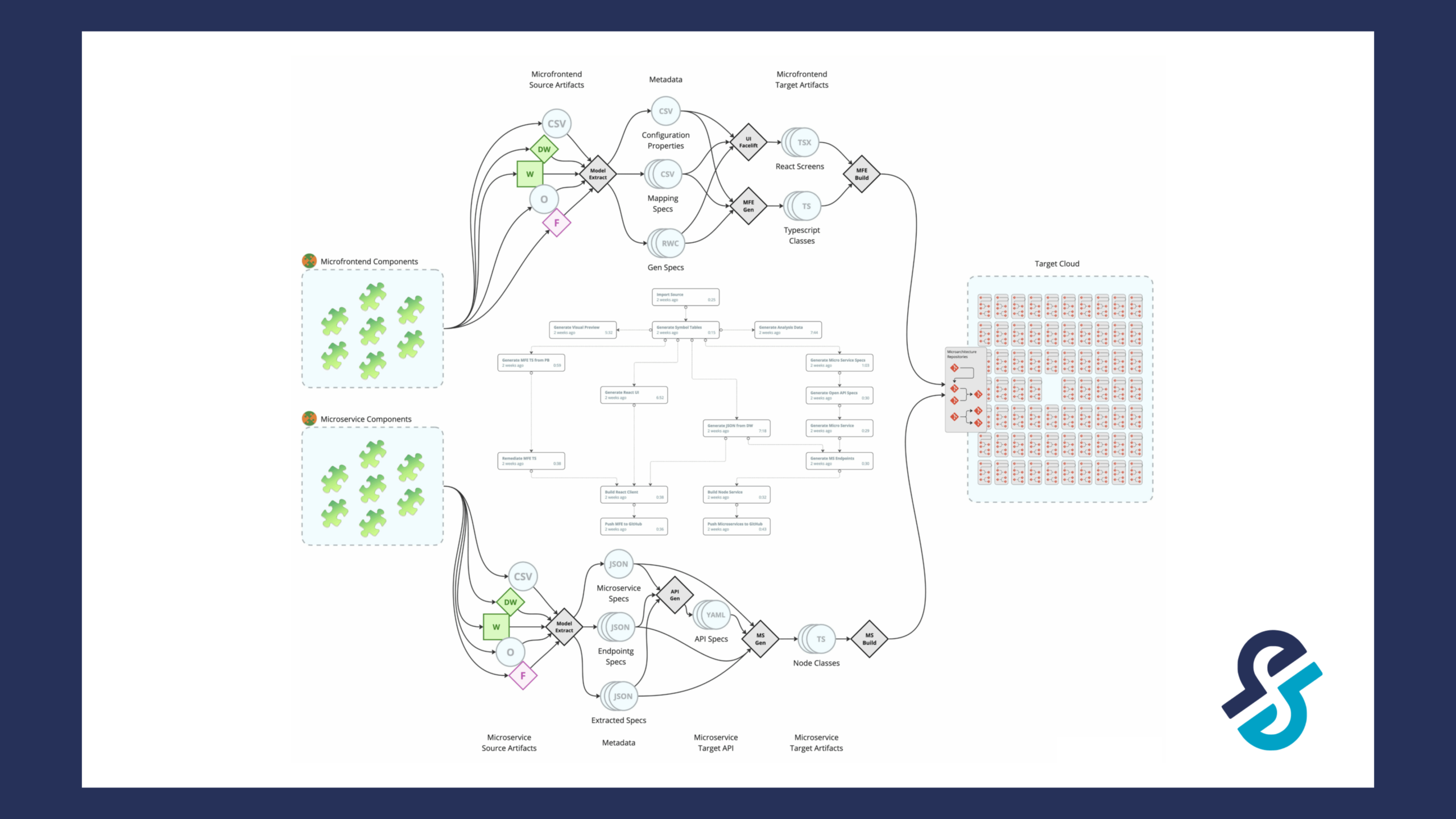
Throughout the evaluation period, the team was continuously impressed with Synchrony’s automation technology, iterative and agile approach, and holistic view of modernization offered by their Modernization Lifecycle Platform (MLP) – from migration to regression testing to production release. As a result, it selected Synchrony as its trusted partner for continued application modernization.
Modernization focused on migrating the VisualAge Generator/Smalltalk GUI desktop technology to EGL RUI web technology. The Synchrony team drove the modernization process while the company’s engineers focused on testing and documentation. MLP was used to manage the project’s planning, execution, tracking, testing, monitoring, and quality assurance.
The company continued the application development while the front-end migration ran in parallel. Using MLP’s automation technology and migration libraries, any new code released to production was merged into the modernization track for migration. The company could also automatically apply test cases and regression testing to the migrated code base.

Using Synchrony’s MLP solution, 433 VisualAge Generator GUI screens were fully migrated to EGL RUI. The company ran 378 test cases over eight weeks to ensure production parity between the legacy application and the new, migrated front-end. The total modernization from start to production took eighteen months. MLP was instrumental in tracking defects, executing test cases, and producing metrics to ensure proper allocation of testing resources while maintaining defect resolution and verification velocity.
As with every software provider, IBM updates EGL RUI to support modern browser and OS technology. Due to the success of the major migration initiative, the company asked Synchrony to use MLP, its ModOps processes, workflows, and automation technologies to upgrade EGL RUI to the latest version.
Using MLP to upgrade the EGL RUI, the time to production-ready code was cut in half. The total project time was reduced to nine months. The test period, which included the same 433 screens and 378 test cases, was reduced to four weeks. Along with the overall better performance of the application’s front-end, the codebase was decreased by 30%. Not only did the company achieve browser and OS compatibility with increased performance, but it also reduced its application footprint.
The latest modernized code was released to production with zero migration-related errors on the new system and zero operational disruptions to the business.
The company didn’t want just a migration vendor, but a partner who could bring modern, agile methodologies to improve build and deployment systems and serve as an extension of their internal IT team. Synchrony’s holistic view of the modernization process, from migration to production, was a critical factor in the project’s success. Moreover, Synchrony helped ensure the in-house team had the knowledge and competencies to maintain and reinforce the modernized software with their DevOps practices.