Your privacy matters. We’ve updated our policies effective March 24, 2026.

LEARN MORE

Modernization Experience Report: Smalltalk Application Portfolio to Java

In-depth experience report shares how one company saved seven years by modernizing a portfolio of Smalltalk applications to Java with Synchrony Systems

Six Smalltalk applications to Java. The company estimated it would take another ten years to complete the portfolio modernization and retire Smalltalk altogether. 

This experience report goes behind the scenes to expose the unique three-year collaboration between Synchrony and a German IT services provider for the financial sector.

This in-depth report is available for limited release to companies interested in understanding the details of modernizing large, legacy applications.

Experience Report Table of Contents:
  • Company 
  • Project background
  • Modernization initiative (Challenges, Requirements, Vendor selection)
  • Synchrony Solutions (Smalltalk Migration Technology (SMT), Modernization Lifecycle Platform (MLP))
  • Modernization engagement
    • Readiness phase (Application portfolio, Work breakdown, Team collaboration, Project timeline)
    • Implementation phase (Splitting the work, Progress of parallel tracks, Progress of the entire project, Halfway point evaluation, Functional testing, Code quality, Integration testing, Final deliverable
    • Conclusions and take-a-ways
  • Appendix (Codebase, Pipelines, Operations, KB and CL, Issues, Deliveries, Datapoints)


Brownfield software development guide

Brownfield refers to physical land requiring clean-up, upgrades, or development before leveraging the property for new purposes. Brownfield software development describes maintaining, upgrading, migrating, interacting with, or leveraging data from legacy applications.

Most of the world’s developers work on and within brownfield applications and environments. While greenfield software development gets the industry buzz, it’s the brownfield technologies with mass adoption and most usage that run companies.

Challenges in brownfield software development

Brownfield software development is not easy. The developers must keep brownfield applications up-to-date, transform critical legacy business logic to modern technologies, and architect interoperability between brownfield and greenfield applications and environments. Some key challenges with brownfield software to note are:

  • Not having a thorough understanding of the legacy applications and their dependencies with other legacy platforms
  • Staffing technical expertise to continue the development and maintenance of legacy applications
  • Developing a strategic modernization roadmap and rapidly executing it while reducing technical risks and business disruptions
  • Determining which parts of legacy applications are business-critical and must be preserved, maintained, migrated, replaced, or retired
  • Managing upgrades, migrations, integrations, and modernization of legacy applications in a consistent, uniform, and repeatable manner while continuing active maintenance (no halts in development).

The inability to adequately address these issues and challenges will have a costly impact on the current and future business.

Adopt continuous modernization to help solve brownfield application development challenges

Instead of the obsolete top-down / waterfall approaches in greenfield applications, development teams have adapted leading DevOps principles such as continuous integration (CI), continuous testing, continuous monitoring, continuous security, and continuous delivery (CD) to take a more agile and iterative approach. Incorporating the continuous modernization (CM) principle to brownfield applications should be a natural extension of DevOps to enhance and fully complete the cycle of software development, maintenance, and evolution.

The principle of continuous modernization is to avoid the need for large, time-consuming, costly, and risky undertaking of major modernization initiatives in the brownfield software space. Executing a continuous modernization strategy requires different processes and automation tools to manage software migrations, modernizations, and upgrades while coexisting with ongoing greenfield and brownfield development projects.

One such tool is MLP, a SaaS platform that brings a uniform upgrade process, a collaborative work environment, and transparent and traceable workflows to continuous modernization. It snaps into your existing CI/CD environments and procedures to give you the ability to apply new software updates systematically and incrementally to your in-house applications, APIs, or any other software components.

Benefits of continuous modernization for brownfield software

Leveraging automated modernization workflow management tools and platforms like MLP for brownfield software upgrades, maintenance, integrations, and modernizations will benefit the business in many ways. Some of the benefits offered by continuous modernization for brownfield applications are outlined below:

  • Accelerate adoption of native, cloud-first, and mobile application architecture
  • Fast-track digital transformation projects to accelerate delivery of business value
  • Reduce security risks associated with legacy applications
  • Keep currency with a rapidly changing technology landscape
  • Improve performance of brownfield applications
  • Continuously eliminate creeping technical debt
  • Prevent massive modernization initiatives in the future

In short, continuous modernization makes it easier to support brownfield application development by providing a systematic, uniform, and accelerated approach to executing modernization roadmaps without disrupting the day-to-day business operations.

Learn more about continuous modernization.

ModOps: DevOps for legacy modernization

DevOps has revolutionized software engineering methodology by unifying development and operations to accelerate software delivery. The older-style waterfall approaches to greenfield application development are being put aside as DevOps principles of agility, iteration, continuous delivery, and automation take center stage.

Modernization must deal with the challenge of transforming millions of lines of existing legacy code, built over decades by dozens, if not hundreds, of engineers, most of whom have moved on or retired altogether. Yet outdated approaches such as “rip and replace” are still the default modernization methodology, employing manual rewrites and disjointed automation tools. This approach is costly, takes an enormous amount of time and resources, and introduces significant risk to the business.

At Synchrony Systems, we believe it’s time to apply the DevOps principles, adopted for greenfield development, to software modernization—or ModOps—to keep pace with the rapid digital transformation.

Accelerating modernization delivery

Modernization focuses on transforming existing legacy systems and applications to the latest platforms and architectures. Unlike greenfield development, where very frequent and incremental changes are made to small bodies of code, modernization requires making wholesale transformations of the entire body of code at once and en masse. Therefore, the traditional manual approaches to modernizations can no longer be justified in today’s rapidly moving digital economy.

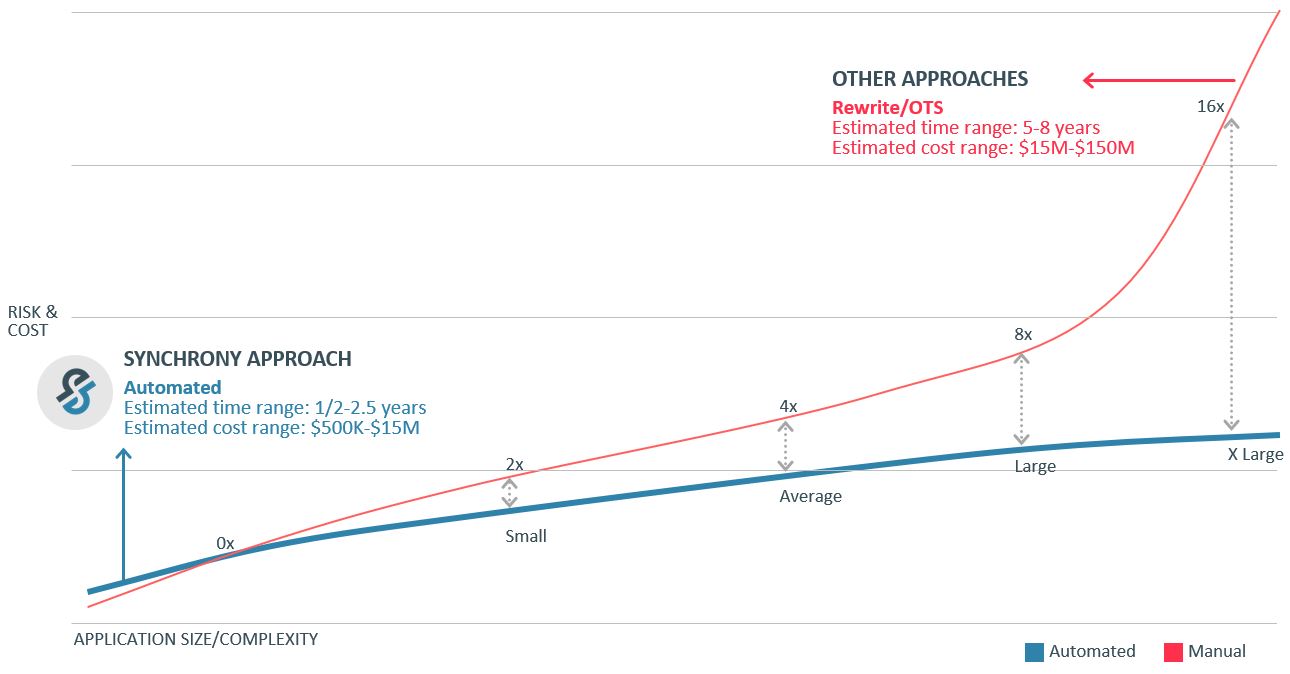
As the chart illustrates, ModOps accelerates modernization delivery and does so at a fraction of the cost and with faster time-to-value. It balances the overall speed, cost, quality, and risk while creating a unified experience that addresses a complex modernization process in a predictable way.

Continuous modernization

Continuous Development (CD), along with Continuous Integration (CI), have become the cornerstones of DevOps— the way applications are being developed and released into production. By replacing CD with Continuous Modernization (CM), ModOps will achieve the same—the way existing applications are to be modernized. Continuous Modernization will bring a high degree of automation and a systematic approach to managing the entire modernization lifecycle.

The three main pillars of ModOps are:

  1. automation-driven modernization and transformation of legacy applications to modern programming languages and platforms;
  2. coexistence of modernization activities with ongoing development activities, without any code freezes; and
  3. functional and UX equivalency with no hidden costs or operational disruptions to the business.

ModOps is the answer for any company whose objective is to preserve its IP and its original investment in mission-critical legacy applications by adapting to and effectively competing in a rapidly moving digital economy.

As in DevOps, ModOps promotes agility, collaboration, and complete transparency. Project managers, migration engineers, testers, and other business stakeholders have full visibility into the overall status and progress of an ongoing modernization at every stage. With built-in planning, tracking, monitoring and dashboards, extensible workflows, automated testing and real-time feedback, a modernization is guaranteed to run smoothly and to be completed on time and on budget.

Tools for ModOps

The evolution of DevOps has spurred the development of tools to help teams more easily apply DevOps principles to the application development process. Modernization Lifecycle Platform (MLP) is doing the same for the application modernization process. It is a DevOps-driven, integrated, Modernization-as-a-Service platform that creates a unified approach to modernizing legacy applications. Whether it’s a modernization of COBOL to Java, PowerBuilder to C# or Smalltalk to Java, the underlying process, methodology, and user experience are uniform, no matter the chosen source and target platform combination. As a result, organizations are just months—not years—away from having their legacy applications transformed to the digital economy of web, mobile, and cloud.

No more legacy applications

We see a future where the application software is never “left behind” or lost to obsolescence. The major business challenges created by legacy applications—growing technical debt and shrinking technical talent—would themselves become obsolete.

Adding Continuous Modernization (CM) alongside CI/CD would give developers the ability to systematically and incrementally apply new software updates, adapt new APIs, or any other software components to in-house applications, thus doing away with any future wholesale modernization initiatives. By embracing ModOps and adopting a platform like MLP, businesses will become more agile, competitive, efficient, and responsive in addressing the demands of today’s digital economy.

Facebook TransCoder: a migration panacea or a mirage?

Last year Facebook announced TransCoder, a tool that converts code from one programming language to another. Like many companies, Facebook also has legacy code that runs critical features and functionality of their platform. They also have billions of active users. It’s no wonder they chose the automation approach for migrating their legacy code to more modern technologies. With this approach, Facebook can preserve its original investment and reduce the risk of significant business disruptions that the proverbial, brute-force rewrite would otherwise bring.

Facebook TransCoder Flow Image
Source: Facebook AI Blog


TransCoder can help modernize legacy systems; however, the devil is always in the details when trying to bring the migrated code to production quality, release the migrated legacy application into production, and retire it.

Any machine learning translation tool can only get the complete migration of an application so far. If Facebook’s TransCoder can translate 90% of the application code, one line out of every ten still needs a software developer’s attention.

For an application with ten million lines of code, one million lines of code would need to be hand-written with production quality.

A manual rewrite of 10% of a large application may take years. In fact, the translated code may never see a production environment. Even with Facebook’s size, virtually unlimited resources, and access to the world’s best talent, the company will still need to manage the entire software migration lifecycle and all of the pieces that it takes to bring the new code into production.

Modernization is more than just code translation

Machine-driven migration tools from source to target programming languages play a crucial role in achieving successful modernization projects. These tools are akin to best-of-breed compilers and their role in greenfield application development. Yes, we need a good compiler, but without the well-established best practices of DevOps, no compiler by itself can ensure the successful completion of a software development project.

What will it take to migrate a large and often complex body of legacy code that runs a critical aspect of the business to a modern technology platform and release it into production without any operational disruptions or development freezes?

This particular challenge has been the Achilles’ heel of every modernization project. No migration tools, including the TransCoder, make any attempt to even mention it or, let alone address it.

Tools like TransCoder are often positioned as “auto-magic.” Buy a piece of AI software, and *poof* all of the migration work is done in a few keystrokes. But a programmer cannot take a COBOL program, wave an AI wand over it, and turn it into microservices or properly architected modern-day application. Right now, AI tools are decades away from being able to transform legacy applications in this manner.

Migration tools inside a modernization process

Migration tools such as TransCoder are just pieces of the chain of moving parts needed to run a well-oiled machine of an otherwise complex modernization process. Therefore, the real value is in integrating such tools inside the entire modernization lifecycle to achieve the kind of an assembly line that is needed to make a complex modernization manageable in terms of process and predictable in terms of time and cost.

No single automation tool is a silver bullet for a modernization project, and we should know. We’ve spent 25+ years modernizing legacy applications, building and using our proprietary migration tools. When we finally managed to integrate the source code migration tools into an entire modernization process, our clients saw considerable gains in code quality, efficiency, and affordability.

Our Modernization Lifecycle Platform (MLP) supports the entire modernization lifecycle: from analysis and planning to transformation and remediation; from build and deployment to testing and production release. It applies the same systematic, iterative, and automation-driven modernization processes to produce production-ready, modernized applications. It is compatible with any translation libraries or rule-sets, no matter the source or target programming language, platform, or framework. By automating the complete modernization process where a tool like TransCoder can be integrated into as part of an entire assembly line, the MLP platform:

  • Saves thousands of hours of manual effort
  • Reduces the time and cost of a modernization by 90% compared to traditional approaches
  • Is 100% automation driven yielding predictable outcomes
  • Ensures 100% functional equivalence
  • Eliminates the risk of introducing unexpected regressions or random defects
  • Provides complete transparency and interoperability for all stakeholders

Like Facebook’s TransCoder, new tools are emerging to take on challenges evident in legacy application modernizations, but they are limited in and of themselves.

An integrated platform that facilitates an automated, reliable, and transparent modernization while ensuring 100% functional equivalence with no operational interruptions is needed to take the migrated application into production.

MLP delivers what TransCoder only promises.

Contact us to see MLP in action.

How to prepare for legacy application modernization

In-house applications, once associated with good fortune, have now become an albatross. These systems may still run business-critical processes or orchestrate data between commercial systems, but their underlying, aging technology has become a real liability. You know it’s only a matter of time before something fails, and it won’t be pretty.

You may be hearing a lot of bluster about the best way to go about modernizing legacy applications. “Refactor,” “re-platform,” “encapsulate and expose for microservices,” “lift and shift,” and “low-code rebuilds” are just a few of the buzz-phrases floating out there. At Synchrony systems, we also have our own view of how best to modernize. But the how is not always as straightforward as some try to make it seem. How to modernize depends on many factors that span well beyond source code or target technology.

So where do you begin? The following steps should not only help you prepare for legacy application modernization; they also should help you clarify the right modernization methodology to pursue.

Know what you have: document your current state

While this may sound like a no-brainer, you’d be surprised at how many companies don’t have a complete, up-to-date overview of their technology stack. Perhaps that’s because they’re busy putting out daily fires or launching new initiatives. Or maybe staff turnover put the critical, technical documentation on the back burner. Regardless of the reason(s), before starting any potential modernization initiatives, you must possess a full technical understanding of your IT portfolio and which parts of it are mission-critical to your business operations.

Three dimensions of the current state must be well understood: architecture, timeline, and capital.

Architecture: While it’s ok to not have all the answers, accurately describing what you know—and highlighting what you don’t—is important.

  • Do you have access to the source code of your in-house applications?
  • Do you understand your applications’ source platform dependency?
  • Do you understand your applications’ component architecture?
  • Do you understand your applications’ runtime architecture?

Timeline: Many in-house applications are built using licensed, 3rd-party software. Understanding the timing of the maintenance and support contracts is an important input to the modernization effort.

Capital: Capital includes the dollars used to support the in-house applications, as well as the resources and time spent maintaining them. You also need to understand what other IT projects your company is currently funding, the budget for the modernization initiatives, and when those funds will be available.

With this information, you can start to map out the priorities for your modernization.

Know where you want to be: document the future state

Sometimes the future state has a strategic mandate from the top—become cloud-first or consolidate technologies onto a single platform. Other times, the future state evolves more organically. Regardless of the path, you need a documented roadmap of the new vision for IT. This plan is really a risk-mitigation strategy for your legacy applications. It’s only a matter of time before the old versions start to fail, their security gets breached, a 3rd-party vendor stops supporting the software, or some other business-impacting event occurs.

Like the current state, your future state plan has the same three dimensions: architecture, timeline, and capital.

Architecture: Future state technology architecture needs to be aligned with the business need, and not just be technology for technology’s sake. The tech vision must map to the business vision and support the business value of investing in modernization. Along with technology, the future state should include recommendations about the people and process changes required to operate in this new architecture.

Timeline: Modernizations can be lengthy projects with many concurrently moving parts. A strong roadmap includes critical dates such as contract renewals, end of support, and/or end of life. It includes budget cycles for funding, and it maps critical hires such as short-term contractors, modernization specialists, and/or full-time developers/IT professionals. The roadmap also should include important business dates like acquisitions, major product launches, peak selling seasons, etc. All these factors can help shape your modernization priorities and urgency.

Capital: In addition to the investment allocation for the initiative, you also need to understand the capital outlay needed for resources—internal and external—required for success.

Determine the path forward

Now you can perform a gap analysis of the current and future states. The timeline and available capital will be key factors—the “how”—that inform your approach to modernization.

Another factor to consider is the relative effort of modernization. For example, rewriting an application from scratch is not only time-intensive from a greenfield development standpoint, but the effort to make it operational would include retraining users, rewriting documentation, re-tooling support, etc. Many hidden costs of rip-and-replace strategies that may be overlooked during the initial scoping will later become quite burdensome.

For very small, in-house applications with minimal business impact, simple migration tools may be all you need for the modernization. For very large, in-house applications, the strategy may be more complex and consist of several approaches, including:

  • Rip and Replace: replace with an off-the-shelf alternative
  • Lift and Shift: re-platform or re-host the entire legacy workload onto a virtual cloud environment
  • Rewrite: retire and invest in ground-up greenfield development
  • Re-architect: attempt to improve in place the underlying legacy application architecture into a more modern, service-based, web architecture.
  • Migrate: using automation, migrate “as-is” to a new target platform, preserving functionality and user experience

At this stage, talking with companies that specialize in modernizations is a wise idea. With the groundwork you’ve done, modernization experts should be able to give you a proposal for moving forward, a timeline, and a cost estimate for the modernization.

Start now

As Benjamin Franklin once said, “By failing to prepare, you are preparing to fail.” It’s never too early to begin the work necessary for a clear strategy to move away from your legacy applications.

At Synchrony Systems, we have over two decades of experience helping companies modernize their legacy, mission-critical applications in the most cost-effective and transparent way possible. Whether you are just starting to think about modernization or have an urgent need, we are happy to talk with you about your specific situation.

5 ways your legacy systems may add to cybersecurity risks

Not all technical debt is created equal. Many legacy business systems—whether architected in-house or purchased from software vendors—contain inherent security vulnerabilities that may be growing worse over time. In a recent Accenture study of government agencies, 85% of IT leaders believe not updating legacy technology will threaten their agency’s future. The Workplace Agility report from Capita and Citrix found more than half of CIOs surveyed think legacy applications are delaying digital transformation.

Here are five security vulnerabilities associated with legacy business systems:

1. Outdated security functionality doesn’t adapt to evolving threat landscape

Today’s hackers enjoy a target rich environment—in 2018, there were more than 15,000 known Common Vulnerabilities and Exposures (CVEs). When legacy systems were developed, these applications may have been on top of then-current cybersecurity practices. But with the passage of even a short time, the threat landscape evolves while many legacy systems get left behind.

Legacy systems may be incompatible with security features surrounding access, such as multi-factor authentication, single-sign on and role-based access, or lack sufficient audit trails or encryption methods. Whatever the reason, these systems are unable to accommodate today’s security best practices.

When security flaws are discovered in legacy software, they are widely published on security blogs and in industry journals. While it is important to update security professionals on vulnerabilities, hackers are also receiving a free education. In the case of legacy systems, cyber criminals have had years to perfect tools for exploiting well-known vulnerabilities.

2. Older hardware, software or databases create legacy dependencies

Sometimes it isn’t just that a legacy application lacks security features, but rather that the ability to continue using that legacy application is contingent upon a variety of legacy dependencies that introduce additional security vulnerabilities. These legacy dependencies can include hardware (such as old mainframe computers), database structures, operating systems, or other legacy software.

A classic example of legacy dependencies can be found within many enterprise ERP systems. Suppose you added a third-party reporting tool or created a customized barcode scanning application five years ago that integrated with an older version of your ERP. You should have upgraded your ERP system twice by now in order to benefit from security enhancements, but you have put it off because moving to the latest version of the environment would break the integrations between your custom apps or third-party solutions.

Over decades many organizations built a web of proprietary, interconnected, mission-critical business systems that still feed into legacy databases. A recent strategic technology plan for Grand Traverse County, Michigan gives an all too familiar description:

“The AS400 based applications that are running on the IBM Platform are in-house programmed over decades. This results in many application revisions by multiple programmers with little or no oversight into best practices for security and usability. This lack of oversight creates what is referred to as spaghetti code, or code that is difficult to untangle and secure.”

Grand Traverse County had built 57 custom applications on its outdated IBM mainframe environment, and the IT department requested over $6 million just to migrate to modern platforms and applications—about 1/10th of the county’s entire annual budget. Modernizing and securing spaghetti code can be complicated, causing many businesses to delay until after a security incident occurs.

Legacy dependencies can also create a drag on business that extends far beyond the IT department. Here are two ways they slow down or prevent the achievement of critical enterprise objectives:

  1. In-house systems can hold back the development of a better customer experience. Are you unable to provide customers with self-service? Do you lack the ability to launch subscription products because a legacy billing system cannot provision and invoice for them correctly?
  2. Legacy dependencies can stall a strategic move to the cloud and digital transformation. A recent survey conducted by market research firm Vanson Bourne found that 85% of enterprise digital transformation architects said legacy databases limit their ability to transform. During transformation projects, 60% of architects observed that managing legacy system involvement took too much of the IT team’s time.

3. Legacy systems lack full-stack security visibility

Legacy systems with spaghetti code also tend to leave discarded bits of code and tools hanging around—quite possibly in your production environment. Small apps may still be used by a few employees, but may not show up in IT inventories, even though they contain old open source code. Because these tools aren’t under active development anymore, there should be a plan to sunset them or modernize them, but if they slip off the IT radar, security lapses may ensue.

Java development magazine Jax cautions IT security professionals to

“Remember, any application – no matter how big, small, old, or new – is fair game for cybercriminals so businesses can shrink their threat surface by removing any potential footholds into their infrastructure. IT and security teams need to implement a plan and process for regularly reviewing their technology stack and sunsetting applications that no longer serve a business function.”

When business systems run on a modern platform, the IT department can utilize full-stack security solution suites to gain better visibility into enterprise-wide security.

4. Internal applications more likely to become externally exposed over time

Even businesses with good security procedures and the best of intentions about solving technical debt incur increased vulnerability over time with legacy systems. That’s because as years (or decades) pass, mergers, acquisitions and corporate restructuring may leave orphaned hardware and software that no one “owns” anymore. With nobody using these assets and no decommissioning plan in place for them, the legacy hardware or software bumbles along in the background, until one day an IT change inadvertently results in its exposure to the external world. An unguarded, unintended door open without anyone keeping an eye out for intrusions.

An example of this occurred when FedEx acquired a company called Bongo. Bongo’s legacy storage server went unnoticed as its IT assets were incorporated into FedEx’s environment. The result was an Amazon S3 server left unsecured online, sitting on FedEx’s network.

5. Legacy platforms lack the ability to implement additional layers of security quickly

Many security packages weren’t designed for legacy mainframe environments and operating systems. And the legacy applications themselves often lack the kind of real-time security monitoring needed to pin down and resolve security intrusions. Legacy systems might monitor performance, for example, but lack the details and contextual information that create the true visibility needed by security professionals. Audit trails and log functionality might be missing altogether or could be in a proprietary format that proves difficult to access and analyze.

The lack of adequate monitoring and logging can get enterprise businesses into trouble quickly if legacy applications are connected to both the internet and an internal corporate network. Once a legacy application has been exploited without triggering any alerts or logs, cybercriminals have free rein to run through the internal network cracking into other systems—potentially undetected—while the IT team lacks visibility into where the original intrusion occurred. By contrast, when you’re operating applications that are part of a modern cloud or hybrid tech stack, you can quickly and easily add plug-and-play security and network monitoring solutions that are interoperable with your platform.

Conclusion

The solution to legacy security vulnerabilities is tech stack modernization, followed by Continuous Modernization to keep future technical debt from accruing new security risks. Gain greater visibility into technical debt that might cause security concerns by creating an application catalog that notes legacy dependencies and assigns a measurement of risk. Then create a decommissioning plan to eliminate technical debt from the riskiest legacy systems first.

Synchrony’s Modernization Lifecycle Platform (MLP) brings an automated upgrade process, a collaborative work environment, and transparent and traceable perspectives to software upgrades. Continuous Modernization, or CM, is a complementary approach to the DevOps practices of Continuous Delivery (CD) and Continuous Integration (CI). CM gives enterprises the ability to systematically and incrementally apply new software updates to in-house applications, APIs, or any other software components, regardless of the underlying technology being upgraded.

Learn More

Yes, I’d like to learn more about Synchrony Systems Modernization and Continuous Modernization technology:

Contact Us

Modernization: from dreaded word to strategic enabler

By Charles Araujo. This article was originally published by Intellyx.

I remember the dreaded words ringing through the house, “Charlie, it’s time to clean your room.”

I pretended I didn’t hear, but inevitably and begrudgingly I stopped what I was doing and began the chore.

Once I was done, however, my mom explained that with my room clean we could now begin the process of transforming it from a child’s bedroom into the teenage haven I had been begging for incessantly.

Getting everything tidied up, it turned out, was the prerequisite to the transformation I so desperately wanted.

Much like “clean your room,” the term modernization has long been a dreaded word in the world of IT.

Uttering it causes involuntary shudders up the spines of IT leaders as they imagine all of the hard work, pain, and suffering to come — with almost no upside at the end of this particularly arduous road.

More importantly, the thinking has gone, while modernization is necessary, investing in it will take precious resources away from more progressive and business-critical initiatives.

So modernization efforts have been left for another day. But it is long past time for this pattern to change.

New advances in both technology and methodologies are transforming modernization from a chore into a strategic enabler — one that may now be the essential component of successful transformations in the digital era.

The problem with modernization

The trepidation surrounding modernization efforts has been well-warranted.

So-called legacy environments — the targets of modernization — are often Byzantine structures that organizations have built layer-by-layer, over the years. Each successive layer has made these systems more complex, more rigid, and almost impossible to change.

As a result, these legacy architectures have become frozen-in-time even as organizations rush to adopt modern technologies in other parts of the technology stack.

With support costs continuing to rise, organizations are recognizing that many of these legacy systems are increasingly becoming liabilities. Still, organizations have seen the pathway to modernization as daunting as they have associated it with the need to completely rewrite and rearchitect these complex and intertwined environments.

These perceived complexities, which have inhibited modernization efforts, however, are now having an even more significant effect. Organizations realize that they must connect their new, modern environments to the legacy systems responsible for core business processes to deliver the sort of end-to-end experiences that customers, partners, and employees demand.

The lack of modernization has now become a roadblock to the business transformations that are vital to an organization’s future.

This situation has left enterprises between the proverbial rock and a hard place. But perhaps modernization doesn’t need to be so difficult after all.

Three shifts that transform modernization

As the need to modernize has become a strategic imperative, both enterprises and tech companies have been exploring ways to overcome its historical challenges.

Those organizations that are finding success with their modernization efforts have discovered that the answer lies in three shifts at the intersection of new technologies and new modernization approaches.

Shift #1: from linear to iteration

First, progressive leaders have realized that they had to stop looking at modernization as a linear, one-dimensional process and, instead, see it as an iterative, modernization lifecycle.

This approach recognizes that modernization demands are themselves continually changing and that modernization is a continual effort that organizations must treat as such.

Shift #2: the move to model-driven

Second, they realized that it was a misconception that was holding them back. They believed that they could only modernize by re-platforming (attempting to transition an existing codebase to a new platform) or via Herculean “rip and replace” efforts in which they completely rewrote an application using modern code and architectures.

They have found greater success, however, with a model-driven approach in which they replicate application functionality, but do so using a combination of a refactored codebase and architectural transformation on modern platforms.

Shift #3: analysis & automation required

Finally, they realized that achieving this type of transformation demands codebase and workflow analysis to deconstruct and manage the modernization effort properly — and that this type of detailed analysis required automation. To achieve this third shift, organizations needed new technologies that would complete this analysis, do automated code conversion, and perform the architectural transformation in a holistic manner.

By making these three shifts, these leading organizations have been able to transform their entire approach to modernization.

The Intellyx take: from roadblock to strategic capability

For most of IT’s existence, modernization has been a nuisance. It has been something that enterprise leaders knew they should do, but which was also a burdensome chore that they would put off if at all possible.

More recently, however, the lack of modernization has become a strategic roadblock.

These rigid and challenging-to-change legacy environments are now inhibiting organizations’ ability to create the type of end-to-end experiences their customers demand.

Bringing a fresh perspective and approach to the modernization challenge, however, is enabling leading organizations to transform their modernization efforts from a roadblock to a strategic enabler.

Those organizations that can modernize their legacy environments most rapidly and effectively, in fact, are realizing a strategic advantage over their competitors that are unable to do so.

This competitive potential is why these leading organizations are turning to companies, such as Synchrony Systems, to give them the tools they need to modernize while sidestepping many of the historical challenges that kept them tied to the past.

The need to modernize legacy systems will only grow in importance as organizations drive forward with their transformational efforts. Those that get modernization right and turn it into a strategic enabler will be the ones that win in the Digital Era.

About the author

Charles Araujo is an industry analyst, internationally recognized authority on the Digital Enterprise, and author of The Quantum Age of IT: Why Everything You Know About IT is About to Change. He is a Principal Analyst with Intellyx, the first and only industry analyst firm focused on agile digital transformation. He has authored three books and published over 100 articles. He has been a regular contributor to both InformationWeek and CIO Insight Magazine and has been quoted or published in magazines, blogs, and websites including Time, CIO, CIO & Leader, IT Business Edge, TechRepublic, Computerworld, USA Today, and Forbes.


Copyright © Intellyx LLC. Synchrony Systems is an Intellyx customer. Intellyx retains final editorial control of this article.

FinovateFall 2019: financial services modernization urgency

FinovateFall in September is always one of the most highly anticipated shows for the FinTech industry. With over 1,600 key influencers, 60+ live demos, and 120+ expert speakers, it’s four intense days of networking, learning, and strategizing for the future.

While this year’s major themes centered around big data, analytics, AI, customer experience (CX), and digital transformation, an underlying buzz said change is in the air. The anticipated change isn’t just about the new tech, which is always exciting, but the shrinking generational digital divide. We are entering unprecedented times where the largest wealth transfer in history will start taking place, and the younger generation is beyond just digitally tuned-in—they don’t know any other way of life.

After reflecting on the show, we’ve distilled what we learned to these four takeaways:

1. Disruption is real and is happening.

We’ve been hearing for some time that the financial services space will be disrupted by the digital economy, but now that time truly seems to be here. Digital-only banks such as Ally are gaining market share, big tech giants like Amazon and Apple have launched digital financial service offerings, and traditional financial institutions such as US Bank are going beyond simple digital strategies to develop highly-personalized, smart mobile banking applications.

“When it comes to financial systems, there are a variety of major threats to the status quo,” wrote Greg Palmer, Vice President of Finovate and Master of Ceremonies for FinovateFall 2019 in his recent blog. “But an alarming number of FIs [financial institutions] are falling into the same trap…they aren’t making the ‘responsible’ or ‘grown up’ decisions right now that will make their lives easier in the future. Instead, they are waiting for the next big shock to force them to.”

The big message from the conference was either innovate and disrupt your financial services company or be disrupted by someone else. Disruption is happening.

2. Company culture can make or break your initiatives.

Although FinovateFall 2019 showcased new tech, many of the session speakers mentioned company culture as a critical factor in transformational initiatives. Cultures must become more agile, innovative, and customer centric to stay competitive. In “Building a Culture of Innovation,” panelists from HSBC, Amazon, and Ondot Systems stressed the role leaders play in a company’s cultural change. It starts at the top with clearly defining and articulating the vision, aligning staff and champions, and proactively managing the process.

They also said to look at examples outside of financial services for inspiration. Companies in other industries have built centers of excellence and innovation labs to help foster creativity, and these lessons can be applied to financial services. If customers are having simple, impactful digital experience with non-financial services industries, they will expect the same from their banking and insurance institutions. Panelists warned not to outright mimic the competition or other industries, however. Take the time to understand what your company’s end customers are seeking, and what makes sense for your company’s team and your company’s brand. Your culture can be a competitive differentiator and driver of transformation.

3. New technology is an enabler of, not a substitute for, sound strategy.

It’s easy to get caught up in the latest and greatest technology as the solution to digital transformation and digital customer experience. But technology is only an enabler of a sound strategy and a thorough understanding of what your current and future customers want and need from your institution.

In the session “Delivering the Next Generation in Customized Customer Experience,” executives from Bank of America, Citi, and Northwestern Mutual discussed the importance of investing in digital experiences that are personalized to the varying needs of customers spanning generations. They recommend mirroring the digital experiences with which customers are already familiar and integrating services into those channels that customers are already using. They also reminded us not to discount the influence of Millennials, as they are promoting change and increasing adoption of digital experiences within older generations.

4. Turn legacy systems from roadblocks to facilitators of innovation

For large, well-established, and decades-old brands, legacy technology is just a fact of life. A few sessions addressed using APIs to extract data from legacy systems to power analytics, dashboards, reports, and even new services. While these API transformation programs can potentially unlock some of the value of the legacy systems, the sessions also included discussions about modernizing legacy systems as part of your overall technology strategy.

The reality is that systems built on aged or legacy technology can be vulnerable to cyberattacks. (Just ask Equifax.) Yet some of these in-house applications still operate core business operations. Rather than bolting on net new technology, develop a plan to modernize these critical legacy applications to help enable the digital experiences that consumers want while reducing security risks.

Thanks to @finovate for a fantastic show. See you next year!

About Synchrony Systems

At Synchrony Systems, we help financial services companies transform legacy, in-house applications to modern technologies while preserving business-critical functionality. Using the world’s only Modernization Lifecycle Platform, Synchrony Systems provides an automated, reliable, and transparent modernization while ensuring 100% functional equivalency with no operational interruptions. And with our continuous upgrades, your in-house applications will never fall behind again.

What are legacy applications? Definition & guide

Our business is the modernization of legacy applications, and we talk about it a lot. Recently, Kathy Bazinet, an IBM Software Technical Sales leader, reached out to us on Twitter and asked:

“I would be really interested in your definition of “legacy applications”. Are you referring to monolithic Java or to COBOL or even something else?”

We thought this was a great question and wanted to share our definition with a broader audience.

How we define legacy applications

You can have a monolithic application written in a modern programming language or environment. Adjectives like “monolithic” or “fat-client” describes how the application is architected. You could argue whether or not a monolithic architecture makes an application legacy.

To us, an application becomes a legacy when what is under the application “layer” — be it a software library or framework, a programming language, or a database — goes out of style or worse, is no longer supported.

Today applications can experience such fate rather quickly. For example, Angular/JS is a modern-day SPA framework from Google that is quite popular. But that technology is now obsolete and has been replaced by another version of that framework renamed to Angular (dropping the JS part). While similar in name, applications are developed quite differently with it. So, a “modern-day” web application developed using Angular/JS is now considered a legacy application.

You can consider a programming language such as PHP to be a legacy web development language as well. Any web applications built with PHP are arguable legacy. Therefore, it’s not only monolithic mainframe or fat-client desktop applications that are legacy. Anytime a software environment or language is no longer supported by its vendor or loses its following, all applications built with it turn into legacy.

Tech debt, therefore, is literally the “drag” that antiquated software platform imparts on its host applications. To modernize these applications, you must first modernize their underlying software platform on top of which they were developed. Once an application is on the modern platform, you are ready to modernize its architecture.

Do you have a modernization question for our team? Shoot us a quick message and we’ll get back in touch with you.

Thanks again to Kathy for the question and the opportunity to share our point of view!