Enterprise Generation Language (EGL) was a powerful tool in its time, but the technological landscape has evolved significantly. Modernizing EGL applications is crucial for businesses to remain competitive and agile.
Here are the primary reasons to modernize:
1. Improve user experience:
Outdated interfaces: EGL applications often have dated user interfaces that are not intuitive or mobile-friendly. Enhanced user interaction: Modernization can create engaging, responsive interfaces that meet contemporary user expectations.
2. Increase efficiency and productivity:
Legacy systems bottlenecks: EGL applications might have performance limitations or scalability issues. Automation: Modernizing can incorporate automation and AI to streamline processes and reduce manual effort. Integration: New technologies enable seamless integration with other systems and data sources.
3. Reduce costs:
Maintenance overhead: Legacy EGL applications can be expensive to maintain due to limited skill sets and support. Infrastructure costs: Modernization can reduce hardware and software costs by leveraging cloud-based solutions.
4. Enhance security:
Vulnerability risks: Older applications are often susceptible to security threats. Compliance: Modernization can help meet industry regulations and data protection standards.
5. Unlock business opportunities:
Data-driven insights: Modernized applications can leverage big data and analytics for better decision-making. Innovation: New technologies and platforms enable innovative products and services development.
6. Talent acquisition and retention:
Skill gap: Finding developers with EGL expertise can be challenging. Attracting talent: Modernizing aligns the technology stack with current industry standards, making the company more attractive to skilled professionals.
7. Future-proofing the business:
Technological advancements: Staying up-to-date with technology is essential for long-term success. Agility: Modern applications are more adaptable to changing business needs.
In essence, modernizing EGL applications is not just about updating the technology; it’s about transforming the business to be more efficient, competitive, and customer-centric.
We offer various solutions, including upgrades and transformations, to migrate your legacy EGL applications to a more modern architecture. Visit our EGL modernization page to learn more.
Company Saves Seven Years by Partnering with Synchrony Systems
Greenwich, CT (October 17, 2023) – Synchrony Systems, Inc., a technology pioneer for the management and execution of complex application modernizations, released an in-depth experience report on the modernization of six Smalltalk applications to Java. It describes the unique three-year collaboration between Synchrony and a German IT services provider for the financial sector.
“This project provided an opportunity to turn the modernization experience on its head,” said Synchrony Systems CEO Slavik Zorin. “We co-developed a true collaborative approach that allowed the company’s engineering team to retain control and have complete visibility into all phases of the modernization process while allowing the application development and modernization to run in parallel. Together, we shrunk an estimated 10-year rewrite of well over two million lines of code down to three years.”
“With Synchrony’s help, their advanced technology stack, and a strong team, we completed migrating all of our Smalltalk applications to the desired target Java architecture and were finally able to retire Smalltalk,” stated the company’s modernization project lead and veteran software developer. “We could not have done it without Synchrony’s technology, modernization expertise, and strong commitment to success.”
The Modernization Experience Report includes details such as:
company and project background
modernization initiative challenges, requirements, and vendor selection
Synchrony Smalltalk Migration Technology (SMT) and modernization platform overview
modernization readiness phase, including work breakdown, team collaboration, and project timeline
modernization implementation phase, including parallel track progress, halfway evaluation, functional testing, and code quality
final deliverable, conclusion, and takeaways
an appendix, including analysis of the codebase, pipelines, operations, deliveries, and more
This in-depth report is available for limited release to companies interested in understanding the details of modernizing large, legacy applications. Request your copy.
In-depth experience report shares how one company saved seven years by modernizing a portfolio of Smalltalk applications to Java with Synchrony Systems
Six Smalltalk applications to Java. The company estimated it would take another ten years to complete the portfolio modernization and retire Smalltalk altogether.
This experience report goes behind the scenes to expose the unique three-year collaboration between Synchrony and a German IT services provider for the financial sector.
This in-depth report is available for limited release to companies interested in understanding the details of modernizing large, legacy applications.
Readiness phase (Application portfolio, Work breakdown, Team collaboration, Project timeline)
Implementation phase (Splitting the work, Progress of parallel tracks, Progress of the entire project, Halfway point evaluation, Functional testing, Code quality, Integration testing, Final deliverable
Conclusions and take-a-ways
Appendix (Codebase, Pipelines, Operations, KB and CL, Issues, Deliveries, Datapoints)
Brownfield refers to physical land requiring clean-up, upgrades, or development before leveraging the property for new purposes. Brownfield software development describes maintaining, upgrading, migrating, interacting with, or leveraging data from legacy applications.
Most of the world’s developers work on and within brownfield applications and environments. While greenfield software development gets the industry buzz, it’s the brownfield technologies with mass adoption and most usage that run companies.
Challenges in brownfield software development
Brownfield software development is not easy. The developers must keep brownfield applications up-to-date, transform critical legacy business logic to modern technologies, and architect interoperability between brownfield and greenfield applications and environments. Some key challenges with brownfield software to note are:
Not having a thorough understanding of the legacy applications and their dependencies with other legacy platforms
Staffing technical expertise to continue the development and maintenance of legacy applications
Developing a strategic modernization roadmap and rapidly executing it while reducing technical risks and business disruptions
Determining which parts of legacy applications are business-critical and must be preserved, maintained, migrated, replaced, or retired
Managing upgrades, migrations, integrations, and modernization of legacy applications in a consistent, uniform, and repeatable manner while continuing active maintenance (no halts in development).
The inability to adequately address these issues and challenges will have a costly impact on the current and future business.
Adopt continuous modernization to help solve brownfield application development challenges
Instead of the obsolete top-down / waterfall approaches in greenfield applications, development teams have adapted leading DevOps principles such as continuous integration (CI), continuous testing, continuous monitoring, continuous security, and continuous delivery (CD) to take a more agile and iterative approach. Incorporating the continuous modernization (CM) principle to brownfield applications should be a natural extension of DevOps to enhance and fully complete the cycle of software development, maintenance, and evolution.
The principle of continuous modernization is to avoid the need for large, time-consuming, costly, and risky undertaking of major modernization initiatives in the brownfield software space. Executing a continuous modernization strategy requires different processes and automation tools to manage software migrations, modernizations, and upgrades while coexisting with ongoing greenfield and brownfield development projects.
One such tool is MLP, a SaaS platform that brings a uniform upgrade process, a collaborative work environment, and transparent and traceable workflows to continuous modernization. It snaps into your existing CI/CD environments and procedures to give you the ability to apply new software updates systematically and incrementally to your in-house applications, APIs, or any other software components.
Benefits of continuous modernization for brownfield software
Leveraging automated modernization workflow management tools and platforms like MLP for brownfield software upgrades, maintenance, integrations, and modernizations will benefit the business in many ways. Some of the benefits offered by continuous modernization for brownfield applications are outlined below:
Accelerate adoption of native, cloud-first, and mobile application architecture
Fast-track digital transformation projects to accelerate delivery of business value
Reduce security risks associated with legacy applications
Keep currency with a rapidly changing technology landscape
Improve performance of brownfield applications
Continuously eliminate creeping technical debt
Prevent massive modernization initiatives in the future
In short, continuous modernization makes it easier to support brownfield application development by providing a systematic, uniform, and accelerated approach to executing modernization roadmaps without disrupting the day-to-day business operations.
DevOps has revolutionized software engineering methodology by unifying development and operations to accelerate software delivery. The older-style waterfall approaches to greenfield application development are being put aside as DevOps principles of agility, iteration, continuous delivery, and automation take center stage.
Modernization must deal with the challenge of transforming millions of lines of existing legacy code, built over decades by dozens, if not hundreds, of engineers, most of whom have moved on or retired altogether. Yet outdated approaches such as “rip and replace” are still the default modernization methodology, employing manual rewrites and disjointed automation tools. This approach is costly, takes an enormous amount of time and resources, and introduces significant risk to the business.
At Synchrony Systems, we believe it’s time to apply the DevOps principles, adopted for greenfield development, to software modernization—or ModOps—to keep pace with the rapid digital transformation.
Accelerating modernization delivery
Modernization focuses on transforming existing legacy systems and applications to the latest platforms and architectures. Unlike greenfield development, where very frequent and incremental changes are made to small bodies of code, modernization requires making wholesale transformations of the entire body of code at once and en masse. Therefore, the traditional manual approaches to modernizations can no longer be justified in today’s rapidly moving digital economy.
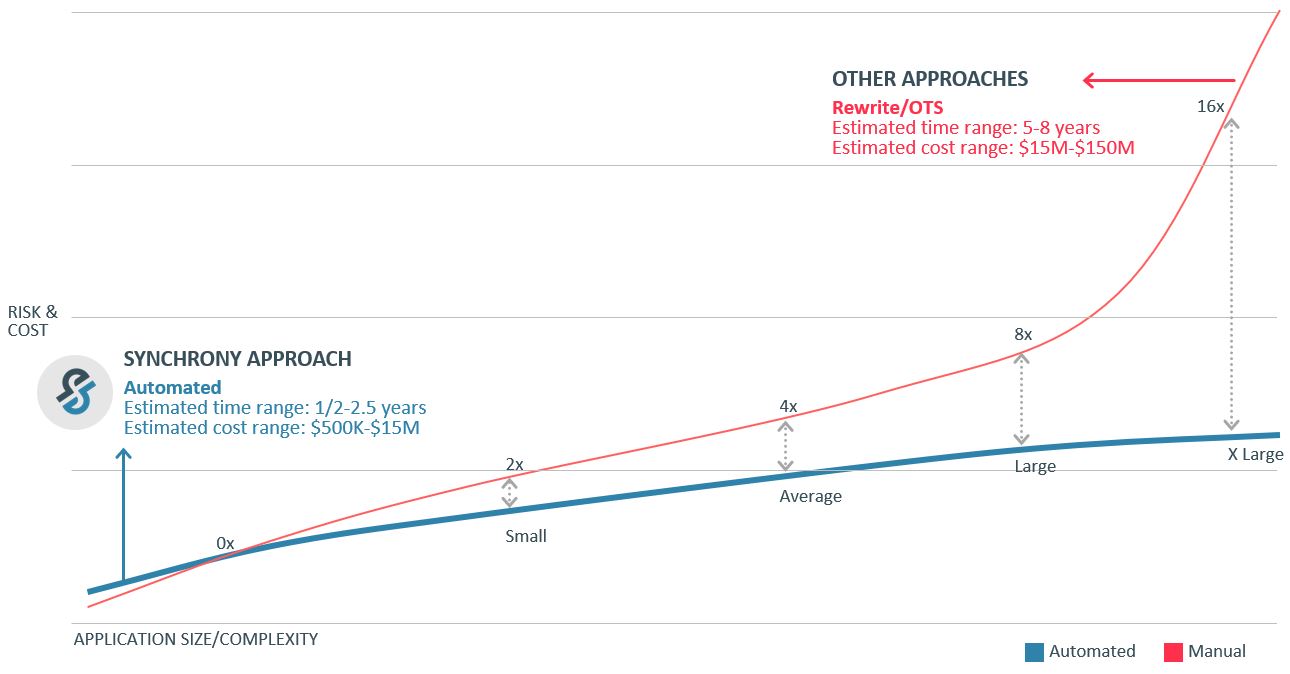
As the chart illustrates, ModOps accelerates modernization delivery and does so at a fraction of the cost and with faster time-to-value. It balances the overall speed, cost, quality, and risk while creating a unified experience that addresses a complex modernization process in a predictable way.
Continuous modernization
Continuous Development (CD), along with Continuous Integration (CI), have become the cornerstones of DevOps— the way applications are being developed and released into production. By replacing CD with Continuous Modernization (CM), ModOps will achieve the same—the way existing applications are to be modernized. Continuous Modernization will bring a high degree of automation and a systematic approach to managing the entire modernization lifecycle.
The three main pillars of ModOps are:
automation-driven modernization and transformation of legacy applications to modern programming languages and platforms;
coexistence of modernization activities with ongoing development activities, without any code freezes; and
functional and UX equivalency with no hidden costs or operational disruptions to the business.
ModOps is the answer for any company whose objective is to preserve its IP and its original investment in mission-critical legacy applications by adapting to and effectively competing in a rapidly moving digital economy.
As in DevOps, ModOps promotes agility, collaboration, and complete transparency. Project managers, migration engineers, testers, and other business stakeholders have full visibility into the overall status and progress of an ongoing modernization at every stage. With built-in planning, tracking, monitoring and dashboards, extensible workflows, automated testing and real-time feedback, a modernization is guaranteed to run smoothly and to be completed on time and on budget.
Tools for ModOps
The evolution of DevOps has spurred the development of tools to help teams more easily apply DevOps principles to the application development process. Modernization Lifecycle Platform (MLP) is doing the same for the application modernization process. It is a DevOps-driven, integrated, Modernization-as-a-Service platform that creates a unified approach to modernizing legacy applications. Whether it’s a modernization of COBOL to Java, PowerBuilder to C# or Smalltalk to Java, the underlying process, methodology, and user experience are uniform, no matter the chosen source and target platform combination. As a result, organizations are just months—not years—away from having their legacy applications transformed to the digital economy of web, mobile, and cloud.
No more legacy applications
We see a future where the application software is never “left behind” or lost to obsolescence. The major business challenges created by legacy applications—growing technical debt and shrinking technical talent—would themselves become obsolete.
Adding Continuous Modernization (CM) alongside CI/CD would give developers the ability to systematically and incrementally apply new software updates, adapt new APIs, or any other software components to in-house applications, thus doing away with any future wholesale modernization initiatives. By embracing ModOps and adopting a platform like MLP, businesses will become more agile, competitive, efficient, and responsive in addressing the demands of today’s digital economy.
Modernize your legacy code for a cloud-native world
Many organizations have already moved to the cloud. Yet the tech debt remains. Applications that were once considered “legacy” now run in modern infrastructure, but they’re still monolithic, tightly coupled, and difficult to change. Cloud hosting alone doesn’t make software cloud-native.
The business logic still matters. These systems still run underwriting, billing, claims, supply chains, and core operations. They cannot simply be replaced. But they can’t stay frozen either.
So what actually reduces tech debt? In this white paper, Jason Bloomberg, President of Intellyx, takes a practical look at legacy modernization — what works, what doesn’t, and where many organizations miscalculate.
Inside the paper:
Why lift and shift often fails to reduce tech debt
The architectural challenges behind monolith-to-cloud transitions
The limits of line-by-line code translation
Balancing automation with human engineering expertise
Last year Facebook announced TransCoder, a tool that converts code from one programming language to another. Like many companies, Facebook also has legacy code that runs critical features and functionality of their platform. They also have billions of active users. It’s no wonder they chose the automation approach for migrating their legacy code to more modern technologies. With this approach, Facebook can preserve its original investment and reduce the risk of significant business disruptions that the proverbial, brute-force rewrite would otherwise bring.
Source: Facebook AI Blog
TransCoder can help modernize legacy systems; however, the devil is always in the details when trying to bring the migrated code to production quality, release the migrated legacy application into production, and retire it.
Any machine learning translation tool can only get the complete migration of an application so far. If Facebook’s TransCoder can translate 90% of the application code, one line out of every ten still needs a software developer’s attention.
For an application with ten million lines of code, one million lines of code would need to be hand-written with production quality.
A manual rewrite of 10% of a large application may take years. In fact, the translated code may never see a production environment. Even with Facebook’s size, virtually unlimited resources, and access to the world’s best talent, the company will still need to manage the entire software migration lifecycle and all of the pieces that it takes to bring the new code into production.
Modernization is more than just code translation
Machine-driven migration tools from source to target programming languages play a crucial role in achieving successful modernization projects. These tools are akin to best-of-breed compilers and their role in greenfield application development. Yes, we need a good compiler, but without the well-established best practices of DevOps, no compiler by itself can ensure the successful completion of a software development project.
What will it take to migrate a large and often complex body of legacy code that runs a critical aspect of the business to a modern technology platform and release it into production without any operational disruptions or development freezes?
This particular challenge has been the Achilles’ heel of every modernization project. No migration tools, including the TransCoder, make any attempt to even mention it or, let alone address it.
Tools like TransCoder are often positioned as “auto-magic.” Buy a piece of AI software, and *poof* all of the migration work is done in a few keystrokes. But a programmer cannot take a COBOL program, wave an AI wand over it, and turn it into microservices or properly architected modern-day application. Right now, AI tools are decades away from being able to transform legacy applications in this manner.
Migration tools inside a modernization process
Migration tools such as TransCoder are just pieces of the chain of moving parts needed to run a well-oiled machine of an otherwise complex modernization process. Therefore, the real value is in integrating such tools inside the entire modernization lifecycle to achieve the kind of an assembly line that is needed to make a complex modernization manageable in terms of process and predictable in terms of time and cost.
No single automation tool is a silver bullet for a modernization project, and we should know. We’ve spent 25+ years modernizing legacy applications, building and using our proprietary migration tools. When we finally managed to integrate the source code migration tools into an entire modernization process, our clients saw considerable gains in code quality, efficiency, and affordability.
Our Modernization Lifecycle Platform (MLP) supports the entire modernization lifecycle: from analysis and planning to transformation and remediation; from build and deployment to testing and production release. It applies the same systematic, iterative, and automation-driven modernization processes to produce production-ready, modernized applications. It is compatible with any translation libraries or rule-sets, no matter the source or target programming language, platform, or framework. By automating the complete modernization process where a tool like TransCoder can be integrated into as part of an entire assembly line, the MLP platform:
Saves thousands of hours of manual effort
Reduces the time and cost of a modernization by 90% compared to traditional approaches
Is 100% automation driven yielding predictable outcomes
Ensures 100% functional equivalence
Eliminates the risk of introducing unexpected regressions or random defects
Provides complete transparency and interoperability for all stakeholders
Like Facebook’s TransCoder, new tools are emerging to take on challenges evident in legacy application modernizations, but they are limited in and of themselves.
An integrated platform that facilitates an automated, reliable, and transparent modernization while ensuring 100% functional equivalence with no operational interruptions is needed to take the migrated application into production.
Smalltalk is a dynamic programming language and a pioneer in object-oriented technology. Its versatility, simplicity, and elegance allowed people to rapidly build complex systems across a variety of industries and applications.
Although other programming languages surpassed Smalltalk in popularity for commercial application development, few captured its unique capabilities.
This makes Smalltalk applications difficult to replace without giving up design and functionality.
The trusted experts at Synchrony Systems have spent over two decades developing technology to address the unique challenges in modernizing Smalltalk applications. Our solution fast tracks Smalltalk modernizations to meet digital transformation demands while preserving the functionality and elegance of the original design. Our solution is designed to prevent operational disruptions — no code rewrites, no code freezes, no halts in development.
Previously, dynamically-typed systems were not good candidates for migrations.
Today, Synchrony’s Static Typing Engine makes these migrations possible. It’s the only proven solution in the market that turns dynamically-typed Smalltalk into statically-typed Smalltalk. It accurately identifies live code and isolates execution paths that are then rapidly migrated or deprecated. The analytical capabilities of our solution give you complete visibility into the Smalltalk interactions within your system. This allows you to extract functionality and migrate it to properly architected microservices.
The entire Smalltalk modernization process is managed through Synchrony’s Modernization Lifecycle Platform. MLP provides an automated, incremental, and agile modernization experience for all stakeholders–from analysis and planning to transformation and remediation to build and deployment to testing and production release. All without impacting the production version of your Smalltalk application or interrupting your day-to-day business operations.
With Synchrony, drastically reduce the cost and eliminate the risk and failure that comes from a rewrite with the most advanced Smalltalk modernization solution on the market.
Ready to launch your Smalltalk into the future? Contact Us.