Your privacy matters. We’ve updated our policies effective March 24, 2026.

LEARN MORE

New experience report reveals details of modernizing six Smalltalk applications to Java

Company Saves Seven Years by Partnering with Synchrony Systems

Greenwich, CT (October 17, 2023) – Synchrony Systems, Inc., a technology pioneer for the management and execution of complex application modernizations, released an in-depth experience report on the modernization of six Smalltalk applications to Java. It describes the unique three-year collaboration between Synchrony and a German  IT services provider for the financial sector.


“This project provided an opportunity to turn the modernization experience on its head,” said Synchrony Systems CEO Slavik Zorin. “We co-developed a true collaborative approach that allowed the company’s engineering team to retain control and have complete visibility into all phases of the modernization process while allowing the application development and modernization to run in parallel. Together, we shrunk an estimated 10-year rewrite of well over two million lines of code down to three years.”  


“With Synchrony’s help, their advanced technology stack, and a strong team, we completed migrating all of our Smalltalk applications to the desired target Java architecture and were finally able to retire Smalltalk,” stated the company’s modernization project lead and veteran software developer. “We could not have done it without Synchrony’s technology, modernization expertise, and strong commitment to success.”


The Modernization Experience Report includes details such as:

  • company and project background
  • modernization initiative challenges, requirements, and vendor selection
  • Synchrony Smalltalk Migration Technology (SMT) and modernization platform overview
  • modernization readiness phase, including work breakdown, team collaboration, and project timeline
  • modernization implementation phase, including parallel track progress, halfway evaluation, functional testing, and code quality
  • final deliverable, conclusion, and takeaways
  • an appendix, including analysis of the codebase, pipelines, operations, deliveries, and more


This in-depth report is available for limited release to companies interested in understanding the details of modernizing large, legacy applications. Request your copy

Modernization Experience Report: Smalltalk Application Portfolio to Java

In-depth experience report shares how one company saved seven years by modernizing a portfolio of Smalltalk applications to Java with Synchrony Systems

Six Smalltalk applications to Java. The company estimated it would take another ten years to complete the portfolio modernization and retire Smalltalk altogether. 

This experience report goes behind the scenes to expose the unique three-year collaboration between Synchrony and a German IT services provider for the financial sector.

This in-depth report is available for limited release to companies interested in understanding the details of modernizing large, legacy applications.

Experience Report Table of Contents:
  • Company 
  • Project background
  • Modernization initiative (Challenges, Requirements, Vendor selection)
  • Synchrony Solutions (Smalltalk Migration Technology (SMT), Modernization Lifecycle Platform (MLP))
  • Modernization engagement
    • Readiness phase (Application portfolio, Work breakdown, Team collaboration, Project timeline)
    • Implementation phase (Splitting the work, Progress of parallel tracks, Progress of the entire project, Halfway point evaluation, Functional testing, Code quality, Integration testing, Final deliverable
    • Conclusions and take-a-ways
  • Appendix (Codebase, Pipelines, Operations, KB and CL, Issues, Deliveries, Datapoints)


Synchrony Systems wins the 2022 Digital Innovator Award from Intellyx

 Greenwich, CT (December 12, 2022) – Synchrony Systems, Inc., the leader in complex application modernizations, announced today that it won the 2022 Digital Innovator Award from Intellyx, a research analyst firm dedicated to digital transformation.


According to their press release, Intellyx bestows this award upon vendors who are the most disruptive and innovative firms in their space, putting a “spotlight on vendors worth watching.”


“It’s an honor to be recognized for the second time by Intellyx for our application modernization technology,” said Slavik Zorin, CEO of Synchrony Systems. “Intellyx recognizes the innovation and positive impact that Synchrony is making in modernizing how modernizations are done. We are thankful for our conversations with the Intellyx team and the insights we gain from those interactions.”


Synchrony is the developer of MLP, a platform-as-a-service that helps customers gain control over the management and execution of complex application modernizations, thus reducing company risks, improving team communication and collaboration, and accelerating the entire modernization initiative. MLP orchestrates automated processes end-to-end, tracks all modernization activities, and provides complete transparency of all modernization activities to stakeholders.


Application owners use MLP to accelerate their adoption of cloud, mobile, and new web technologies by fast-tracking and de-risking complex modernizations. Migration tool vendors grow their business by making their migration tools and services consumable by customers and system integrators through the platform. System Integrators increase their profit margins using MLP to orchestrate migration tools from multiple vendors and leverage MLP’s systematic, repeatable, and reliable processes to manage complex application modernization.


For more details on the award and other winning vendors in this group, visit the Fall 2022 Intellyx Digital Innovator awards page.


About Synchrony Systems, Inc.
Customers gain control over the management and execution of complex application modernizations using Synchrony Systems’ Platform-as-a-Service–MLP. MLP is an end-to-end solution that orchestrates automated migration and modernization processes, tracks all modernization activities, and provides complete transparency of all modernization activities to stakeholders. This results in reduced company risks, improved team communication and collaboration, and accelerated modernization initiatives. MLP was named a 2018 SIIA CODiE Awards finalist for Best DevOps Tool and a 2019 SIIA CODiE Award Finalist for Best Emerging Technology. Synchrony Systems has been named a Digital Innovator from Intellyx in 2021 and again in 2022.

Slavik Zorin of Synchrony Systems to present at Camp Smalltalk Supreme

Sessions include static-type inferencing Smalltalk for application code analysis and decoupling Smalltalk applications for GUI migration to popular web frameworks.

Greenwich, CT (May 16, 2022) – Synchrony Systems, Inc., a leading technology provider for managing legacy application migrations and modernizations, announced today that Slavik Zorin is speaking at Camp Smalltalk Supreme, a yearly conference focused on the Smalltalk programming language. The event is June 10-12, 2022, in Toronto, Canada, celebrating the language’s 50th birthday.


“Smalltalk’s versatility, simplicity, and elegance allowed developers to build sophisticated applications to manage and run business-critical processes,” said Slavik Zorin, CEO of Synchrony Systems. “Yet today’s advances in modern web technologies and industry’s demands for more interactive digital experiences have put Smalltalk applications under pressure. I’m looking forward to showcasing how our technology can preserve the value of Smalltalk applications while enabling interoperability with cloud and mobile application development best practices.”


On Friday, June 10, Zorin will present “Static-Type Inferencing Smalltalk for Application Code Analysis,” demonstrating a static type system in Smalltalk along with Synchrony’s type inferencing technology within their Smalltalk Modernization Technology (SMT).


On Sunday, June 12, Zorin will present “De-coupling Smalltalk Applications for GUI Migration to Popular Web Frameworks,” featuring case studies of commercial Smalltalk applications that underwent a Smalltalk GUI migration while preserving the back-end functionality and design.


Camp Smalltalk Supreme will also feature keynote sessions from Adele Goldberg and Dan Ingalls, two of the original Smalltalk creators at Xerox PARC.


For more information about the conference, visit the conference website at Camp Smalltalk Supreme.


About Synchrony Systems, Inc.

We help customers manage and accelerate application migration, modernization, and transformation through automation technology, assisted workflows, and seamless integration into CI/CD processes, enabling an iterative, continuous modernization approach with no halts in application development. Our Modernization Lifecycle Platform (MLP) is a scalable, cloud-based platform for managing and executing end-to-end migrations and modernizations of legacy IT applications to modern software architectures and platforms. MLP was named a 2021 Digital Innovator from Intellyx, 2019 SIIA CODiE Award Finalist for Best Emerging Technology, and 2018 SIIA CODiE Awards finalist for Best DevOps Tool.

Brownfield software development guide

Brownfield refers to physical land requiring clean-up, upgrades, or development before leveraging the property for new purposes. Brownfield software development describes maintaining, upgrading, migrating, interacting with, or leveraging data from legacy applications.

Most of the world’s developers work on and within brownfield applications and environments. While greenfield software development gets the industry buzz, it’s the brownfield technologies with mass adoption and most usage that run companies.

Challenges in brownfield software development

Brownfield software development is not easy. The developers must keep brownfield applications up-to-date, transform critical legacy business logic to modern technologies, and architect interoperability between brownfield and greenfield applications and environments. Some key challenges with brownfield software to note are:

  • Not having a thorough understanding of the legacy applications and their dependencies with other legacy platforms
  • Staffing technical expertise to continue the development and maintenance of legacy applications
  • Developing a strategic modernization roadmap and rapidly executing it while reducing technical risks and business disruptions
  • Determining which parts of legacy applications are business-critical and must be preserved, maintained, migrated, replaced, or retired
  • Managing upgrades, migrations, integrations, and modernization of legacy applications in a consistent, uniform, and repeatable manner while continuing active maintenance (no halts in development).

The inability to adequately address these issues and challenges will have a costly impact on the current and future business.

Adopt continuous modernization to help solve brownfield application development challenges

Instead of the obsolete top-down / waterfall approaches in greenfield applications, development teams have adapted leading DevOps principles such as continuous integration (CI), continuous testing, continuous monitoring, continuous security, and continuous delivery (CD) to take a more agile and iterative approach. Incorporating the continuous modernization (CM) principle to brownfield applications should be a natural extension of DevOps to enhance and fully complete the cycle of software development, maintenance, and evolution.

The principle of continuous modernization is to avoid the need for large, time-consuming, costly, and risky undertaking of major modernization initiatives in the brownfield software space. Executing a continuous modernization strategy requires different processes and automation tools to manage software migrations, modernizations, and upgrades while coexisting with ongoing greenfield and brownfield development projects.

One such tool is MLP, a SaaS platform that brings a uniform upgrade process, a collaborative work environment, and transparent and traceable workflows to continuous modernization. It snaps into your existing CI/CD environments and procedures to give you the ability to apply new software updates systematically and incrementally to your in-house applications, APIs, or any other software components.

Benefits of continuous modernization for brownfield software

Leveraging automated modernization workflow management tools and platforms like MLP for brownfield software upgrades, maintenance, integrations, and modernizations will benefit the business in many ways. Some of the benefits offered by continuous modernization for brownfield applications are outlined below:

  • Accelerate adoption of native, cloud-first, and mobile application architecture
  • Fast-track digital transformation projects to accelerate delivery of business value
  • Reduce security risks associated with legacy applications
  • Keep currency with a rapidly changing technology landscape
  • Improve performance of brownfield applications
  • Continuously eliminate creeping technical debt
  • Prevent massive modernization initiatives in the future

In short, continuous modernization makes it easier to support brownfield application development by providing a systematic, uniform, and accelerated approach to executing modernization roadmaps without disrupting the day-to-day business operations.

Learn more about continuous modernization.

IT modernization insights for government CIOs

A few of our team members attended the Beyond the Beltway 2022 – Virtual Event hosted by the Center for Digital Government. It was an incredible opportunity to hear directly from state and local government CIOs and CSOs. They discussed the initiatives they are working on, the tech trends important to their region, and the best ways the private sector can be a true partner in finding solutions to their problems.

One thing was certainly evident, government CIOs and CSOs have their work cut out for them. They have to balance federal directives with constituent service expectations within the constraints and protocols of the local governing body. The featured speakers from government organizations across the country were generous with their insights, and the sessions were expertly moderated by the staff at the Center for Digital Government. Here are a few things we learned about technology modernization at the state and local levels of government.

1. Strategic plans inform technology modernization considerations

Although the featured CIOs spoke to the specific needs of their region, they all stressed that their strategic plan, which is available to the public, guides all modernization considerations. Their projects reflect these overarching government directives heard throughout the event:

  • Keep our systems secure (cybersecurity)
  • Protect the privacy of our people (PII data)
  • Meet constituent expectations (digital engagement)
  • Support remote and hybrid workforces (secure cloud-based systems)
  • Prove compliance (tracking and reporting)

Any modernization project will advance progress towards the strategic plans and support the overarching directives.

2. CIOs use existing technologies, processes, people, and relationships wherever possible

The featured CIOs spoke passionately about being good stewards of taxpayer dollars. They always first evaluate and leverage existing systems and expertise wherever possible. Then, they review internal processes and skills and engage with partners they know and trust.

If a technology modernization initiative is needed, government CIOs reach out to each other looking for similar, successful projects. They want the highest probability of success with the least risk possible – and don’t want to re-invent the wheel.

3. Funding for technology modernization is only part of the solution

Yes, having money allocated for technology modernization is great. But the CIOs stressed that the funding is only a piece of the overall initiative. The more significant challenges lie in the execution of getting the project completed.

Government CIOs are looking for holistic proposals beyond the specific technology solution. The proposals must also include:

  • External experts assigned to the project
  • Internal IT resources required to support the project
  • Best practice frameworks and guides
  • Relevant case studies
  • Knowledge transfer plans
  • Long-term support considerations (maintenance fees, upgrades, training, etc.)

Comprehensive plans help give the CIOs confidence that the modernization project is successful and sustainable.

One final point stressed by several of the speakers – it’s challenging to retain internal IT talent within the government. It’s a very competitive job landscape, with many choosing employment in the private sector. Therefore, CIOs tend to give favor to external suppliers who will help upskill and reskill government employees to support the modern technology and processes

4. Technology suppliers need to do their homework

The public availability of contact information for government IT staff makes reaching out to the CIOs incredibly easy. While our speakers welcome the outreach, they are often disappointed that technology suppliers haven’t researched what matters for that specific CIO office. The cold outreaches are broad, generalized, and focused on selling to the CIO.

Government CIOs want the outreach, but they want to understand the pitched technology fits within the context of their strategic plan and the ecosystem of providers they already use. This information is publicly available, so they want suppliers to do their homework and frame the solution in the following ways:

  • Plan – what specific initiatives or directives does the technology modernization support?
  • People – who are the people involved, and how will others and the community benefit?
  • Process – what process improvements does the technology modernization support?
  • Technology – what are examples of it working for similar organizations solving like challenges?
  • Policy Implications – what are the policies considerations surrounding the technology?
  • Performance – how do we measure and share positive outcomes resulting from technology modernization?

The final thought one CIO offered to technology vendors was, “bring me leading edge, not bleeding edge, tech.” The agreement was while cutting-edge technology may be interesting, it doesn’t have a place in government until sufficiently proven.

5. Public CIOs want true partnerships with private sector technology providers

State and Local CIOs are operating to plans that extend years into the future. They also are tying every technology investment to the needs of their community, such as democratizing broadband access and keeping their citizens safe from cybercriminals. These challenges can’t be solved with a single technology or even within a single administration. And the balancing forces within the government mean technology modernization progress is slow compared to the private sector.

Therefore, government CIOs want partners with them for the long haul. They want partners committed to being a part of the solution beyond the technology they may provide. Partners who can bring ideas, best practices, and other partners and who take the time to build a personal and trusted relationship give the most value. Those are the partners who work on the government project.

Synchrony Systems’ work in state and local government

We have been fortunate to serve several state and local government organizations such as Bay Area Rapid Transportation (BART), City of Atlanta Fire Department, Oregon State Judicial Department, and New York City Police Department. Through our trusted partnerships, we helped migrate and modernize their legacy applications to modern, cloud-based, and mobile-friendly applications and user interfaces.

Our automated migration and modernization technology allows our partners like IBM, Astadia, and TSRI to leverage our platform and expertise on government modernization initiatives efficiently and effectively.

ModOps: DevOps for legacy modernization

DevOps has revolutionized software engineering methodology by unifying development and operations to accelerate software delivery. The older-style waterfall approaches to greenfield application development are being put aside as DevOps principles of agility, iteration, continuous delivery, and automation take center stage.

Modernization must deal with the challenge of transforming millions of lines of existing legacy code, built over decades by dozens, if not hundreds, of engineers, most of whom have moved on or retired altogether. Yet outdated approaches such as “rip and replace” are still the default modernization methodology, employing manual rewrites and disjointed automation tools. This approach is costly, takes an enormous amount of time and resources, and introduces significant risk to the business.

At Synchrony Systems, we believe it’s time to apply the DevOps principles, adopted for greenfield development, to software modernization—or ModOps—to keep pace with the rapid digital transformation.

Accelerating modernization delivery

Modernization focuses on transforming existing legacy systems and applications to the latest platforms and architectures. Unlike greenfield development, where very frequent and incremental changes are made to small bodies of code, modernization requires making wholesale transformations of the entire body of code at once and en masse. Therefore, the traditional manual approaches to modernizations can no longer be justified in today’s rapidly moving digital economy.

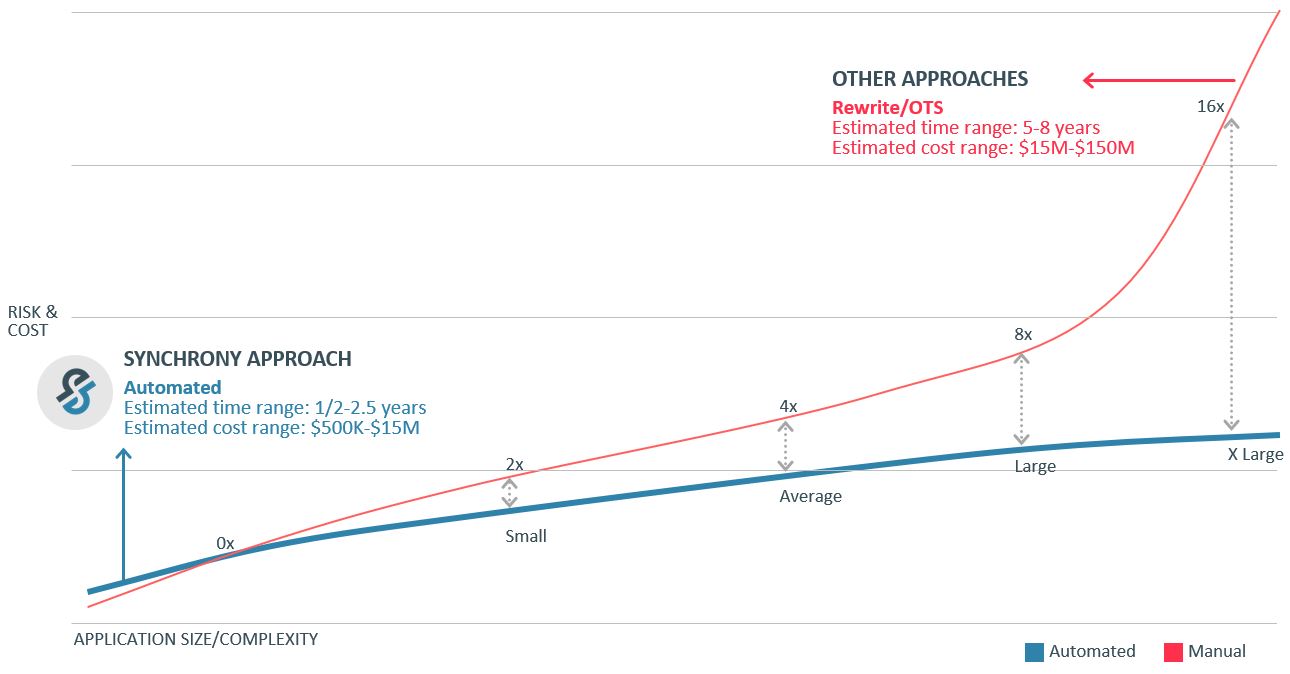
As the chart illustrates, ModOps accelerates modernization delivery and does so at a fraction of the cost and with faster time-to-value. It balances the overall speed, cost, quality, and risk while creating a unified experience that addresses a complex modernization process in a predictable way.

Continuous modernization

Continuous Development (CD), along with Continuous Integration (CI), have become the cornerstones of DevOps— the way applications are being developed and released into production. By replacing CD with Continuous Modernization (CM), ModOps will achieve the same—the way existing applications are to be modernized. Continuous Modernization will bring a high degree of automation and a systematic approach to managing the entire modernization lifecycle.

The three main pillars of ModOps are:

  1. automation-driven modernization and transformation of legacy applications to modern programming languages and platforms;
  2. coexistence of modernization activities with ongoing development activities, without any code freezes; and
  3. functional and UX equivalency with no hidden costs or operational disruptions to the business.

ModOps is the answer for any company whose objective is to preserve its IP and its original investment in mission-critical legacy applications by adapting to and effectively competing in a rapidly moving digital economy.

As in DevOps, ModOps promotes agility, collaboration, and complete transparency. Project managers, migration engineers, testers, and other business stakeholders have full visibility into the overall status and progress of an ongoing modernization at every stage. With built-in planning, tracking, monitoring and dashboards, extensible workflows, automated testing and real-time feedback, a modernization is guaranteed to run smoothly and to be completed on time and on budget.

Tools for ModOps

The evolution of DevOps has spurred the development of tools to help teams more easily apply DevOps principles to the application development process. Modernization Lifecycle Platform (MLP) is doing the same for the application modernization process. It is a DevOps-driven, integrated, Modernization-as-a-Service platform that creates a unified approach to modernizing legacy applications. Whether it’s a modernization of COBOL to Java, PowerBuilder to C# or Smalltalk to Java, the underlying process, methodology, and user experience are uniform, no matter the chosen source and target platform combination. As a result, organizations are just months—not years—away from having their legacy applications transformed to the digital economy of web, mobile, and cloud.

No more legacy applications

We see a future where the application software is never “left behind” or lost to obsolescence. The major business challenges created by legacy applications—growing technical debt and shrinking technical talent—would themselves become obsolete.

Adding Continuous Modernization (CM) alongside CI/CD would give developers the ability to systematically and incrementally apply new software updates, adapt new APIs, or any other software components to in-house applications, thus doing away with any future wholesale modernization initiatives. By embracing ModOps and adopting a platform like MLP, businesses will become more agile, competitive, efficient, and responsive in addressing the demands of today’s digital economy.

Synchrony Systems launches new capabilities to support EGL migrations

Organizations can upgrade to the latest version of EGL technologies or move to alternative platforms with MLP

Greenwich, CT (September 7, 2021) – Synchrony Systems, Inc., a leader in legacy application modernizations, announced today the release of a 4GL EGL migration solution as part of its Modernization Lifecycle Platform (MLP) offering.


“News such as no longer supporting JSF and Jasper reports and IBM moving EGL to HCL puts a question mark in the platform’s future,” said Oleg Arsky, chief product officer at Synchrony Systems. “Pair that with the desire to move applications to Web SPA with Angular/React/Vue, it made sense for us to invest in building a complete EGL migration solution to help our customers approach EGL modernizations in the best way suited for their future-state and business needs.”


Using Synchrony’s automation technology within MLP, applications built in the legacy 4GL EGL platform can be migrated wholesale or incrementally to the target architecture, programming language, and platform of the organization’s choice. This includes upgrading to the latest version of EGL technologies or moving to alternative platforms. The new capabilities for Synchrony’s EGL Modernization solution include:

  • Report Framework Upgrade — Jasper Reports to BIRT Reports
  • Web Upgrade — EGL/JSF to EGL/RUI
  • Web Facelift — EGL/TUI to EGL/RUI
  • Platform Transformation — EGL to Java/C# on the backend and JavaScript on the frontend


“Companies who work with Synchrony get more than best-of-breed migration tools,” Slavik Zorin, CEO of Synchrony Systems. “Our strength and focus are on migrating large and often complex bodies of legacy code that run critical aspects of the business to modern technology platforms and release them into production without any operational disruptions or development freezes.”


“The real value for organizations is integrating our EGL migration tools inside the entire modernization lifecycle to achieve the kind of an assembly line that is needed to make a complex EGL modernization manageable in terms of process and predictable in terms of time and cost,” added Arsky. “That why we are excited to offer a complete EGL migration solution integrated with MLP.”


For more information, visit the EGL modernization solution page, MLP page, or contact us.


About Synchrony Systems, Inc.

We help enterprises transform legacy in-house applications to modern technologies while preserving business-critical functionality. Synchrony’s Modernization Lifecycle Platform (MLP) is a scalable, cloud-based platform for managing and executing end-to-end migrations and modernizations of legacy IT applications to modern software architectures and platforms. It enables automated code conversion, transformation, remediation, and upgrades of millions of lines of code in minutes, ensuring consistent, reliable, and repeatable results. MLP was named a 2021 Digital Innovator from Intellyx, 2019 SIIA CODiE Award Finalist for Best Emerging Technology, and 2018 SIIA CODiE Awards finalist for Best DevOps Tool.

How to pay off your technical debt (whitepaper)

Modernize your legacy code for a cloud-native world

Many organizations have already moved to the cloud. Yet the tech debt remains. Applications that were once considered “legacy” now run in modern infrastructure, but they’re still monolithic, tightly coupled, and difficult to change. Cloud hosting alone doesn’t make software cloud-native.

The business logic still matters. These systems still run underwriting, billing, claims, supply chains, and core operations. They cannot simply be replaced. But they can’t stay frozen either.

So what actually reduces tech debt? In this white paper, Jason Bloomberg, President of Intellyx, takes a practical look at legacy modernization — what works, what doesn’t, and where many organizations miscalculate.

Inside the paper:

  • Why lift and shift often fails to reduce tech debt
  • The architectural challenges behind monolith-to-cloud transitions
  • The limits of line-by-line code translation
  • Balancing automation with human engineering expertise
  • Why iterative approaches reduce modernization risk
  • The importance of scoping and lifecycle management in architecture transformation

If your cloud strategy hasn’t delivered the flexibility you expected, this paper offers a more grounded way to think about modernization.


Download your free copy of the tech debt white paper today.

Synchrony Systems wins 2021 Digital Innovator Award from Intellyx

Greenwich, CT (June 16, 2021) – Synchrony Systems, Inc., a leader in legacy application modernizations, today announced the selection to the inaugural class of the 2021 Digital Innovator Award from Intellyx, the first and only analyst firm dedicated to digital transformation.


“At Intellyx, we get dozens of PR pitches each day from a wide range of vendors,” said Jason Bloomberg, President of Intellyx. “We will only set up briefings with the most disruptive and innovative firms in their space. That’s why it made sense for us to call out the companies that made the cut.”


“It’s an honor to be recognized by Intellyx for our innovation in the IT modernization space,” said Slavik Zorin, CEO of Synchrony Systems. “We’ve spent 25+ years modernizing legacy applications, building and using our proprietary migration tools. When we integrated the source code migration tools into an entire modernization process, our clients saw considerable gains in code quality, efficiency, and affordability.”


Synchrony’s Modernization Lifecycle Platform (MLP) supports the entire modernization lifecycle: from analysis and planning to transformation and remediation, from build and deployment to testing and production release. It applies the same systematic, iterative, and automation-driven modernization processes to produce production-ready, modernized applications.


It is compatible with any translation libraries or rule-sets, no matter the source or target programming language, platform, or framework. By automating the complete modernization process migration tools can be integrated into as part of an entire modernization assembly line.


To see the full list of winners, visit the Intellyx announcement.


About Synchrony Systems, Inc.

We help enterprises transform legacy in-house applications to modern technologies while preserving business-critical functionality. Synchrony’s Modernization Lifecycle Platform (MLP) is a scalable, cloud-based platform for managing and executing end-to-end migrations and modernizations of legacy IT applications to modern software architectures and platforms. It enables automated code conversion, transformation, remediation, and upgrades of millions of lines of code in minutes, ensuring consistent, reliable, and repeatable results. MLP was named a 2019 SIIA CODiE Award Finalist for Best Emerging Technology and 2018 SIIA CODiE Awards finalist for Best DevOps Tool.