Synchrony Systems CEO and co-founder Slavik Zorin has been recognized as a thought leader in the Forbes Technology Council, contributing insights across four expert panel roundups in 2026.
“In large systems, finding sensitive data is usually the easier part. The harder part is keeping enough context around each access: what business operation used it, who authorized the action, and where the data went next. Without that, teams end up reconstructing activity after the fact from incomplete evidence.”
“There is an assumption that aligning initiatives to business goals is enough. In large systems, that breaks down quickly. What matters is preserving the behaviors the business depends on. The first step is to identify and verify those behaviors so changes can be made without introducing unintended consequences.”
“One area is risk and compliance decision-making. These decisions have traditionally been based on fragmented views of system behavior. With AI and analytics, organizations can assemble a more complete picture across applications and environments, improving how risks are understood and how compliance is validated.”
“The real risk is invisible technical debt. Open AI models can generate code that appears correct but gradually diverges from the architecture of the system. At enterprise scale, those inconsistencies compound. Without governance, organizations risk automating the creation of technical debt.”
Slavik Zorin, co-founder & CEO of Synchrony Systems, is a legacy app modernization expert with 30+ years leading complex global projects.
…
At some point, most established organizations find themselves lost in what I call the “legacy maze.”
A routine system update breaks an unrelated function. Fixing that issue exposes another dependency no one remembers creating. A modernization roadmap that once looked sensible now stretches years into the future, while the people who truly understand the system are nearing retirement. Progress is slow, risk is high and every turn seems to reveal yet another dead end.
This is rarely a technology failure. It is almost always a leadership one. Legacy applications don’t collapse overnight. They accumulate complexity over decades. By the time executives feel the pain, the organization is already deep inside the maze.
Why modernization so often stalls
Many modernization efforts fail not because leaders underestimate the importance of technology, but because they overestimate how linear the journey will be.
Most core systems in large enterprises were built for a different era: batch processing rather than real-time decisions, stability rather than speed and internal users rather than customers. Over time, these systems were patched, extended and repurposed to meet new regulatory, operational and market demands. Business logic became embedded everywhere, often undocumented. Change one thing, and five others break.
From a leadership perspective, this creates three compounding risks:
• Operational drag: When applications can’t exchange data in real time, organizations compensate with manual workarounds. Decisions slow down. Opportunities are missed. Employees spend their time navigating systems instead of serving customers or improving the business.
• Risk concentration: Critical knowledge often lives in the heads of a shrinking group of specialists. When those employees leave or retire, fragility becomes institutional.
• Strategic paralysis: Leaders know the applications must change, but rip-and-replace feels too risky, too expensive and too disruptive. So modernization becomes a perpetual initiative, constantly funded with no end in sight.
In regulated industries such as financial services and insurance, where compliance deadlines and digital expectations collide, this tension becomes especially acute.
The false promise of a big-bang transformation
One of the most common traps executives fall into is assuming modernization must be all-or-nothing. Replace everything. Re-platform the entire enterprise. Emerge years later, transformed.
In reality, these efforts often stall under their own weight. Timelines stretch. Business requirements change midstream. Patience erodes before meaningful value is delivered.
The fact is that modernization is not an event. It is a managed, staged transformation that must deliver business value along the way.
From maze to map: principles that work
Organizations that successfully escape the legacy maze follow a consistent set of principles:
• Start with value, not systems. Instead of asking, “Which application do we modernize?”, ask, “Which business capabilities matter most right now?” Revenue engines, compliance-critical processes and customer-facing workflows are often the right starting points.
• Preserve what works. Legacy does not mean obsolete. Many older systems encode decades of domain expertise. The goal is not to discard that logic, but to liberate it. Making it more accessible, testable and adaptable.
• Modernize incrementally. Extract high-value functions into modular components that can evolve and be deployed independently without disrupting business operations. This reduces risk while delivering visible progress that creates early wins and builds momentum.
• Make progress measurable. Leaders and teams need to see tangible results. That means faster release cycles, improved user experiences and reduced dependency on scarce skills. These outcomes matter just as much as technical milestones and should be considered key performance indicators.
Using technology as a tool
Modern architectures matter in a modernization journey. But they are a means, not the main objective.
The real goal is alignment with how the business operates. Systems must evolve while the organization continues to serve customers, comply with regulations and compete in the market. Done well, modernization reduces risk over time rather than concentrating it into a single moment.
In practice, this often means running old and new systems side by side, shifting responsibility gradually as confidence grows. User experiences improve incrementally. Teams learn new ways of working without abandoning what already functions.
What executives should ask before starting
Before approving another modernization initiative, senior leaders should ask:
• Will this deliver measurable business value within the first year?
• Can we modernize without betting the company on a single cutover?
• Are we reducing dependency on scarce skills?
• How will we measure progress quarter by quarter?
If the answers are vague, the organization may already be wandering deeper into the maze.
The way out
Legacy systems are not going away and are not embarrassments to hide. They are assets that powered decades of growth.
Escaping the legacy maze doesn’t require heroic rewrites or an overnight transformation. It requires a map: clarity where the value lives, willingness to move in stages and the discipline to modernize without disrupting the business.
For leaders who take that approach, modernization becomes less about a technology project and becomes what it truly is: a strategy for restoring agility, resilience and confidence in the systems that run the enterprise.
This interview with Cynthia Corsetti and Synchrony CEO Slavik Zorin was originally published by Authority Magazine. You can read the original article here.
…
Digital transformation has become a crucial component for businesses striving to stay competitive and relevant in today’s rapidly evolving landscape. As technology continues to shape industries and redefine business models, companies must adapt and leverage digital tools and strategies to unlock new opportunities for growth and innovation. In this interview series, we aim to explore various aspects of digital transformation, including best practices, challenges, success stories, and expert insights. We are talking to thought leaders, industry experts, entrepreneurs, technology innovators, and executives who have firsthand experience in driving digital transformation initiatives within their organizations.
As part of this series, we had the pleasure of interviewing Slavik Zorin.
Slavik Zorin is CEO & Co-Founder of Synchrony Systems — he is a recognized expert in legacy application modernization with more than 30 years of hands-on experience leading complex projects across financial services, insurance, government, and global enterprises. Slavik is the visionary behind Modernization Lifecycle Management and Synchrony’s Modernization Lifecycle Platform (MLP). His work enables organizations to transform legacy systems into modern architectures with speed, accuracy, and traceability.
…
Thank you so much for joining us in this interview series. Before we dive in, our readers would love to “get to know you” a bit better. Can you tell us a bit about your ‘backstory’ and how you got started?
Hi, Cynthia! Thank you for having me today to share my background and discuss the digital transformation space. My company, Synchrony Systems, helps businesses upgrade their old, critical software systems to modern, efficient platforms. We use a combination of automation and AI-assisted tools to ensure the transition is smooth, cost-effective, and minimizes disruption to daily operations.
I often say my entire career has been lived in the before-and-after of software. I started as an independent consultant in the early days of software development, working with a programming language called Smalltalk. This led to a partnership with IBM, where we helped companies move their systems into IBM’s environment. Our first major project in the early 90s showed us the need for automation, and we began developing tools to make these transitions smoother.
As the industry evolved, we had to continually reinvent ourselves, learning each new technology wave. Those experiences ultimately shaped our focus today: orchestrated, low-risk legacy application modernization through our Modernization Lifecycle Platform (MLP).
In essence, my journey has centered on turning outdated systems into modern, efficient applications that keep businesses moving forward.
Can you share a story about the funniest mistake you made when you were first starting? Can you tell us what lessons or ‘takeaways’ you learned from that?
Back in the early days of our company in the late 90s/early 2000s, when we were still transitioning from being a pure Smalltalk shop into a modernization and migration firm, I was asked to deliver a highly customized three‑day training course for one of our biggest financial clients at the time. Their chief architect, an incredibly bright and respected leader, had spent years building an advanced new framework for their commercial loan system. My job was to train their engineers how to use it.
Because the material was complex and the timeline was impossibly tight, I pulled multiple all‑nighters building the course and preparing the printed materials. By the time the first day of training arrived, I had been awake far longer than any sane human should have been. And, then it happened. In the middle of delivering the course, right there in front of the client and their entire technical team, I fell asleep. Literally nodded off mid‑session.
Our client, thankfully understanding just how much effort had put into preparing the training, quietly took over the class while I slept… in front of everyone. During a break, I realized what had happened. I sat red‑faced, while the room full of engineers tried politely, and unsuccessfully, not to laugh.
The good news? The training went on and the relationship didn’t just survive. It thrived for years afterward. They even eventually hired us to migrate to the very system they once tried to rewrite themselves. One big takeaway from that experience is that strong relationships can help you weather even the most embarrassing moments.
None of us are able to achieve success without some help along the way. Is a particular person who you are grateful for who helped get you to where you are? Can you share a story?
From the very beginning, I built this company alongside my wife, Regena, who has been an essential partner in every sense. While I focus on the engineering and technical vision, she oversees the entire business backbone. From running finance, legal, contracting, accounting, and HR, she essentially manages all of the operational infrastructure that keeps us moving forward.
In addition, our Synchrony team is made up of talented engineers and long‑tenured experts. Even as a small company where everyone wears multiple hats, our employees and contractors form a group of highly skilled, engineering‑driven teams that have grown alongside the company’s evolving modernization mission.
Is there a particular book, podcast, or film that made a significant impact on you? Can you share a story or explain why it resonated with you so much?
A thinker who had a huge impact on me was author and journalist, Christopher Hitchens. I discovered him by accident through a debate podcast, and I was immediately blown away by his intellect, independence, and clarity of thought. I ended up listening to everything he ever recorded and reading all his books. His ability to stand his ground, think deeply, and communicate honestly has shaped how I approach conversations, decisions, and relationships both personally and in business.
Are you working on any new, exciting projects now? How do you think that might help people?
What excites me most right now is the evolution of our Modernization Lifecycle Platform (MLP). MLP is our proprietary platform designed to help organizations upgrade their old applications in a structured and transparent way. It covers everything from analyzing the current system to transforming the code, testing, and deploying the new system. By standardizing this process and integrating automation, MLP significantly reduces the risks and costs that usually come with modernization projects.
The next evolution of MLP is particularly exciting because it introduces AI-assisted tools to support in the initial modernization readiness assessment phase of the process. The goal is to make modernization something companies can manage confidently, without it being a disruptive, once-a-decade crisis. This evolution empowers businesses to keep up with new technologies and digital demands, all while ensuring their critical systems continue running smoothly behind the scenes.
Thank you for all that. Let’s now turn to the main focus of our discussion about Digital Transformation. Digital transformation can mean many things to many people, from your perspective, how do you define digital transformation in your industry?
For us, digital transformation means modernizing mission‑critical legacy applications. That means transforming outdated systems into modern, scalable technologies that better support today’s digital business demands. What’s unique to Synchrony is our focus on the core systems the business actually runs on. Many of these systems were built decades ago in languages like Smalltalk, PowerBuilder, EGL, and mainframe environments. Long before Zero Trust security, modern architectures, or continuous delivery existed.
It’s similar to home improvement. You can’t just upgrade the aesthetics — you have to maintain and correct old wiring, plumbing, insulation, and other invisible aspects that keep the home running. When modernization is done correctly, organizations benefit from stronger cybersecurity, more automated compliance, and more interoperability and extensibility that support continuous improvement.
Which companies can most benefit from a Digital Transformation?
Any company that is running important business operations on decades-old applications and software will benefit from a digital transformation. Across the globe, this is a frequent issue in financial services, government, insurance, utilities, higher-ed and healthcare sectors. Companies in those industries are often particularly vulnerable to retiring experts, increasing maintenance costs, growing regulatory demands, and systems that are difficult to integrate with modern platforms. Neglecting these systems leads to compounding technical debt that can put your whole enterprise at risk.
Has integrating Digital Transformation been a challenging process for some companies? What are the challenges? How do you help resolve them?
Most companies underestimate the complexity of their legacy systems, and we often see the same issues crop up repeatedly.
One common problem is decision paralysis and delay. Organizations know they need to modernize, but they keep delaying it. Those delays also mean these critical projects often lose internal champions to turnover and attrition, stalling momentum.
Overconfidence in in-house rewrites is another frequent challenge. Many companies underestimate the complexity of modernization and assume their in-house teams can handle it alongside their other responsibility. This leads to multi-year delays, blown budgets and no cohesive plans. Or, similarly, they rely too heavily on AI tools that aren’t equipped to properly handle such an enormous task.
Finally, perhaps the most frustrating challenge we see is when the true cost of technical debt is discovered too late. Deferred maintenance turns the already challenging task of modernization into a cost-prohibitive crisis.
Our platform and approach are specifically designed to address these challenges and help businesses modernize quickly without the disruption to the business that comes from fully rewriting their applications.
Ok. Thank you. Here is the primary question of our discussion. Based on your experience and success, what are “Five Ways a Company Can Use Digital Transformation To Take It To The Next Level”? Please share a story or an example for each.
1. Make Legacy Systems Intelligible Before You Touch Them
The biggest mistake companies make is jumping straight into rewriting or replacing systems they don’t fully understand. The first step is always a deep analysis: counting screens, functions, dependencies, integrations, and understanding how the application actually behaves in production. This creates a data-driven foundation for planning.
For example, in our modernization projects, we ingest millions of lines of existing code and generate a complete application inventory. This approach keeps estimates within 20–30% of reality, instead of being off by 300–400% like many manual rewrites.
2. Use Orchestrated, Automated Modernization, Not Risky Rewrites
Manual rewrites are slow, risky, and nearly impossible to estimate accurately. Orchestrated, rules-based automation gives you consistency, traceability, and repeatability. Our tools function like compilers: we take legacy code as input and generate modernized equivalents, reducing both cost and risk.
For instance, our earliest work with IBM on Smalltalk migrations taught us this valuable lesson. By building migration tools instead of relying on manual rewrites, IBM was able to resell our software for large projects where automation dramatically reduced project timelines and improved predictability. They built over a $100 million modernization business that our technical solutions were a part of.
3. Modernize What Matters — And Keep In Mind, Not Everything Matters
Not all legacy logic is bad. Some should be preserved, some refactored, and some removed entirely. Selective modernization minimizes disruption while maximizing ROI. It focuses effort on the parts of the system that matter most to the business.
For instance, applying Pareto’s Principle often reveals that roughly 20% of an application delivers 80% of its business value. By modernizing that high‑impact portion first, organizations can deliver results faster, reduce risk, and avoid rewriting low‑value areas. This targeted approach creates early wins by modernizing a heavily used functionality without taking on the full cost and complexity of modernizing the entire system at once.
4. Adopt Continuous Modernization to Control Technical Debt
Instead of waiting until systems become dangerously outdated, organizations should integrate incremental updates into their regular development workflow. Continuous Modernization (CM) reduces upgrade complexity, improves security, and prevents technical debt from snowballing.
To illustrate, in the CM model, upgrades run in isolated branches and are automatically tested. Issues are caught early, when they’re smaller and less expensive, rather than discovered years later when outdated dependencies force a massive overhaul. This approach can extend the lifespan of mission-critical systems while keeping costs predictable.
5. Treat Security as an Architectural Outcome, Not a Patch Job
Legacy systems were never designed for Zero Trust security, identity-centric access, or real-time observability. Modernization makes systems visible, traceable, and structurally capable of continuous security and compliance. You can’t secure what you can’t see.
Consider the following example. We work with companies to modernize legacy platforms that have become opaque and tightly coupled. By moving to service‑based architectures with clear trust boundaries and least‑privilege access, they shift from reactive patching to security that’s engineered, validated, and auditable.
In your opinion, how can companies best create a “culture of innovation” in order to create new competitive advantages?
A culture of innovation starts with accepting a simple reality that today’s modern system is tomorrow’s legacy. If teams focus on this mission, innovation becomes a continuous discipline rather than a one-time initiative.
From our experience, companies innovate best when they treat modernization like engineering and not improvising. This means transparent workflows, measurable progress, clear architecture, and tools that help teams understand their systems. Our platform makes all modernization activity visible, from test results to automation runs, to defect patterns, which encourages learning and faster iteration.
Innovation thrives when teams feel empowered to evolve systems continuously, supported by data, tooling, and processes that reduce risk and uncertainty.
Can you please give us your favorite “Life Lesson Quote”? Can you share how that was relevant to you in your life?
A quote I often come back to is: “Today’s state of the art system is tomorrow’s legacy.”
After 30 years in this field, I’ve seen every modern platform eventually become the next modernization challenge: Smalltalk, EGL, PowerBuilder, and early Java frameworks. That reality shaped my entire career. It taught me to treat modernization as something continuous and engineered, not a one-time event. It’s why we built structured tools, automation, and ultimately a full Modernization Lifecycle Platform to help organizations evolve without losing the functionality and the underlying value embedded in their systems. For me, this quote is a reminder to stay adaptable. No matter how advanced a system looks today, it will eventually be tomorrow’s legacy system.
How can our readers further follow your work?
You can follow me on LinkedIn and also go to sync-sys.com and visit our blog to learn more about Application Modernization and the digital transformation.
Thank you so much for sharing these important insights. We wish you continued success and good health!
…
About The Interviewer: Cynthia Corsetti is a CEO and Executive Coach. She is the founder of CC consulting and the host of the podcast, “The Only CEO”. Cynthia has been featured in numerous publications and has been a guest on dozens of podcasts and radio shows. Cynthia helps CEO’s and other c-suite executives to increase their impact, influence, and productivity. She helps clients develop a clear vision, strategy, and roadmap to achieve their goals. Her clients include both new and experienced leaders, as well as those transitioning to new roles. Cynthia holds an MBA from Harvard Business School and a BA from the University of California, Berkeley. She is a certified coach and a member of the International Coach Federation.
Migrating to a cloud-native architecture is one of the most powerful ways to improve business agility. The modern cloud delivers virtually unlimited, on-demand compute power, enabling platforms to scale instantly to meet demand. It’s no surprise that 94% of companies worldwide already use cloud computing in some capacity, and 97% of IT leaders plan to expand their cloud systems in the next few years (source).
Yet many enterprises remain constrained by legacy, monolithic applications. These systems hold critical business logic but act as bottlenecks to digital transformation. Insurance applications, banking platforms, and other unique software systems have been built over the course of decades in languages like PowerBuilder, EGL, and Smalltalk, among others. These types of systems require a flexible, customizable, scalable, and agile modernization process that can be easily jump-started to deliver incremental results.
But how can you untangle a complex monolith without disrupting stable functionality and critical business operations? After all, carving out pieces of a monolithic system is a manual, labor-intensive, and time-consuming process. To move forward in today’s climate, organizations need a controlled, automated approach that ensures critical functions can be safely modernized, tested, and deployed in a timely manner.
The optimal solution lies in a more modern architecture built on microservices and micro-frontends. Microservices are a web of independent, modular components that can be scaled, updated, and reused individually. Micro-frontends are user-facing components that can operate either independently or as a cohesive whole.
Modernizing the front end is just as important as modernizing straight business logic. Forrester Research finds that companies investing in UI/UX design see a $100 return for every $1 spent. Outdated interfaces remain one of the most immediate barriers for legacy applications, and micro-frontends directly address this need.
Synchrony Systems’ Modernization Lifecycle Platform (MLP) comes equipped with end-to-end automation for extracting “subsets” of business logic and user interface, and transforming them into reusable components for microservices and micro-frontends. This enables organizations to modernize their monolithic legacy applications into a hyperscale cloud architecture. By focusing on the high-value business functionality first, Synchrony helps accelerate modernization timelines so enterprises can deploy and test migrated functions and complete features continuously in months instead of years.
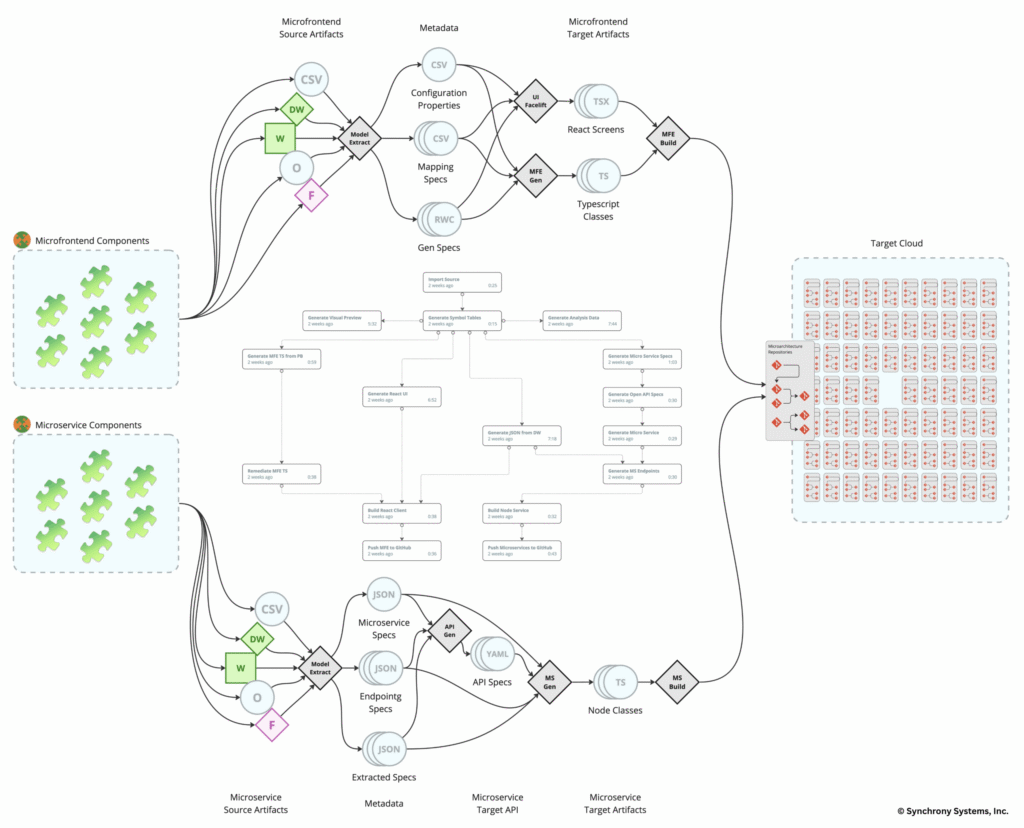
The illustration below shows how MLP orchestrates a modernization solution from a PowerBuilder monolithic architecture to a target microarchitecture with a TypedScript/React frontend and a TypedScript/Node.js backend as the target programming languages. (click image to enlarge)
How monoliths become microservices and micro-frontends
Rather than migrating monolithic legacy codebases wholesale or “as-is,” Synchrony offers a technology-assisted reengineering process and workflow that is iterative, incremental, and analysis-driven.
Analytics and application rationalization
First, an exhaustive analytical inspection of your legacy application is performed using modernization technology purpose-built to identify and extract high-value business scenarios and their execution paths. This analysis produces targeted, self-contained components (a.k.a. “subsets”) for every identified business scenario embedded inside each monolithic codebase. This extraction acts as the foundation for exposing the hidden application “component vocabulary” in terms of application layers, subsystems, and business functions. Powered by the newly exposed knowledge of your system, the extracted component architecture becomes the stepping stone that drives continuous and incremental modernization toward the target cloud component architecture.
Target architecture metadata harness
The new application component architecture is the first representation and visualization of the formerly monolithic application’s structural decomposition into a granular micro-frontend/microservice layer. The component model is used for generating the required metadata that drives the execution of every modernization service agent, such as: a) data access generation; b) business objects generation; and c) UI facelift generation into a reactive frontend. This is where client-specific requirements are also incorporated to align with IT’s model target architecture.
Fine-tuning the transformation engine
The breakdown of subsets further undergoes an iterative process that identifies micro-frontends, microservices, and common layers used by both. An interactive process identifies UI/UX requirements and service layer requirements (typically slated for data access) to produce highly granular, reusable, and scalable components on the target. The process results in custom-tailored code refactoring, transformation, and generation, rules knowledgebases (KBs) for target business services, and facelift rules for a modern, reactive target web frontend.
Orchestrating modernization workflows
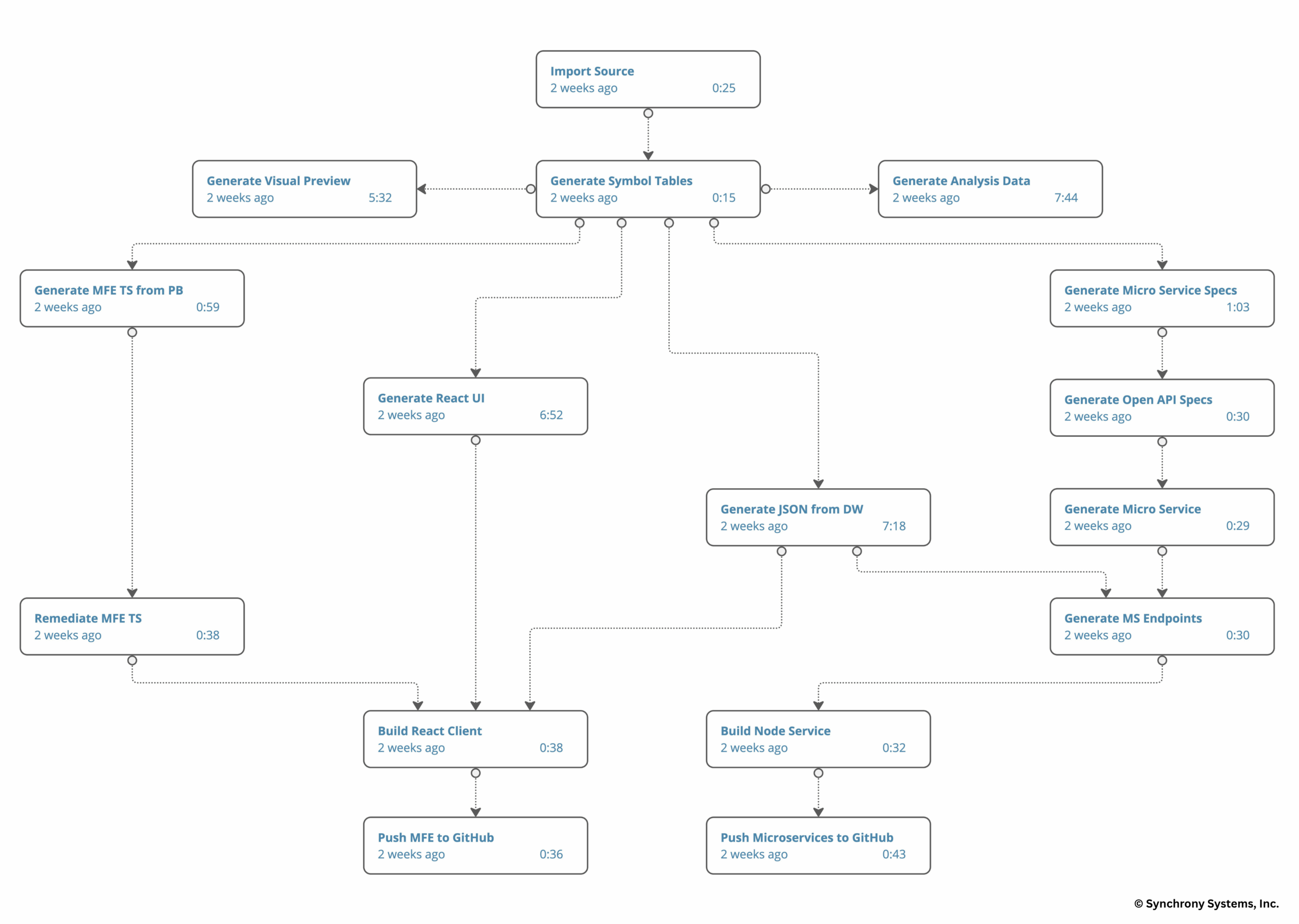
The analytics, metadata harness, and fine-tuned transformation knowledgebase are all assembled into custom-tailored workflows. When executed end-to-end, they produce the desired target architecture, consisting of hundreds and often thousands of structural (repositories) and microarchitectural (microservices and micro-frontends) components. Workflows can be invoked on demand by users or triggered by specific events, such as commits to newly generated code or updates to the metadata harness or KB. The holistic integration of code, tools, and processes ensures that the modernization project runs efficiently and at scale.
Continuous modernization
All units of execution inside a workflow, known as “autoflows,” can be thought of as pipelines of pipelines that enable continuous execution of the entire modernization lifecycle. The original monolithic application architecture is incrementally decomposed into independent, atomic, and stateless microservices and self-contained, reusable micro-frontends, ready for deployment into IT-specific cloud environments. The result is a transformed application with cloud-native architecture and modern UI/UX, preserving the original business logic and retaining 100% functional equivalence.
The illustration below shows an end-to-end customized MLP modernization workflow for monolithic client/server desktop applications. (click image to enlarge)
Why modernizing to microservices and micro-frontends improves speed and agility
Customers can continuously extract high-value functionality and features from their legacy applications at their own pace and timeframe, until everything is modernized.
Eliminating dead code and breaking the monolithic functionality into a web of independent microarchitecture components eliminates technical debt and fosters technological agility.
Legacy applications get fully transformed into modern target architectures, unlike the like-for-like, “as-is” transformations that preserve the legacy architectural semantics, making it hard to be agile and scalable on modern target platforms.
Microservices and micro-frontends are delivered incrementally as early milestones for customers to test and deploy into production piecemeal, rather than waiting for the entire application to be modernized.
Built for flexibility and adaptation, Synchrony’s modernization platform conforms to the customer’s specific target architecture, tooling, and requirements (e.g., RESTful, Kubernetes, cloud infrastructure, API gateway, widget libraries, data access harnesses, etc.) rather than dictating a standardized solution.
Real-world transformation: from monoliths to microarchitectures
Modernizing monolithic application architectures into microarchitectures enables companies to untangle decades of core domain functionality and extract it into highly reusable components. Synchrony has helped dozens of teams extract and transform critical domain functionality and UI from their legacy client/server or host/mainframe monolithic architectures into reusable target microarchitectures.
PowerBuilder
A PowerBuilder client/server application subset (after removing dead code and selecting the initial set of high-value components) with a traditional monolithic architecture:
Windows → 323
Data Windows → 1,908
Lines of Code (LOC) → 416K
Yields the following cloud microarchitecture:
Micro-frontends → 47
Microservices → 488
Repositories → 1,650
Would you like to learn how this could be applied to your in-house legacy applications?
Contact us to meet with our senior modernization specialists for an in-depth conversation and consultation about the target architecture options your in-house portfolio of legacy applications can take.
Microarchitecture in legacy application modernization FAQ
This FAQ addresses common questions about our technology, drawing from our expertise in modernization. Whether you’re a developer, architect, or CTO, these insights can help you understand how to revitalize your tech stack without disrupting operations.
What is microservices extraction in legacy application modernization?
Synchrony Systems’ Microservices Extraction technology is an automated tool that untangles complex legacy monoliths and converts them into a network of reusable microservices and microfrontends. It focuses on extracting subsets of business logic and user interfaces from languages such as PowerBuilder, EGL, and Smalltalk. This process creates independent, modular components that can be scaled, updated, and deployed individually in a cloud-native environment, such as TypeScript/React for frontends and TypeScript/Node.js for backends.
Why should enterprises modernize legacy applications into microarchitectures?
Legacy applications are, by definition, outdated. They are built on aging infrastructure and rely on a talent pool nearing retirement to keep running. These systems inherently limit scalability, agility, and innovation. By modernizing to microservices and micro-frontends, organizations can leverage the cloud’s on-demand compute power, enabling instant scaling to meet demand. This shift eliminates technical debt, fosters technological agility, and allows for incremental improvements without a full overhaul.
How does Synchrony Systems’ platform differ from traditional modernization approaches?
Traditional methods often involve manual, labor-intensive processes or “as-is” migrations that preserve outdated semantics, making it hard to achieve true agility. Synchrony’s platform uses end-to-end automation for an iterative, incremental, analysis-driven reengineering process. It avoids wholesale migrations by focusing on high-value business scenarios first, delivering functional equivalents in months rather than years. The result is a hyperscale cloud architecture tailored to your specific requirements, including RESTful services, Kubernetes, and custom API gateways.
What are microservices and micro-frontends, and why are they important?
Microservices are independent, modular backend components that handle specific business functions, allowing them to be scaled, updated, or reused without affecting the entire system. Microfrontends are user-facing UI components that can operate standalone or integrate seamlessly. Together, they create a flexible “web” of components that improve speed, reusability, and overall application performance.
What is Synchrony’s step-by-step process for microservices extraction?
The process is built into the Modernization Lifecycle Platform (MLP) and includes several key phases:
Analytics and application rationalization: An exhaustive analysis identifies high-value business scenarios and extracts self-contained components, revealing the application’s hidden “component vocabulary” across layers, subsystems, and functions.
Target architecture metadata harness: This generates metadata to drive modernization agents, incorporating client-specific requirements for data access, business objects, and reactive UI generation.
Fine-tuning the transformation engine: Subsets are broken down into granular micro-frontends and microservices. An interactive process refines UI/UX and service layer needs, creating custom refactoring rules and knowledgebases.
Orchestrating modernization workflows: Analytics, metadata, and transformation rules are assembled into custom workflows that produce structural repositories and microarchitectural components. These can be triggered on demand or by events like code commits.
Continuous modernization: Workflows run as “autoflows” (pipelines of pipelines), incrementally decomposing the monolith into atomic, stateless components ready for cloud deployment. The final output is a fully transformed application that preserves business logic and is 100% functionally equivalent.
If the modernization process is automated, how does it ensure safety?
Synchrony’s MLP emphasizes controlled automation to avoid disrupting stable functionality. It uses purpose-built technology for inspection, extraction, and transformation, ensuring critical functions are modernized, tested, and deployed safely and accurately. Automation handles the heavy lifting, but the process includes iterative fine-tuning and interactive elements to incorporate your team’s input throughout the modernization process, minimizing risks and maintaining operational continuity.
Can modernization be done incrementally without a big-bang approach?
Absolutely. MLP enables continuous extraction of high-value functionality at your own pace. Microservices and microfrontends are delivered as early milestones, enabling testing and piecemeal production deployment. This eliminates the need to wait for the entire application to be modernized, reducing downtime and accelerating timelines from years to months.
What benefits does this technology provide in terms of speed and agility?
Reduced technical debt: Breaks down monoliths into independent components, eliminating dead code and enabling easier updates.
Improved scalability and flexibility: Components conform to your target architecture (e.g., cloud infrastructure, widget libraries), fostering reuse across teams.
Faster time-to-market: Incremental deployments mean quicker value realization from high-priority features.
Improved UI/UX: Transforms outdated interfaces into modern, reactive frontends, enhancing user experience and ROI.
Full transformation: Unlike “as-is” methods, it delivers a truly cloud-native architecture for long-term agility.
Which legacy languages and systems does Synchrony support?
MLP is designed for a variety of legacy systems, including client/server desktop applications written in languages such as PowerBuilder, EGL, Smalltalk, VisualGen, COBOL, and more. It’s flexible and customizable, able to handle unique monolithic architectures across insurance, banking, and other industries.
How can I get started with Synchrony Systems’ Microservices Extraction technology?
Contact us to connect with our senior modernization specialists.
Company Saves Seven Years by Partnering with Synchrony Systems
Greenwich, CT (October 17, 2023) – Synchrony Systems, Inc., a technology pioneer for the management and execution of complex application modernizations, released an in-depth experience report on the modernization of six Smalltalk applications to Java. It describes the unique three-year collaboration between Synchrony and a German IT services provider for the financial sector.
“This project provided an opportunity to turn the modernization experience on its head,” said Synchrony Systems CEO Slavik Zorin. “We co-developed a true collaborative approach that allowed the company’s engineering team to retain control and have complete visibility into all phases of the modernization process while allowing the application development and modernization to run in parallel. Together, we shrunk an estimated 10-year rewrite of well over two million lines of code down to three years.”
“With Synchrony’s help, their advanced technology stack, and a strong team, we completed migrating all of our Smalltalk applications to the desired target Java architecture and were finally able to retire Smalltalk,” stated the company’s modernization project lead and veteran software developer. “We could not have done it without Synchrony’s technology, modernization expertise, and strong commitment to success.”
The Modernization Experience Report includes details such as:
company and project background
modernization initiative challenges, requirements, and vendor selection
Synchrony Smalltalk Migration Technology (SMT) and modernization platform overview
modernization readiness phase, including work breakdown, team collaboration, and project timeline
modernization implementation phase, including parallel track progress, halfway evaluation, functional testing, and code quality
final deliverable, conclusion, and takeaways
an appendix, including analysis of the codebase, pipelines, operations, deliveries, and more
This in-depth report is available for limited release to companies interested in understanding the details of modernizing large, legacy applications. Request your copy.
Greenwich, CT (December 12, 2022) – Synchrony Systems, Inc., the leader in complex application modernizations, announced today that it won the 2022 Digital Innovator Award from Intellyx, a research analyst firm dedicated to digital transformation.
According to their press release, Intellyx bestows this award upon vendors who are the most disruptive and innovative firms in their space, putting a “spotlight on vendors worth watching.”
“It’s an honor to be recognized for the second time by Intellyx for our application modernization technology,” said Slavik Zorin, CEO of Synchrony Systems. “Intellyx recognizes the innovation and positive impact that Synchrony is making in modernizing how modernizations are done. We are thankful for our conversations with the Intellyx team and the insights we gain from those interactions.”
Synchrony is the developer of MLP, a platform-as-a-service that helps customers gain control over the management and execution of complex application modernizations, thus reducing company risks, improving team communication and collaboration, and accelerating the entire modernization initiative. MLP orchestrates automated processes end-to-end, tracks all modernization activities, and provides complete transparency of all modernization activities to stakeholders.
Application owners use MLP to accelerate their adoption of cloud, mobile, and new web technologies by fast-tracking and de-risking complex modernizations. Migration tool vendors grow their business by making their migration tools and services consumable by customers and system integrators through the platform. System Integrators increase their profit margins using MLP to orchestrate migration tools from multiple vendors and leverage MLP’s systematic, repeatable, and reliable processes to manage complex application modernization.
About Synchrony Systems, Inc.
Customers gain control over the management and execution of complex application modernizations using Synchrony Systems’ Platform-as-a-Service–MLP. MLP is an end-to-end solution that orchestrates automated migration and modernization processes, tracks all modernization activities, and provides complete transparency of all modernization activities to stakeholders. This results in reduced company risks, improved team communication and collaboration, and accelerated modernization initiatives. MLP was named a 2018 SIIA CODiE Awards finalist for Best DevOps Tool and a 2019 SIIA CODiE Award Finalist for Best Emerging Technology. Synchrony Systems has been named a Digital Innovator from Intellyx in 2021 and again in 2022.
Sessions include static-type inferencing Smalltalk for application code analysis and decoupling Smalltalk applications for GUI migration to popular web frameworks.
Greenwich, CT (May 16, 2022) – Synchrony Systems, Inc., a leading technology provider for managing legacy application migrations and modernizations, announced today that Slavik Zorin is speaking at Camp Smalltalk Supreme, a yearly conference focused on the Smalltalk programming language. The event is June 10-12, 2022, in Toronto, Canada, celebrating the language’s 50th birthday.
“Smalltalk’s versatility, simplicity, and elegance allowed developers to build sophisticated applications to manage and run business-critical processes,” said Slavik Zorin, CEO of Synchrony Systems. “Yet today’s advances in modern web technologies and industry’s demands for more interactive digital experiences have put Smalltalk applications under pressure. I’m looking forward to showcasing how our technology can preserve the value of Smalltalk applications while enabling interoperability with cloud and mobile application development best practices.”
On Friday, June 10, Zorin will present “Static-Type Inferencing Smalltalk for Application Code Analysis,” demonstrating a static type system in Smalltalk along with Synchrony’s type inferencing technology within their Smalltalk Modernization Technology (SMT).
On Sunday, June 12, Zorin will present “De-coupling Smalltalk Applications for GUI Migration to Popular Web Frameworks,” featuring case studies of commercial Smalltalk applications that underwent a Smalltalk GUI migration while preserving the back-end functionality and design.
Camp Smalltalk Supreme will also feature keynote sessions from Adele Goldberg and Dan Ingalls, two of the original Smalltalk creators at Xerox PARC.
For more information about the conference, visit the conference website at Camp Smalltalk Supreme.
About Synchrony Systems, Inc.
We help customers manage and accelerate application migration, modernization, and transformation through automation technology, assisted workflows, and seamless integration into CI/CD processes, enabling an iterative, continuous modernization approach with no halts in application development. Our Modernization Lifecycle Platform (MLP) is a scalable, cloud-based platform for managing and executing end-to-end migrations and modernizations of legacy IT applications to modern software architectures and platforms. MLP was named a 2021 Digital Innovator from Intellyx, 2019 SIIA CODiE Award Finalist for Best Emerging Technology, and 2018 SIIA CODiE Awards finalist for Best DevOps Tool.
Organizations can upgrade to the latest version of EGL technologies or move to alternative platforms with MLP
Greenwich, CT (September 7, 2021) – Synchrony Systems, Inc., a leader in legacy application modernizations, announced today the release of a 4GL EGL migration solution as part of its Modernization Lifecycle Platform (MLP) offering.
“News such as no longer supporting JSF and Jasper reports and IBM moving EGL to HCL puts a question mark in the platform’s future,” said Oleg Arsky, chief product officer at Synchrony Systems. “Pair that with the desire to move applications to Web SPA with Angular/React/Vue, it made sense for us to invest in building a complete EGL migration solution to help our customers approach EGL modernizations in the best way suited for their future-state and business needs.”
Using Synchrony’s automation technology within MLP, applications built in the legacy 4GL EGL platform can be migrated wholesale or incrementally to the target architecture, programming language, and platform of the organization’s choice. This includes upgrading to the latest version of EGL technologies or moving to alternative platforms. The new capabilities for Synchrony’s EGL Modernization solution include:
Report Framework Upgrade — Jasper Reports to BIRT Reports
Web Upgrade — EGL/JSF to EGL/RUI
Web Facelift — EGL/TUI to EGL/RUI
Platform Transformation — EGL to Java/C# on the backend and JavaScript on the frontend
“Companies who work with Synchrony get more than best-of-breed migration tools,” Slavik Zorin, CEO of Synchrony Systems. “Our strength and focus are on migrating large and often complex bodies of legacy code that run critical aspects of the business to modern technology platforms and release them into production without any operational disruptions or development freezes.”
“The real value for organizations is integrating our EGL migration tools inside the entire modernization lifecycle to achieve the kind of an assembly line that is needed to make a complex EGL modernization manageable in terms of process and predictable in terms of time and cost,” added Arsky. “That why we are excited to offer a complete EGL migration solution integrated with MLP.”
We help enterprises transform legacy in-house applications to modern technologies while preserving business-critical functionality. Synchrony’s Modernization Lifecycle Platform (MLP) is a scalable, cloud-based platform for managing and executing end-to-end migrations and modernizations of legacy IT applications to modern software architectures and platforms. It enables automated code conversion, transformation, remediation, and upgrades of millions of lines of code in minutes, ensuring consistent, reliable, and repeatable results. MLP was named a 2021 Digital Innovator from Intellyx, 2019 SIIA CODiE Award Finalist for Best Emerging Technology, and 2018 SIIA CODiE Awards finalist for Best DevOps Tool.
Greenwich, CT (June 16, 2021) – Synchrony Systems, Inc., a leader in legacy application modernizations, today announced the selection to the inaugural class of the 2021 Digital Innovator Award from Intellyx, the first and only analyst firm dedicated to digital transformation.
“At Intellyx, we get dozens of PR pitches each day from a wide range of vendors,” said Jason Bloomberg, President of Intellyx. “We will only set up briefings with the most disruptive and innovative firms in their space. That’s why it made sense for us to call out the companies that made the cut.”
“It’s an honor to be recognized by Intellyx for our innovation in the IT modernization space,” said Slavik Zorin, CEO of Synchrony Systems. “We’ve spent 25+ years modernizing legacy applications, building and using our proprietary migration tools. When we integrated the source code migration tools into an entire modernization process, our clients saw considerable gains in code quality, efficiency, and affordability.”
Synchrony’s Modernization Lifecycle Platform (MLP) supports the entire modernization lifecycle: from analysis and planning to transformation and remediation, from build and deployment to testing and production release. It applies the same systematic, iterative, and automation-driven modernization processes to produce production-ready, modernized applications.
It is compatible with any translation libraries or rule-sets, no matter the source or target programming language, platform, or framework. By automating the complete modernization process migration tools can be integrated into as part of an entire modernization assembly line.
We help enterprises transform legacy in-house applications to modern technologies while preserving business-critical functionality. Synchrony’s Modernization Lifecycle Platform (MLP) is a scalable, cloud-based platform for managing and executing end-to-end migrations and modernizations of legacy IT applications to modern software architectures and platforms. It enables automated code conversion, transformation, remediation, and upgrades of millions of lines of code in minutes, ensuring consistent, reliable, and repeatable results. MLP was named a 2019 SIIA CODiE Award Finalist for Best Emerging Technology and 2018 SIIA CODiE Awards finalist for Best DevOps Tool.
Many companies have accelerated their modernization plans in order to meet the new demands of conducting business in a digital-only or primarily digital environment. A recent survey released by Maria DB in partnership with Propeller Insights found that 40% of businesses are accelerating cloud adoption plans, and business leaders expect a long-term benefit from the technology agility and new ways of working.
“Modernizing certain functionality is always more urgent than the rest. True, it will eventually be important to modernize most or all of the legacy application functionality, but today the focus is on what’s most important,” Bloomberg continues.
No longer a pipe dream: automated microservices extraction from the monolith
The historical criticism of a microservices approach to modernizing monolithic applications has been driven by the human ability to understand (or not) the architecture and programming of the monolith itself. If the intellectual capital that developed the application left the company and/or the documentation was weak, then trying to develop properly architected microservices to replace functionality was wrought with issues. When trying to wrap a monolith with microservices, the defects of the legacy architecture translated through to the microservices layer. A microservices approach to replacing the monolith was a mere pipe dream.
Thanks to Synchrony Systems’ innovative engineering and deep domain expertise in the migration automation field, new modernization technology is available that can identify and extract full execution paths of critical business functions and automatically migrate them to the desired target platform as microservices. These microservices have a modern architecture which makes them suitable to be deployed immediately to the cloud and to platforms such as Kubernetes. The microservices extraction technology preserves 100% of the functional equivalence of the legacy functionality, ensuring existing operational processes remain intact postmodernization.
Along with the narrow, vertical fully executable functionality, the microservices extraction technology can also accurately identify candidate “dead” code that can be removed altogether. This reduces technical debt and total cost of ownership by deprecating functionality that no longer matters, and therefore, should not be modernized.
No longer is it necessary to modernize the entire application. Automatic microservices extraction technology gives businesses the ability to rapidly modernize only the code that matters and addresses urgent business needs today.
The benefits of microservices can finally be achieved during application modernization
This microservices extraction technology makes it possible to modernize monolithic legacy applications and realize the long-sought benefits of microservices architecture. These benefits include:
Speed—migrate key business functions to the target platform in months, not years.
Agility—deliver incremental, modern microservices aligned with your DevOps practices.
Flexibility—transform business-critical functionality driven by business priorities.
Scalability—deploy truly scalable microservices and without the bottleneck of the legacy monolith.
Savings—reduce technical debt, the total cost of ownership and the upfront spend on the modernization.
Companies will also benefit from the new services model for modernizations, Modernization-as-a-Service (MaaS), that microservices extraction capabilities enable. Modernizations now can be planned, budgeted, and executed incrementally over time instead of an all-or-nothing approach.