Your privacy matters. We’ve updated our policies effective March 24, 2026.

LEARN MORE

Can continuous modernization prevent tech debt?

When was the last time your development team proposed a major software modernization project?

If it feels like you’re always either planning one, executing one, or recovering from one, the true problem may lie in your approach to modernization.

Most organizations discover their technical debt only after it’s metastasized: when security vulnerabilities force urgent patches, when critical dependencies reach end-of-life, or when talented developers refuse to work on outdated tech stacks. By then, what started as deferred maintenance has ballooned into a protracted six-figure overhaul.

Is adopting a Continuous Modernization (CM) approach the only surefire way to prevent an avalanche of technical debt?

What is Continuous Modernization?

Continuous Modernization is a proactive software maintenance strategy that systematically updates your proprietary applications, APIs, and internal software components as part of your regular development workflow. Rather than allowing dependencies to age until they require massive overhaul projects, CM integrates incremental updates directly into your existing DevOps processes.

Continuous Modernization is a natural extension of CI/CD practices. Just as Continuous Integration and Continuous Deployment automate testing and releases, Continuous Modernization automates the process of keeping your technology stack current with the latest versions of databases, frameworks, SDKs, and third-party libraries.

The hidden cost of deferred updates

Here’s a scenario that plays out repeatedly across enterprise IT departments: an application launches successfully with modern dependencies. Development teams move on to new projects. Months pass, then years. Meanwhile, that once-current application quietly falls behind. What begins as a minor version lag – perhaps staying on an older database driver or postponing a framework update – compounds over time. Before long, your “stable” application is running on unsupported software versions with known security vulnerabilities and compatibility issues.

When the gap becomes too wide to ignore, you’re forced to launch a major modernization initiative. Development resources that should be building revenue-generating features instead get redirected to upgrade work that delivers no visible value to stakeholders. The maintenance burden that was once manageable has transformed into an expensive, high-risk project.

McKinsey finds that technical debt accounts for roughly 40% of IT balance sheets – and adds 10-20% to the costs of any given IT project.

How Continuous Modernization prevents tech debt accumulation

Continuous Modernization flips this reactive approach on its head. Instead of waiting until upgrades become emergencies, organizations establish automated pipelines that handle updates incrementally and continuously.

The process works by running parallel upgrade tracks alongside your standard development workflow. When new versions of dependencies become available, they’re automatically tested against your codebase in isolated environments. Issues are identified early when they’re still small and manageable, rather than discovering compatibility problems years later when dozens of dependencies demand simultaneous updates.

This approach delivers several key advantages:

Smaller, manageable changes: Updating one or two dependencies at a time is significantly less risky than upgrading an entire stack simultaneously. Each change can be thoroughly tested and validated before moving forward.

Reduced upgrade complexity: When applications stay relatively current, upgrade paths remain straightforward. The documentation and community support for recent version transitions is robust, and breaking changes are well documented.

Lower resource requirements: Small, regular updates require far less time and effort than infrequent, massive overhauls that grind productivity to a halt. Teams can handle modernization work within normal cycles rather than requiring dedicated projects.

Improved security posture: Security patches and vulnerability fixes get applied promptly rather than languishing in a backlog of deferred maintenance work.

Better developer experience: Engineers spend less time wrestling with legacy technology and more time working with modern tools and patterns.
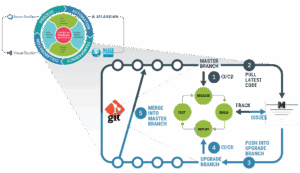
A flow chart showing the Continuous Modernization process


Implementing Continuous Modernization in your DevOps pipeline

Successful adoption of Continuous Modernization requires proactive, systematic processes and the right tooling. Here’s how mature CM practices typically integrate with existing workflows:

Automated upgrade branches

Continuous Modernization pipelines operate in dedicated upgrade branches, isolated from your main development codebase. This isolation is critical: it allows upgrade processes to run without any risk to production code or active development work.

When new software versions become available, automated systems pull your latest source code into upgrade branches and apply the necessary updates. This happens continuously in the background while your team continues normal development activities.

Integration with existing CI/CD testing

After upgrades are applied in the isolated branch, your standard regression test suites run automatically. This leverages all the testing infrastructure you’ve already built – unit tests, integration tests, end-to-end tests, and performance benchmarks.

If tests pass, the upgrade branch can be merged back into your main development line. If tests fail, the issues are logged, tracked, and remediated before any code reaches production.

Customizable upgrade rules

Every application and organization has unique requirements. An effective Continuous Modernization platform allows teams to customize the upgrade process. This usually means defining which dependencies to prioritize, establishing version constraints, specifying breaking change policies, and setting approval workflows.

These rules ensure the modernization process aligns with your organization’s risk tolerance and change management practices.

The business case for Continuous Modernization

While Continuous Modernization is fundamentally a technical practice, it delivers measurable business value:

Predictable maintenance costs: Regular, small updates cost less and are more predictable than emergency modernization projects. Finance teams appreciate the ability to budget for steady-state maintenance rather than lumpy capital investments.

Faster time-to-market: In one study, Stripe found that developers spend an average of 13.5 hours per week addressing technical debt, translating to 33% of their time spent on maintenance rather than shipping new features. When technical debt is kept under control, development teams spend more time shipping features and less time fighting antiquated tooling.

Reduced risk: Large-scale modernization projects are inherently risky: they touch many parts of the system simultaneously and often require extended testing periods. Continuous Modernization distributes that risk across many smaller, less risky changes.

Extended application lifespan: Custom applications represent significant investments. Continuous Modernization helps organizations maximize the return on those investments by keeping systems viable longer without requiring costly rewrites.

Getting started with Continuous Modernization

If your organization is dealing with aging custom applications, mounting technical debt, or expensive modernization cycles, it’s time to consider a Continuous Modernization approach.

Start by identifying applications that are critical to operations but beginning to show their age. Look for systems where dependencies are more than a few versions behind, security patches are piling up, or it’s becoming difficult to find engineers willing to work on outdated tech stacks.

These applications are ideal candidates for implementing Continuous Modernization pipelines. With the right platform and processes in place, you can transform them from growing liabilities into well-maintained, modern assets.

The shift to Continuous Modernization doesn’t happen overnight, but the investment pays dividends. Organizations that adopt CM spend less time in crisis mode and more time delivering value. They maintain more secure, stable, and sustainable application portfolios. And they position themselves to take advantage of new technologies and capabilities as they emerge, rather than being held back by ever-snowballing legacy technical debt.

Continuous Modernization FAQ

What types of applications benefit most from Continuous Modernization?

Continuous Modernization is most valuable for business-critical custom applications that you plan to maintain long-term. This includes internal enterprise applications, customer-facing APIs, and proprietary platforms that are actively used but not under constant feature development. 

How is Continuous Modernization different from regular software maintenance?

Traditional software maintenance is reactive: teams address issues as they arise or tackle updates when they become urgent. Continuous Modernization is proactive and systematic, establishing automated processes that continuously evaluate and apply updates before they become problems. It’s the difference between regularly rotating your tires and changing your oil versus waiting until your car breaks down.

Does Continuous Modernization work with legacy applications?

Yes, although implementing Continuous Modernization for legacy applications may require some initial setup work. The first step typically involves getting the application into source control (if it isn’t already), establishing basic automated testing, and documenting dependencies. Once these foundations are in place, Continuous Modernization processes can be applied even to older systems. In fact, legacy applications stand to benefit the most from CM adoption since they typically carry the most technical debt.

How much does Continuous Modernization cost compared to periodic modernization projects?

While Continuous Modernization requires ongoing investment in tooling and processes, organizations typically find that regular, incremental updates cost significantly less than periodic, large-scale modernization initiatives – both in direct expenses and in the opportunity cost of stretched resources and delayed features. Additionally, costs become more predictable and can be budgeted as operational expenses rather than unpredictable capital projects.

Will Continuous Modernization break our applications?

When properly implemented, Continuous Modernization actually reduces the risk of breakage. In Synchrony Systems’ Modernization Lifecycle Platform (MLP), updates happen in isolated branches and go through full regression testing before merging. Issues are caught early when they’re easier to fix. Compare this to letting dependencies age for years and then attempting a massive update – the latter scenario is far more likely to cause unexpected problems.

How long does Continuous Modernization take?

By proactively performing regular, incremental updates, organizations avoid the need for painful, expensive “big bang” modernization projects. With Continuous Modernization, modernization cycles usually occur four times per year and take approximately 2-4 weeks. This includes automated dependency updates, code transformations, and full regression testing.

Can Continuous Modernization handle breaking changes in dependencies?

Yes. Sophisticated Continuous Modernization platforms can apply transformation rules to adapt code when dependencies introduce breaking changes. For complex breaking changes that require architectural decisions, the process pauses for human review and input. Teams can also establish policies around accepting major version updates versus sticking with minor and patch releases.

What happens when an update fails testing?

When an automated update fails regression testing, the issue is logged and tracked just like any other bug. The upgrade stays in the isolated branch and your main codebase is unaffected. Teams can investigate the failure, adjust upgrade rules if needed, or decide to skip that particular version and wait for the next release. This failure-and-remediation cycle happens safely, away from production code.

Do we need special tools to implement Continuous Modernization?

While you can cobble together Continuous Modernization processes using standard CI/CD tools and custom scripting, specialized platforms designed for Continuous Modernization –  like Synchrony’s Modernization Lifecycle Platform – make the process significantly more efficient and reliable. These platforms provide pre-built upgrade rules, customizable workflows, and integration with existing DevOps toolchains.

How does Continuous Modernization fit with our existing CI/CD pipeline?

Continuous Modernization runs parallel to your standard CI/CD pipeline rather than replacing it. Upgrade branches feed into your existing testing and deployment infrastructure. Most organizations find that Continuous Modernization enhances their DevOps practices rather than conflicting with them, adding another dimension of automation and reliability to their software delivery process.
 

Modernization 2.0: legacy to microservices transformation

Migrating to a cloud-native architecture is one of the most powerful ways to improve business agility. The modern cloud delivers virtually unlimited, on-demand compute power, enabling platforms to scale instantly to meet demand. It’s no surprise that 94% of companies worldwide already use cloud computing in some capacity, and 97% of IT leaders plan to expand their cloud systems in the next few years (source).

Yet many enterprises remain constrained by legacy, monolithic applications. These systems hold critical business logic but act as bottlenecks to digital transformation. Insurance applications, banking platforms, and other unique software systems have been built over the course of decades in languages like PowerBuilder, EGL, and Smalltalk, among others. These types of systems require a flexible, customizable, scalable, and agile modernization process that can be easily jump-started to deliver incremental results.

But how can you untangle a complex monolith without disrupting stable functionality and critical business operations? After all, carving out pieces of a monolithic system is a manual, labor-intensive, and time-consuming process. To move forward in today’s climate, organizations need a controlled, automated approach that ensures critical functions can be safely modernized, tested, and deployed in a timely manner.

Architectural breakthrough: microservices + micro-frontends

The optimal solution lies in a more modern architecture built on microservices and micro-frontends. Microservices are a web of independent, modular components that can be scaled, updated, and reused individually. Micro-frontends are user-facing components that can operate either independently or as a cohesive whole.

Modernizing the front end is just as important as modernizing straight business logic. Forrester Research finds that companies investing in UI/UX design see a $100 return for every $1 spent. Outdated interfaces remain one of the most immediate barriers for legacy applications, and micro-frontends directly address this need.

Synchrony Systems’ Modernization Lifecycle Platform (MLP) comes equipped with end-to-end automation for extracting “subsets” of business logic and user interface, and transforming them into reusable components for microservices and micro-frontends. This enables organizations to modernize their monolithic legacy applications into a hyperscale cloud architecture. By focusing on the high-value business functionality first, Synchrony helps accelerate modernization timelines so enterprises can deploy and test migrated functions and complete features continuously in months instead of years.

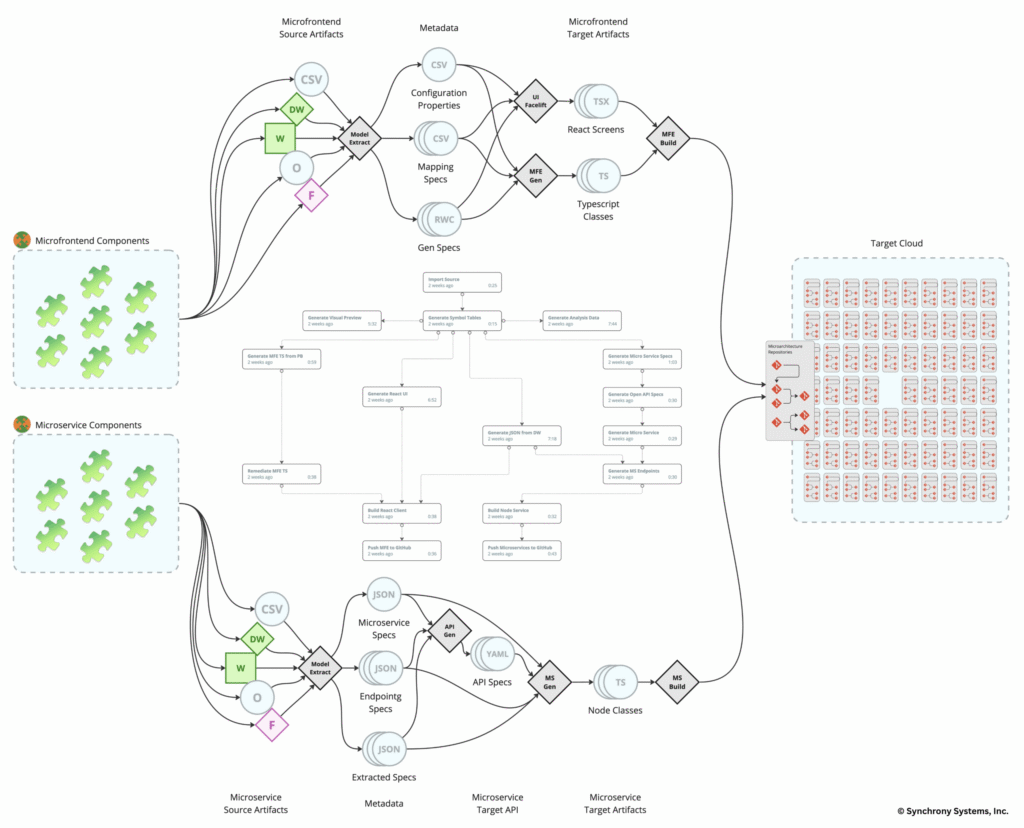
The illustration below shows how MLP orchestrates a modernization solution from a PowerBuilder monolithic architecture to a target microarchitecture with a TypedScript/React frontend and a TypedScript/Node.js backend as the target programming languages. (click image to enlarge)

Illustration of how MLP orchestrates a modernization solution from a PowerBuilder monolithic architecture to a target microarchitecture with a TypedScript/React frontend and a TypedScript/Node.js backend as the target programming languages

How monoliths become microservices and micro-frontends

Rather than migrating monolithic legacy codebases wholesale or “as-is,” Synchrony offers a technology-assisted reengineering process and workflow that is iterative, incremental, and analysis-driven.

Analytics and application rationalization

First, an exhaustive analytical inspection of your legacy application is performed using modernization technology purpose-built to identify and extract high-value business scenarios and their execution paths. This analysis produces targeted, self-contained components (a.k.a. “subsets”) for every identified business scenario embedded inside each monolithic codebase. This extraction acts as the foundation for exposing the hidden application “component vocabulary” in terms of application layers, subsystems, and business functions. Powered by the newly exposed knowledge of your system, the extracted component architecture becomes the stepping stone that drives continuous and incremental modernization toward the target cloud component architecture.

Target architecture metadata harness

The new application component architecture is the first representation and visualization of the formerly monolithic application’s structural decomposition into a granular micro-frontend/microservice layer. The component model is used for generating the required metadata that drives the execution of every modernization service agent, such as: a) data access generation; b) business objects generation; and c) UI facelift generation into a reactive frontend. This is where client-specific requirements are also incorporated to align with IT’s model target architecture.

Fine-tuning the transformation engine

The breakdown of subsets further undergoes an iterative process that identifies micro-frontends, microservices, and common layers used by both. An interactive process identifies UI/UX requirements and service layer requirements (typically slated for data access) to produce highly granular, reusable, and scalable components on the target. The process results in custom-tailored code refactoring, transformation, and generation, rules knowledgebases (KBs) for target business services, and facelift rules for a modern, reactive target web frontend.

Orchestrating modernization workflows

The analytics, metadata harness, and fine-tuned transformation knowledgebase are all assembled into custom-tailored workflows. When executed end-to-end, they produce the desired target architecture, consisting of hundreds and often thousands of structural (repositories) and microarchitectural (microservices and micro-frontends) components. Workflows can be invoked on demand by users or triggered by specific events, such as commits to newly generated code or updates to the metadata harness or KB. The holistic integration of code, tools, and processes ensures that the modernization project runs efficiently and at scale.

Continuous modernization

All units of execution inside a workflow, known as “autoflows,” can be thought of as pipelines of pipelines that enable continuous execution of the entire modernization lifecycle. The original monolithic application architecture is incrementally decomposed into independent, atomic, and stateless microservices and self-contained, reusable micro-frontends, ready for deployment into IT-specific cloud environments. The result is a transformed application with cloud-native architecture and modern UI/UX, preserving the original business logic and retaining 100% functional equivalence.

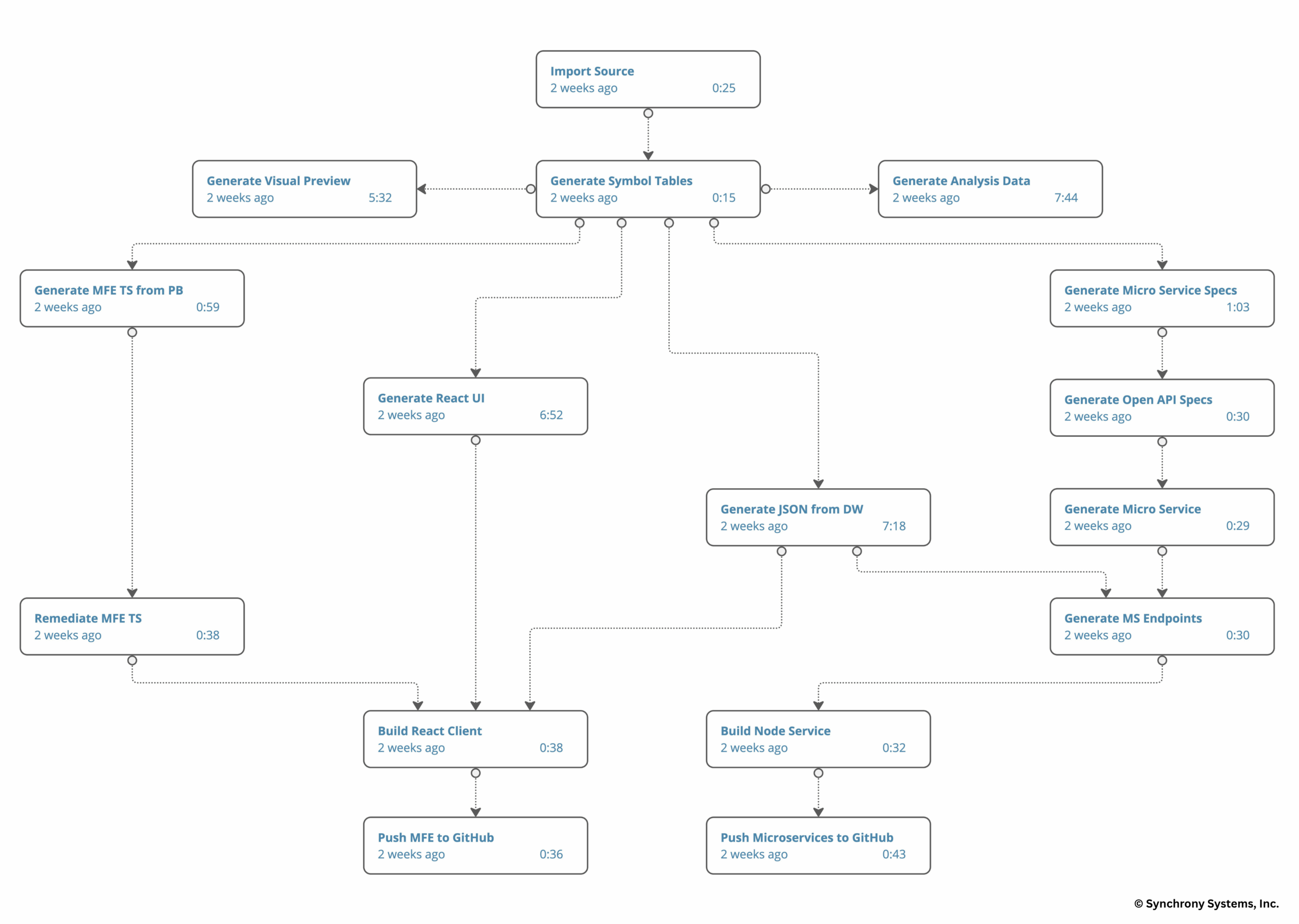
The illustration below shows an end-to-end customized MLP modernization workflow for monolithic client/server desktop applications. (click image to enlarge)

Illustration shows an end-to-end customized MLP modernization workflow for monolithic client/server desktop applications

Why modernizing to microservices and micro-frontends improves speed and agility

  • Customers can continuously extract high-value functionality and features from their legacy applications at their own pace and timeframe, until everything is modernized.
  • Eliminating dead code and breaking the monolithic functionality into a web of independent microarchitecture components eliminates technical debt and fosters technological agility.
  • Legacy applications get fully transformed into modern target architectures, unlike the like-for-like, “as-is” transformations that preserve the legacy architectural semantics, making it hard to be agile and scalable on modern target platforms.
  • Microservices and micro-frontends are delivered incrementally as early milestones for customers to test and deploy into production piecemeal, rather than waiting for the entire application to be modernized.
  • Built for flexibility and adaptation, Synchrony’s modernization platform conforms to the customer’s specific target architecture, tooling, and requirements (e.g., RESTful, Kubernetes, cloud infrastructure, API gateway, widget libraries, data access harnesses, etc.) rather than dictating a standardized solution.

Real-world transformation: from monoliths to microarchitectures

Modernizing monolithic application architectures into microarchitectures enables companies to untangle decades of core domain functionality and extract it into highly reusable components. Synchrony has helped dozens of teams extract and transform critical domain functionality and UI from their legacy client/server or host/mainframe monolithic architectures into reusable target microarchitectures.

PowerBuilder

A PowerBuilder client/server application subset (after removing dead code and selecting the initial set of high-value components) with a traditional monolithic architecture:

  • Windows → 323
  • Data Windows → 1,908
  • Lines of Code (LOC) → 416K

Yields the following cloud microarchitecture:

  • Micro-frontends → 47
  • Microservices → 488
  • Repositories → 1,650

Would you like to learn how this could be applied to your in-house legacy applications?

Contact us to meet with our senior modernization specialists for an in-depth conversation and consultation about the target architecture options your in-house portfolio of legacy applications can take.


Microarchitecture in legacy application modernization FAQ

This FAQ addresses common questions about our technology, drawing from our expertise in modernization. Whether you’re a developer, architect, or CTO, these insights can help you understand how to revitalize your tech stack without disrupting operations.

What is microservices extraction in legacy application modernization?

Synchrony Systems’ Microservices Extraction technology is an automated tool that untangles complex legacy monoliths and converts them into a network of reusable microservices and microfrontends. It focuses on extracting subsets of business logic and user interfaces from languages such as PowerBuilder, EGL, and Smalltalk. This process creates independent, modular components that can be scaled, updated, and deployed individually in a cloud-native environment, such as TypeScript/React for frontends and TypeScript/Node.js for backends.

Why should enterprises modernize legacy applications into microarchitectures?

Legacy applications are, by definition, outdated. They are built on aging infrastructure and rely on a talent pool nearing retirement to keep running. These systems inherently limit scalability, agility, and innovation. By modernizing to microservices and micro-frontends, organizations can leverage the cloud’s on-demand compute power, enabling instant scaling to meet demand. This shift eliminates technical debt, fosters technological agility, and allows for incremental improvements without a full overhaul.

How does Synchrony Systems’ platform differ from traditional modernization approaches?

Traditional methods often involve manual, labor-intensive processes or “as-is” migrations that preserve outdated semantics, making it hard to achieve true agility. Synchrony’s platform uses end-to-end automation for an iterative, incremental, analysis-driven reengineering process. It avoids wholesale migrations by focusing on high-value business scenarios first, delivering functional equivalents in months rather than years. The result is a hyperscale cloud architecture tailored to your specific requirements, including RESTful services, Kubernetes, and custom API gateways.

What are microservices and micro-frontends, and why are they important?

Microservices are independent, modular backend components that handle specific business functions, allowing them to be scaled, updated, or reused without affecting the entire system. Microfrontends are user-facing UI components that can operate standalone or integrate seamlessly. Together, they create a flexible “web” of components that improve speed, reusability, and overall application performance.

What is Synchrony’s step-by-step process for microservices extraction?

The process is built into the Modernization Lifecycle Platform (MLP) and includes several key phases:

  • Analytics and application rationalization: An exhaustive analysis identifies high-value business scenarios and extracts self-contained components, revealing the application’s hidden “component vocabulary” across layers, subsystems, and functions.
  • Target architecture metadata harness: This generates metadata to drive modernization agents, incorporating client-specific requirements for data access, business objects, and reactive UI generation.
  • Fine-tuning the transformation engine: Subsets are broken down into granular micro-frontends and microservices. An interactive process refines UI/UX and service layer needs, creating custom refactoring rules and knowledgebases.
  • Orchestrating modernization workflows: Analytics, metadata, and transformation rules are assembled into custom workflows that produce structural repositories and microarchitectural components. These can be triggered on demand or by events like code commits.
  • Continuous modernization: Workflows run as “autoflows” (pipelines of pipelines), incrementally decomposing the monolith into atomic, stateless components ready for cloud deployment. The final output is a fully transformed application that preserves business logic and is 100% functionally equivalent.

If the modernization process is automated, how does it ensure safety?

Synchrony’s MLP emphasizes controlled automation to avoid disrupting stable functionality. It uses purpose-built technology for inspection, extraction, and transformation, ensuring critical functions are modernized, tested, and deployed safely and accurately. Automation handles the heavy lifting, but the process includes iterative fine-tuning and interactive elements to incorporate your team’s input throughout the modernization process, minimizing risks and maintaining operational continuity.

Can modernization be done incrementally without a big-bang approach?

Absolutely. MLP enables continuous extraction of high-value functionality at your own pace. Microservices and microfrontends are delivered as early milestones, enabling testing and piecemeal production deployment. This eliminates the need to wait for the entire application to be modernized, reducing downtime and accelerating timelines from years to months.

What benefits does this technology provide in terms of speed and agility?

  • Reduced technical debt: Breaks down monoliths into independent components, eliminating dead code and enabling easier updates.
  • Improved scalability and flexibility: Components conform to your target architecture (e.g., cloud infrastructure, widget libraries), fostering reuse across teams.
  • Faster time-to-market: Incremental deployments mean quicker value realization from high-priority features.
  • Improved UI/UX: Transforms outdated interfaces into modern, reactive frontends, enhancing user experience and ROI.
  • Full transformation: Unlike “as-is” methods, it delivers a truly cloud-native architecture for long-term agility.

Which legacy languages and systems does Synchrony support?

MLP is designed for a variety of legacy systems, including client/server desktop applications written in languages such as PowerBuilder, EGL, Smalltalk, VisualGen, COBOL, and more. It’s flexible and customizable, able to handle unique monolithic architectures across insurance, banking, and other industries.

How can I get started with Synchrony Systems’ Microservices Extraction technology?

Contact us to connect with our senior modernization specialists.


Your IT budget is 80% maintenance — here’s how to optimize it

Most enterprise IT organizations allocate 60-80% of their IT budgets to maintaining legacy systems rather than innovating powerful new capabilities. This isn’t sustainable in a market where hyper-scalable, cloud-native technologies and architectures, coupled with the meteoric rise of generative AI, drive competitive advantages.

The root cause? Traditional application modernization approaches create a boom-bust cycle where small technology gaps snowball into massive, expensive system overhauls that consume entire teams for years.

Why IT budget optimization matters now

With pressure to innovate, reduce costs, and adopt emerging technologies, IT budget optimization has become a board-level priority. Every dollar spent keeping outdated systems alive is a dollar not invested in growth.

Organizations that modernize strategically can reduce IT maintenance costs, free up resources for innovation, and keep systems current without costly disruption.

The continuous modernization advantage

Leading organizations are adopting Continuous Modernization (CM) as an approach to IT budget optimization, treating technology updates as an ongoing process rather than periodic disruptions. This approach complements existing CI/CD practices by systematically applying incremental updates to applications, APIs, and software components before small gaps become major problems.

Synchrony Systems helps enterprises make this shift through its Modernization Lifecycle Platform (MLP), a system designed to keep legacy and modern technologies evolving side-by-side.

The methodology works by establishing parallel upgrade pipelines that test new versions of dependencies, frameworks, and platforms in isolated environments. Instead of allowing technical debt to accumulate until it necessitates a major overhaul, teams maintain currency through regular, small updates integrated into standard development workflows.

Deloitte’s 2025 Tech Trends report identifies AI as the common thread of nearly every enterprise technology trend. Organizations that use continuous modernization can systematically incorporate emerging technologies without the architectural disruption typically associated with traditional approaches.

Implementation patterns that lower maintenance costs

Successful continuous modernization implementations share common characteristics:

  • Automated Impact Analysis: Before any update, automated tools analyze potential effects on existing code, dependencies, and system integration points. This preview capability allows teams to understand implications before committing to changes.
  • Isolated Testing Environments: Updates occur in dedicated branches or environments that simulate production but pose no actual risk to operational systems. Teams can experiment, test, and iterate without affecting business operations.
  • Integration with Existing Workflows: Rather than requiring new processes, effective CM approaches integrate directly with established CI/CD pipelines. Development teams continue using familiar tools and workflows while gaining systematic modernization capabilities.
  • Customizable Update Rules: Different applications and business contexts require different modernization approaches. Leading platforms provide configurable rules that allow teams to tailor the modernization process to their specific requirements and risk tolerances.
  • Transparent Tracking and Rollback: Users have complete visibility into what changed, when, and why, along with reliable rollback capabilities when updates don’t perform as expected.

Industry adoption patterns

Enterprise technology adoption follows predictable stages: technical innovation, experimentation, initial pilots, business scaling, and full deployment. Organizations implementing continuous modernization are typically in the pilot or early scaling phases, gaining a competitive advantage while others struggle with traditional approaches.

Urgency is growing. Application modernization has become pivotal for businesses striving to enhance efficiency, agility, and competitiveness. Enterprise applications must modernize to replace existing procedures with more practical, adaptable, and scalable solutions.

Companies without systematic modernization strategies face mounting technical debt that eventually demands massive, disruptive overhauls — exactly what continuous modernization prevents.

Making the transition

The shift to continuous modernization requires both technical and organizational changes:
Technical Infrastructure: Establish parallel development pipelines, automated testing capabilities, and monitoring systems that can handle frequent, small changes rather than infrequent, large ones.

  • Team Skills: Development teams need familiarity with advanced automation tools, impact analysis techniques, and systematic upgrade processes.
  • Risk Management: Promote organizational comfort with continuous changes supported by robust rollback and monitoring capabilities, instead of sporadic revamps.
  • Governance Integration: Align with existing change management, security review, and compliance processes to ensure continuous updates don’t bypass necessary controls.

The path forward

Ready to implement continuous modernization? Start with pilot applications that represent typical technology stacks and business criticality levels. Success with initial implementations provides both technical learning and organizational confidence, paving the way for broader adoption.

The goal isn’t perfect implementation from day one. It’s establishing systematic processes that prevent the accumulation of technical debt while enabling rapid adoption of new technologies and capabilities.

Given the accelerating pace of enterprise technology change, the question isn’t whether to adopt continuous modernization, but how quickly you can implement it effectively across your application portfolio.


Synchrony Systems’ Modernization Lifecycle Platform (MLP) offers a unified approach, supporting systematic modernization across diverse technology stacks, including mainframe and EGL applications, as well as PowerBuilder and Smalltalk systems. Learn more about implementing continuous modernization for your organization here.

How AI is transforming tech debt management

Every enterprise operates with some degree of tech debt. With millions of lines of legacy code powering critical operations, tech debt is inevitable—eventually, all code becomes outdated. While tech debt isn’t inherently “bad,” it can limit an enterprise’s ability to adapt, innovate, and remain competitive.Addressing tech debt isn’t just about identifying issues; it’s about managing them across an enterprise modernization initiative with orchestration, insight, and accountability. That’s where platforms like MLP (Modernization Lifecycle Platform) become essential.

AI-powered modernization solutions offer advanced capabilities to enhance the assessment and management of tech debt, such as:

Automated code analysis

AI-powered tools can automatically analyze codebases to detect code smells, architectural issues, and other indicators of tech debt. For example, CodeScene uses machine learning algorithms to identify patterns in version control data, highlighting hotspots, i.e., code areas frequently modified and may require attention. This behavioral code analysis helps prioritize tech debt mitigation efforts.

Predictive maintenance

AI can predict which parts of the code will likely cause future issues by analyzing historical data and code evolution patterns. This foresight enables teams to proactively address potential problems before they escalate, effectively managing tech debt.

Prioritization of refactoring efforts

AI can assess the impact of tech debt on various aspects of software performance and maintainability, helping teams prioritize refactoring efforts based on factors like code complexity, defect density, and contribution to business goals. Tools like NDepend provide metrics and visualizations that assist in understanding and managing tech debt within .NET applications.

Estimation of remediation costs

AI can estimate the effort required to address specific tech debt items, enabling better planning and resource allocation. The SQALE method, for instance, offers a framework for assessing source code quality and estimating the remediation costs associated with tech debt.

Continuous monitoring and reporting

AI-driven tools can continuously monitor codebases for new tech debt instances, providing developers real-time feedback. This continuous integration ensures that tech debt is managed proactively, preventing its accumulation over time.

These AI capabilities are most effective when deployed within a unified modernization framework. MLP provides the end-to-end infrastructure to integrate AI into each phase of tech debt remediation, from initial discovery and impact assessment to automated code transformation and final validation. By embedding AI tooling into the MLP workflow, organizations can move beyond static analysis to execute modernization plans with measurable outcomes and full traceability.

Platforms like MLP make this integration actionable by supporting AI-assisted analysis and rule-based automation across diverse environments, including mainframe, midrange, and distributed systems. MLP’s ability to coordinate modernization assets, automate repetitive tasks, and generate audit trails gives enterprises a practical path to address tech debt while aligning modernization efforts with business priorities.

By integrating AI into the software development lifecycle, organizations can significantly enhance their ability to identify, assess, and manage tech debt. This will lead to more maintainable codebases, efficient development processes, and a stronger foundation for future innovation.

Why modernize EGL applications?

Enterprise Generation Language (EGL) was a powerful tool in its time, but the technological landscape has evolved significantly. Modernizing EGL applications is crucial for businesses to remain competitive and agile.

Here are the primary reasons to modernize:

1. Improve user experience:

Outdated interfaces: EGL applications often have dated user interfaces that are not intuitive or mobile-friendly.
Enhanced user interaction: Modernization can create engaging, responsive interfaces that meet contemporary user expectations.

2. Increase efficiency and productivity:

Legacy systems bottlenecks: EGL applications might have performance limitations or scalability issues.
Automation: Modernizing can incorporate automation and AI to streamline processes and reduce manual effort.
Integration: New technologies enable seamless integration with other systems and data sources.

3. Reduce costs:

Maintenance overhead: Legacy EGL applications can be expensive to maintain due to limited skill sets and support.
Infrastructure costs: Modernization can reduce hardware and software costs by leveraging cloud-based solutions.

4. Enhance security:

Vulnerability risks: Older applications are often susceptible to security threats.
Compliance: Modernization can help meet industry regulations and data protection standards.

5. Unlock business opportunities:

Data-driven insights: Modernized applications can leverage big data and analytics for better decision-making.
Innovation: New technologies and platforms enable innovative products and services development.

6. Talent acquisition and retention:

Skill gap: Finding developers with EGL expertise can be challenging.
Attracting talent: Modernizing aligns the technology stack with current industry standards, making the company more attractive to skilled professionals.

7. Future-proofing the business:

Technological advancements: Staying up-to-date with technology is essential for long-term success.
Agility: Modern applications are more adaptable to changing business needs.

In essence, modernizing EGL applications is not just about updating the technology; it’s about transforming the business to be more efficient, competitive, and customer-centric.

We offer various solutions, including upgrades and transformations, to migrate your legacy EGL applications to a more modern architecture. Visit our EGL modernization page to learn more.

ModOps: DevOps for legacy modernization

DevOps has revolutionized software engineering methodology by unifying development and operations to accelerate software delivery. The older-style waterfall approaches to greenfield application development are being put aside as DevOps principles of agility, iteration, continuous delivery, and automation take center stage.

Modernization must deal with the challenge of transforming millions of lines of existing legacy code, built over decades by dozens, if not hundreds, of engineers, most of whom have moved on or retired altogether. Yet outdated approaches such as “rip and replace” are still the default modernization methodology, employing manual rewrites and disjointed automation tools. This approach is costly, takes an enormous amount of time and resources, and introduces significant risk to the business.

At Synchrony Systems, we believe it’s time to apply the DevOps principles, adopted for greenfield development, to software modernization—or ModOps—to keep pace with the rapid digital transformation.

Accelerating modernization delivery

Modernization focuses on transforming existing legacy systems and applications to the latest platforms and architectures. Unlike greenfield development, where very frequent and incremental changes are made to small bodies of code, modernization requires making wholesale transformations of the entire body of code at once and en masse. Therefore, the traditional manual approaches to modernizations can no longer be justified in today’s rapidly moving digital economy.

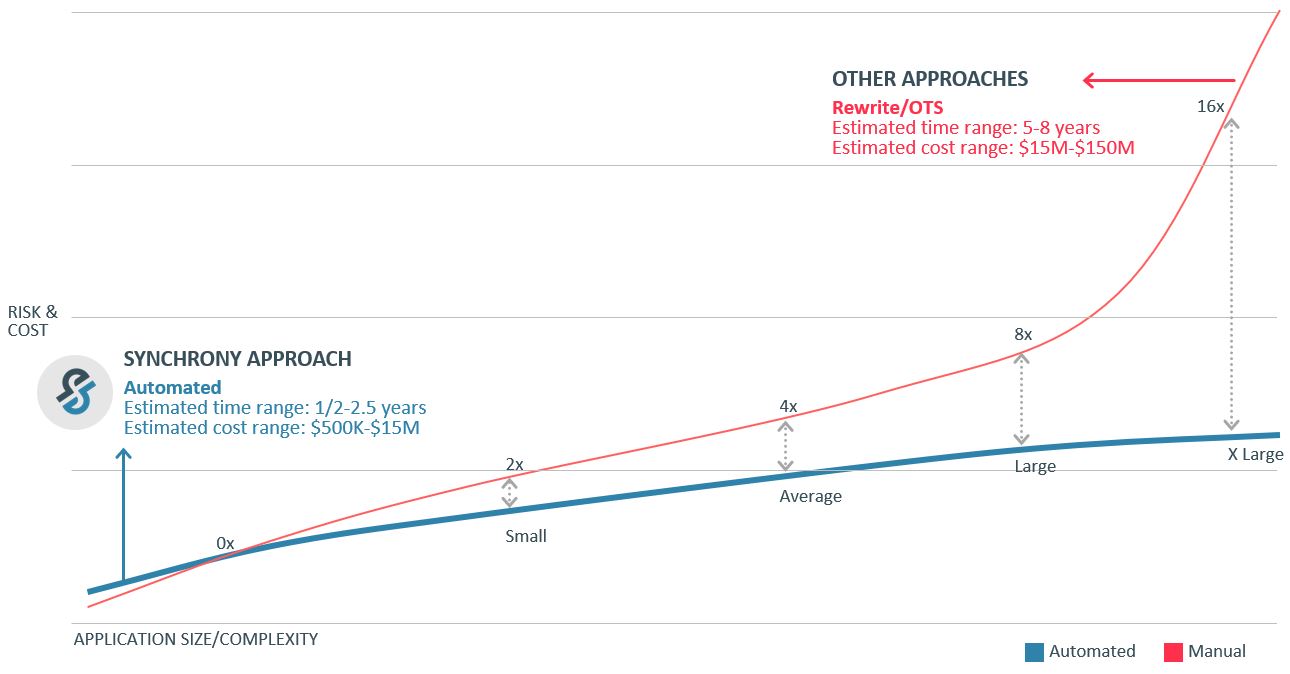
As the chart illustrates, ModOps accelerates modernization delivery and does so at a fraction of the cost and with faster time-to-value. It balances the overall speed, cost, quality, and risk while creating a unified experience that addresses a complex modernization process in a predictable way.

Continuous modernization

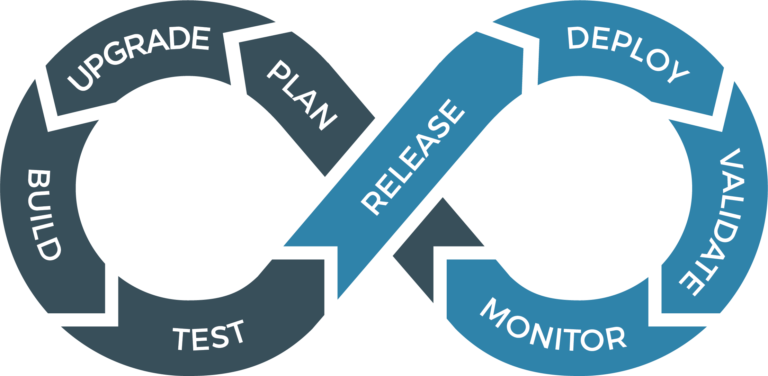
Continuous Development (CD), along with Continuous Integration (CI), have become the cornerstones of DevOps— the way applications are being developed and released into production. By replacing CD with Continuous Modernization (CM), ModOps will achieve the same—the way existing applications are to be modernized. Continuous Modernization will bring a high degree of automation and a systematic approach to managing the entire modernization lifecycle.

The three main pillars of ModOps are:

  1. automation-driven modernization and transformation of legacy applications to modern programming languages and platforms;
  2. coexistence of modernization activities with ongoing development activities, without any code freezes; and
  3. functional and UX equivalency with no hidden costs or operational disruptions to the business.

ModOps is the answer for any company whose objective is to preserve its IP and its original investment in mission-critical legacy applications by adapting to and effectively competing in a rapidly moving digital economy.

As in DevOps, ModOps promotes agility, collaboration, and complete transparency. Project managers, migration engineers, testers, and other business stakeholders have full visibility into the overall status and progress of an ongoing modernization at every stage. With built-in planning, tracking, monitoring and dashboards, extensible workflows, automated testing and real-time feedback, a modernization is guaranteed to run smoothly and to be completed on time and on budget.

Tools for ModOps

The evolution of DevOps has spurred the development of tools to help teams more easily apply DevOps principles to the application development process. Modernization Lifecycle Platform (MLP) is doing the same for the application modernization process. It is a DevOps-driven, integrated, Modernization-as-a-Service platform that creates a unified approach to modernizing legacy applications. Whether it’s a modernization of COBOL to Java, PowerBuilder to C# or Smalltalk to Java, the underlying process, methodology, and user experience are uniform, no matter the chosen source and target platform combination. As a result, organizations are just months—not years—away from having their legacy applications transformed to the digital economy of web, mobile, and cloud.

No more legacy applications

We see a future where the application software is never “left behind” or lost to obsolescence. The major business challenges created by legacy applications—growing technical debt and shrinking technical talent—would themselves become obsolete.

Adding Continuous Modernization (CM) alongside CI/CD would give developers the ability to systematically and incrementally apply new software updates, adapt new APIs, or any other software components to in-house applications, thus doing away with any future wholesale modernization initiatives. By embracing ModOps and adopting a platform like MLP, businesses will become more agile, competitive, efficient, and responsive in addressing the demands of today’s digital economy.

Modernization: from dreaded word to strategic enabler

By Charles Araujo. This article was originally published by Intellyx.

I remember the dreaded words ringing through the house, “Charlie, it’s time to clean your room.”

I pretended I didn’t hear, but inevitably and begrudgingly I stopped what I was doing and began the chore.

Once I was done, however, my mom explained that with my room clean we could now begin the process of transforming it from a child’s bedroom into the teenage haven I had been begging for incessantly.

Getting everything tidied up, it turned out, was the prerequisite to the transformation I so desperately wanted.

Much like “clean your room,” the term modernization has long been a dreaded word in the world of IT.

Uttering it causes involuntary shudders up the spines of IT leaders as they imagine all of the hard work, pain, and suffering to come — with almost no upside at the end of this particularly arduous road.

More importantly, the thinking has gone, while modernization is necessary, investing in it will take precious resources away from more progressive and business-critical initiatives.

So modernization efforts have been left for another day. But it is long past time for this pattern to change.

New advances in both technology and methodologies are transforming modernization from a chore into a strategic enabler — one that may now be the essential component of successful transformations in the digital era.

The problem with modernization

The trepidation surrounding modernization efforts has been well-warranted.

So-called legacy environments — the targets of modernization — are often Byzantine structures that organizations have built layer-by-layer, over the years. Each successive layer has made these systems more complex, more rigid, and almost impossible to change.

As a result, these legacy architectures have become frozen-in-time even as organizations rush to adopt modern technologies in other parts of the technology stack.

With support costs continuing to rise, organizations are recognizing that many of these legacy systems are increasingly becoming liabilities. Still, organizations have seen the pathway to modernization as daunting as they have associated it with the need to completely rewrite and rearchitect these complex and intertwined environments.

These perceived complexities, which have inhibited modernization efforts, however, are now having an even more significant effect. Organizations realize that they must connect their new, modern environments to the legacy systems responsible for core business processes to deliver the sort of end-to-end experiences that customers, partners, and employees demand.

The lack of modernization has now become a roadblock to the business transformations that are vital to an organization’s future.

This situation has left enterprises between the proverbial rock and a hard place. But perhaps modernization doesn’t need to be so difficult after all.

Three shifts that transform modernization

As the need to modernize has become a strategic imperative, both enterprises and tech companies have been exploring ways to overcome its historical challenges.

Those organizations that are finding success with their modernization efforts have discovered that the answer lies in three shifts at the intersection of new technologies and new modernization approaches.

Shift #1: from linear to iteration

First, progressive leaders have realized that they had to stop looking at modernization as a linear, one-dimensional process and, instead, see it as an iterative, modernization lifecycle.

This approach recognizes that modernization demands are themselves continually changing and that modernization is a continual effort that organizations must treat as such.

Shift #2: the move to model-driven

Second, they realized that it was a misconception that was holding them back. They believed that they could only modernize by re-platforming (attempting to transition an existing codebase to a new platform) or via Herculean “rip and replace” efforts in which they completely rewrote an application using modern code and architectures.

They have found greater success, however, with a model-driven approach in which they replicate application functionality, but do so using a combination of a refactored codebase and architectural transformation on modern platforms.

Shift #3: analysis & automation required

Finally, they realized that achieving this type of transformation demands codebase and workflow analysis to deconstruct and manage the modernization effort properly — and that this type of detailed analysis required automation. To achieve this third shift, organizations needed new technologies that would complete this analysis, do automated code conversion, and perform the architectural transformation in a holistic manner.

By making these three shifts, these leading organizations have been able to transform their entire approach to modernization.

The Intellyx take: from roadblock to strategic capability

For most of IT’s existence, modernization has been a nuisance. It has been something that enterprise leaders knew they should do, but which was also a burdensome chore that they would put off if at all possible.

More recently, however, the lack of modernization has become a strategic roadblock.

These rigid and challenging-to-change legacy environments are now inhibiting organizations’ ability to create the type of end-to-end experiences their customers demand.

Bringing a fresh perspective and approach to the modernization challenge, however, is enabling leading organizations to transform their modernization efforts from a roadblock to a strategic enabler.

Those organizations that can modernize their legacy environments most rapidly and effectively, in fact, are realizing a strategic advantage over their competitors that are unable to do so.

This competitive potential is why these leading organizations are turning to companies, such as Synchrony Systems, to give them the tools they need to modernize while sidestepping many of the historical challenges that kept them tied to the past.

The need to modernize legacy systems will only grow in importance as organizations drive forward with their transformational efforts. Those that get modernization right and turn it into a strategic enabler will be the ones that win in the Digital Era.

About the author

Charles Araujo is an industry analyst, internationally recognized authority on the Digital Enterprise, and author of The Quantum Age of IT: Why Everything You Know About IT is About to Change. He is a Principal Analyst with Intellyx, the first and only industry analyst firm focused on agile digital transformation. He has authored three books and published over 100 articles. He has been a regular contributor to both InformationWeek and CIO Insight Magazine and has been quoted or published in magazines, blogs, and websites including Time, CIO, CIO & Leader, IT Business Edge, TechRepublic, Computerworld, USA Today, and Forbes.


Copyright © Intellyx LLC. Synchrony Systems is an Intellyx customer. Intellyx retains final editorial control of this article.

True cost of tech debt in legacy apps

Tech debt usually carries a negative connotation. While it may sound like something to be ashamed of, in truth, every enterprise operates with some degree of tech debt. It’s really an indicator of success—you’ve grown so much, over such a long time that your technology could not keep up. Millions of lines of existing computing code undergird most enterprise operations, and sooner or later, “all code is technical debt.”

So tech debt is not inherently “bad” but it can certainly prevent enterprise businesses from achieving the agility required to maintain relevance in our evolving digital economy. As proprietary legacy systems continue to age, the modern technology stack is advancing at increasing speed. Newer platforms offer greater interoperability and help organizations leverage the full value of their business data through analytics and AI.

Technology-driven competitive pressures are building

Traditionally conservative industries, such as financial services and insurance, tend to carry a higher tech debt load. Banks and insurers rightly wish to avoid any mistakes with software systems that underpin their customers’ financial security.

Mission-critical systems are often architected on legacy platforms with proprietary codebases that expanded over multiple decades, making them difficult to replace or update. Eliminating tech debt comes with fear of significant business disruption. However, executives do recognize that customers demand a better customer experience from brands. Today, 96% of insurers believe digital ecosystems are making an impact on the industry.

Customers expect to be able to personalize the services they need. They crave a fully digital experience with 24/7/365 access to accounts, quotes, and information, as well as multiple channels of customer support. Enterprises need to employ digital, mobile, cloud, and IoT technologies to drive new value for customers. Laggards risk being outmaneuvered by innovative fintech and insurtech businesses using advanced technologies to differentiate themselves. Here are a few examples:

Legacy platforms can only be pushed so far

Many legacy platforms simply can’t support the types of new services that banks and insurers want to offer customers nor the new tools to empower employees.  To fully leverage the value of big data and utilize advanced technologies, enterprises need a modern tech stack.

Unfortunately, many continue to try to bolt new technologies onto outdated platforms, with limited success. After studying the state of digital transformation in the banking and insurance sector, Forrester analysts concluded that innovations were largely being built on top of outdated technology and that risk-averse cultures slowed digital transformation and got in the way of efforts to learn how to monetize data and offer greater value to customers.

When surveyed by Capita and Citrix last year, 56% of CIOs admitted that legacy applications are delaying digital transformation for the entire organization, and 84% said an inability to roll out new services is affecting business competitiveness. When asked why enterprises don’t rid their legacy applications of tech debt, CIOs cited:  The cost of re-architecting or transforming applications (68%), user disruption (43%), and lack of in-house skills (36%).

Executives may lack visibility into the true cost imposed on their organizations by tech debt in their legacy systems. Let’s look at how to quantify tech debt in dollars and cents, and then look at the bigger picture of business risk.

Assessing your tech debt: the math

When deciding when or if it is the right time to pay off tech debt, most organizations assess it in terms of the dollars required. Kelly Sutton described the math behind paying off tech debt. To quantify how much debt is currently carried by the organization, it is necessary to calculate the principal and interest:

  • The investment required to pay off the debt (programmer hours or contractor developers) can be thought of as the principal.
  • The cost of continuing business-as-usual by using engineering resources to bridge the debt on existing platforms can be thought of as the interest. This can be measured in terms of the number of incidents to resolve or the person-hours required.

With this way of quantifying the cost of tech debt, enterprises can compare the ongoing cost of the tech debt versus the one-time cost to fix it. This provides a framework for decision-making about which debts are worth paying off and how IT projects should be prioritized. But this assessment only captures the short-term (near current) condition of your tech debt. For a longer-term assessment, we have to expand the thought process to include the softer costs.

Calculating the true cost of tech debt: opportunities lost

Once you can perform the math of tech debt today, it’s time to think in bigger terms. After all, tech debt is not solely based on the cost of hampered organizational productivity today. The much larger cost may be found in how tech debt will constrain your business in the future.

To calculate the true cost of tech debt, we need to think in terms of risk. What current business opportunities could be jeopardized or even lost in the future due to excess tech debt? Consider these questions:

  1. Will tech debt prevent your product teams from delivering new features, products, or services that customers demand?
  2. Does tech debt obstruct your organization’s ability to work effectively and efficiently? For example, is your organization able to collect and visualize data, in real-time, from every global location for complete enterprise visibility?
  3. Is tech debt limiting workforce recruiting and retention? For example, does a lack of support for cloud platforms prevent hiring remote employees? Does a convoluted codebase make it difficult to attract top IT developers?
  4. Are there opportunities to partner with (or acquire) promising fintech or insurtech startups that cannot be explored because technology stacks are too disparate?
  5. Is the organization already losing customers due to a stale/outdated customer experience? How quickly might that accelerate as new competitors arrive?
  6. How might tech debt prevent full monetization of enterprise data?

In the larger competitive landscape, what does your organization stand to lose in both the near- and long-term? The long-term is more difficult to predict, because you do not yet know all of the opportunities that will arise in the future, given the rapid pace of technological change. But bank on this: If tech debt is already slowing your organization, or forcing you to pivot away from new opportunities, the “rising inflation on technical debt” will only compound the problem with time. Characterize the full risk profile of tech debt now, so the executive team can gain greater visibility into its true cost for decision-making purposes.

About Synchrony Systems

At Synchrony Systems, we help companies reduce tech debt by transforming legacy, in-house applications to modern technologies while preserving business-critical functionality. With our Modernization Lifecycle Platform, we provide an automated, reliable, and transparent modernization while ensuring 100% functional equivalency with no operational interruptions. And with our continuous upgrades, your in-house applications will never fall behind again.


Government IT modernization RFP guide

As businesses and consumers rapidly advance in their use of cloud, mobile, and web 2.0 technologies, governments, and sectors such as energy are navigating their own IT modernization initiatives. They have a precarious balancing act of embracing digital strategies and mobile initiatives to serve the people while safeguarding sensitive information and using technology in smart, secure, and affordable ways.

Maintaining legacy systems is expensive. Over the last decade, the U.S. federal government spent roughly 75-80% of its IT budget on the operation and maintenance of its outdated legacy systems. Recently the U.S. Office of Management and Budget (OMB) has codified IT modernization as a key objective and is working closely with participating agencies to establish funds that can help replace legacy IT systems and produce modern IT equipment and services.

The U.S. federal government is not alone. U.S. state and local governments and governments around the globe are also striving to serve their constituents with modern technology while reducing the amount they spend on legacy systems. Their efforts to move to a digital, mobile-first engagement model often are held back under the weight of legacy systems—and, in many cases, smaller budgets.

Slavik Zorin, CEO of Synchrony Systems, has been in the software modernization field for over 20 years. He has worked closely with trusted government partners such as IBM and the “Big Four” firms helping government organizations transform their legacy applications, thereby reducing costs while gaining the benefits of modern architecture. He offers these tips when developing an RFI or RFP for your modernization initiative:

1. Look for options other than rip-and-replace proposals

In today’s age of digital transformations, something even more disruptive to the organization than the upkeep of its monolithic legacy systems is a monolithic, big-bang approach to modernizing these systems. Many of the default, go-to large System Integrators that respond to RFPs are continuing to offer antiquated, wholesale rip-and-replace solutions. At the outset, the time, resource, and dollar estimate of these approaches appears reasonable. However, the eventual cost is significantly higher than anticipated because of change requests arising from the continuously shifting requirements of an evolving legacy system during the modernization project. These change requests introduce a high risk to the modernization project and compound the cost and time to complete it. RFP reviewers need to be mindful of a proposal that offers a low initial price but has a contract designed for unlimited change request triggers.

In contrast, a new approach to modernization driven by 100% automation, provided by companies such as Synchrony Systems, changes the status quo. They offer a highly transparent, efficient, and predictable modernization solution at a fraction of both the price and the risk of the traditional rip-and-replace solutions. Not only does this new approach fit within the shrinking budgets of the public sector, but the process requires little to no internal IT involvement and no end-user retraining once the modernization project is complete.

2. Ask how vendors will preserve the functional equivalence

Your government IT professionals have spent years building systems specialized for your agency, department, or office. The final application was probably developed organically, adding functionality as needed and modified as the needs of the organization changed. Your IT “subject-matter experts” certainly know your systems inside and out, and those systems contain critical functionality to support your agency’s operations.

The challenge with legacy applications is not the functionality but the aging technology that the functionality is built upon. What necessitates the modernization are your maintenance costs, skills shortage, technical requirements imposed by the regulatory compliance changes, and overall inability to provide modern digital experiences to your constituents. The move to modern technology is no longer the debate. The question is whether the modernized system will be one that your IT department can recognize and continue to maintain as efficiently and effectively as it has been to date.

By looking for modernization solutions that focus on the preservation of the original investment into legacy applications, your organization will end up with modernized systems that have equivalent functionality and a recognizable user experience. Therefore, the transition plan to take ownership of the application in a new platform will be more immediate, operationally frictionless, and will have significant cost savings.

3. Understand the potential impact on the user experience

As mentioned before, rewrites or wholesale replacements of mission-critical applications inevitably leave the organization with an entirely different system. In addition to the cost, time, and effort of the traditional rip-and-replace modernization, your IT department would also be required to re-train all the end-users on the new system and update all internal processes and documentation. This hidden cost, which is often quite high, gets overlooked.

User experience (UX) equivalency means that the modernized system would remain recognizable to the end-user and would be 100% equivalent from a usability perspective. One modernization that Synchrony Systems performed was a mainframe application for the New York Police Department. Due to a tight budget, NYPD wanted to avoid any additional retraining that would typically follow a modernization project. Synchrony Systems offered a solution that would mimic exactly the look and feel of the 3270 green screens, but in the modern, native, browser-based technology. The modernized application was delivered within the promised timeframe and budget, without any change requests and, as promised, without any end-user retraining.

Some may argue against having the modernized application look and feel like the dated application, but the benefits are far too great to ignore, especially for the government. These benefits include no end-user retraining for internal or external users; no need to update support, knowledge bases, training manuals, or any other documentation; and no productivity loss because UX equivalency preserves all the known productivity shortcuts already developed by end-users. Only a modernization that guarantees UX equivalency can ensure no disruptions to the government’s operations.

4. Ask vendors how to avoid code freezes

Mission-critical legacy applications are typically in use every day (and sometimes 24/7). More often than not, these systems require frequent code changes to address the numerous changes in regulatory compliance and government operations.

Vendors that offer traditional manual rewrite modernization approaches are forced to impose “code freezes,” i.e., periods of time where no changes can be made to the application. Such is the nature of a wholesale rewrite; for the rewrite to have any chance to complete, the system must remain unchanged while it is in progress. For many organizations, this is simply prohibitive, hence the reason legacy applications remain on aging technology.

The ability to maintain and update the legacy application while it’s being modernized to a new technology entirely changes the dynamics of modernization projects. At Synchrony Systems, we are able to support the coexistence of modernization activities with ongoing development activities without any code freezes. Powered by our Modernization Lifecycle Platform, ongoing new releases of the legacy application are continuously synchronized by replaying all the recorded automation that has taken place up to that point. For companies like SoCalGas, with a proprietary system that had daily pricing changes, the elimination of code freezes was essential.

In reviewing the bids from your RFP, be sure to fully understand if code freezes are a part of the modernization process and how it may impact your organization.

In summary

The move to digital is an opportunity for the government itself to become more agile in its operations and service to its constituents. And, more than any other organization, the government must be completely transparent and ensure continued fiscal responsibility to spend taxpayers’ dollars wisely.

Using these few tips can put your organization on the right path for digital transformation.

The antiquated rip-and-replace and manual rewrite practices of traditional System Integrators are opaque, very expensive, and risky. Synchrony Systems offers a modernization process and platform that is fully transparent and predictable, rooted in technology and automation, and enables us to provide reliable and unchanging fixed prices that do not rely on hidden change-request practices that have been the status quo in this industry. If your organization or agency has this need and is looking for a guaranteed success that is fast, cost-effective, and risk-averse, send us an email or give us a call at (203) 355-3636.

Slack collaboration in modernization projects

Mobile devices have changed the face of collaboration. Alert notifications and instant access are now ubiquitous and user-friendly in a wide range of apps for banking and finance, shopping, travel planning, and dating—the list is endless. Because these features are also penetrating the B2B world, access to team members is now only a tap away.

Platforms for workforce collaboration are taking productivity to the next level. Slack is among the premier platforms to provide customization and extensibility through APIs for collaboration integration with 3rd party apps. At Synchrony, we have leveraged Slack capabilities to create a just-in-time process collaboration workflow for software modernization projects.

Collaboration shift-left

Today the common practice is for users to log in and navigate through dashboards to get the latest project data or check the next assigned task. The integration of Synchrony’s Modernization Lifecycle Platform (MLP) with Slack collaboration takes the notion of shift-left to the next level: project stakeholders are aware of events sooner and can respond faster, as an integrated collaboration eliminates intermediate steps. With these features, modernization team members have access to the latest project data and can interact with the project’s workflow and fellow team members—right from their pockets—by responding to project events that are pushed by the collaboration service event bus.

Let’s take the system administration functions as an example. Empowered by Slack’s slash commands, sysadmin members now have access to a command-line interface to quickly inquire and control cloud compute and storage resources from their mobile phones. Events from cloud monitoring services, such as the AWS Cloud Watch, will inform administrators about resource constraints and allow resolution through Slack interactive messages. These message responses are routed through the custom Slack MLP App to Node.js services that manage resources through the cloud service APIs.

Modernization developers and testers also can collaborate using Slack messages. When a tester adds a new defect from the MLP TestLog user interface, a message is broadcast on the project’s channel and the developers immediately get the notification. Once a fix is available and delivered to the project’s repository, the project lead gets an interactive message that the automated workflow is ready to process the fix and can initiate the tasks directly from Slack. The Slack interaction will be visible to other team members, and the MLP user interface will also reflect the workflow progress. Upon completion of automated tasks, the project manager can respond to the availability of a new automated task by assigning resolved defects and test cases back to testers for verification—all within Slack.


Project managers also have the ability to create event subscriptions based on event types, users, event data, and calendar information. The subscriptions are processed by the MLP collaboration services that gather project metrics and push them to the Slack user interface. For example, an event subscription can be created to produce a just-in-time notification of the project metrics for a weekly project review meeting with various stakeholders. The metric results will get pushed onto the project’s channel, with a link back to the MLP metrics UI that will allow project stakeholders to instantly drill into the metric details during the meeting.


Distributed team collaboration

Modernization projects are often carried out by multiple teams whose members are typically customers, solution providers, and system integrators. These teams perform tasks such as project management, migration tools development, application migration, build, deployment, and delivery to testers, testing, and quality assurance, etc. MLP supports this ecosystem through project and task workflow configuration, and solution configuration and release. Project issues can be redirected to solution providers, who can respond to notifications by creating and delivering new solution releases that generate Slack notifications. These, in turn, enable authorized team members to automatically install updates and run the project workflow with the latest changes. Subsequently, testers are notified of the availability of the latest updates and can proceed to validate the delivered fixes.

The usage of Slack channels enables all stakeholders to keep the project’s pulse and to track all its activities in a central location. Slack’s latest search/filter capabilities enable users to quickly identify project events of interest and evaluate their current state. Project managers can see the testing activity and track responses from developers. Channels also include shared conversation among project stakeholders that enables turning these conversations quickly into actionable items. For example, a message with a screenshot from a customer can be turned into a defect/task using a Slack action.

The effect of pushing the available project data to all stakeholders begs the following question: what’s the next step in productivity? Each modernization project is unique, but all projects develop patterns over time and note common factors that are ripe for mining, such as testing/fixing patterns, release patterns, etc. Machine Learning integration is definitely the future. Perhaps notifications will take the form of recommendations about how to adapt the work, based on project circumstances. But that’s for another blog post…

If your team is ready to take advantage of today’s leading collaboration tools for your modernization project, Synchrony can help.