Enterprise Generation Language (EGL) was a powerful tool in its time, but the technological landscape has evolved significantly. Modernizing EGL applications is crucial for businesses to remain competitive and agile.
Here are the primary reasons to modernize:
1. Improve user experience:
Outdated interfaces: EGL applications often have dated user interfaces that are not intuitive or mobile-friendly. Enhanced user interaction: Modernization can create engaging, responsive interfaces that meet contemporary user expectations.
2. Increase efficiency and productivity:
Legacy systems bottlenecks: EGL applications might have performance limitations or scalability issues. Automation: Modernizing can incorporate automation and AI to streamline processes and reduce manual effort. Integration: New technologies enable seamless integration with other systems and data sources.
3. Reduce costs:
Maintenance overhead: Legacy EGL applications can be expensive to maintain due to limited skill sets and support. Infrastructure costs: Modernization can reduce hardware and software costs by leveraging cloud-based solutions.
4. Enhance security:
Vulnerability risks: Older applications are often susceptible to security threats. Compliance: Modernization can help meet industry regulations and data protection standards.
5. Unlock business opportunities:
Data-driven insights: Modernized applications can leverage big data and analytics for better decision-making. Innovation: New technologies and platforms enable innovative products and services development.
6. Talent acquisition and retention:
Skill gap: Finding developers with EGL expertise can be challenging. Attracting talent: Modernizing aligns the technology stack with current industry standards, making the company more attractive to skilled professionals.
7. Future-proofing the business:
Technological advancements: Staying up-to-date with technology is essential for long-term success. Agility: Modern applications are more adaptable to changing business needs.
In essence, modernizing EGL applications is not just about updating the technology; it’s about transforming the business to be more efficient, competitive, and customer-centric.
We offer various solutions, including upgrades and transformations, to migrate your legacy EGL applications to a more modern architecture. Visit our EGL modernization page to learn more.
Company Saves Seven Years by Partnering with Synchrony Systems
Greenwich, CT (October 17, 2023) – Synchrony Systems, Inc., a technology pioneer for the management and execution of complex application modernizations, released an in-depth experience report on the modernization of six Smalltalk applications to Java. It describes the unique three-year collaboration between Synchrony and a German IT services provider for the financial sector.
“This project provided an opportunity to turn the modernization experience on its head,” said Synchrony Systems CEO Slavik Zorin. “We co-developed a true collaborative approach that allowed the company’s engineering team to retain control and have complete visibility into all phases of the modernization process while allowing the application development and modernization to run in parallel. Together, we shrunk an estimated 10-year rewrite of well over two million lines of code down to three years.”
“With Synchrony’s help, their advanced technology stack, and a strong team, we completed migrating all of our Smalltalk applications to the desired target Java architecture and were finally able to retire Smalltalk,” stated the company’s modernization project lead and veteran software developer. “We could not have done it without Synchrony’s technology, modernization expertise, and strong commitment to success.”
The Modernization Experience Report includes details such as:
company and project background
modernization initiative challenges, requirements, and vendor selection
Synchrony Smalltalk Migration Technology (SMT) and modernization platform overview
modernization readiness phase, including work breakdown, team collaboration, and project timeline
modernization implementation phase, including parallel track progress, halfway evaluation, functional testing, and code quality
final deliverable, conclusion, and takeaways
an appendix, including analysis of the codebase, pipelines, operations, deliveries, and more
This in-depth report is available for limited release to companies interested in understanding the details of modernizing large, legacy applications. Request your copy.
In-depth experience report shares how one company saved seven years by modernizing a portfolio of Smalltalk applications to Java with Synchrony Systems
Six Smalltalk applications to Java. The company estimated it would take another ten years to complete the portfolio modernization and retire Smalltalk altogether.
This experience report goes behind the scenes to expose the unique three-year collaboration between Synchrony and a German IT services provider for the financial sector.
This in-depth report is available for limited release to companies interested in understanding the details of modernizing large, legacy applications.
Readiness phase (Application portfolio, Work breakdown, Team collaboration, Project timeline)
Implementation phase (Splitting the work, Progress of parallel tracks, Progress of the entire project, Halfway point evaluation, Functional testing, Code quality, Integration testing, Final deliverable
Conclusions and take-a-ways
Appendix (Codebase, Pipelines, Operations, KB and CL, Issues, Deliveries, Datapoints)
Greenwich, CT (December 12, 2022) – Synchrony Systems, Inc., the leader in complex application modernizations, announced today that it won the 2022 Digital Innovator Award from Intellyx, a research analyst firm dedicated to digital transformation.
According to their press release, Intellyx bestows this award upon vendors who are the most disruptive and innovative firms in their space, putting a “spotlight on vendors worth watching.”
“It’s an honor to be recognized for the second time by Intellyx for our application modernization technology,” said Slavik Zorin, CEO of Synchrony Systems. “Intellyx recognizes the innovation and positive impact that Synchrony is making in modernizing how modernizations are done. We are thankful for our conversations with the Intellyx team and the insights we gain from those interactions.”
Synchrony is the developer of MLP, a platform-as-a-service that helps customers gain control over the management and execution of complex application modernizations, thus reducing company risks, improving team communication and collaboration, and accelerating the entire modernization initiative. MLP orchestrates automated processes end-to-end, tracks all modernization activities, and provides complete transparency of all modernization activities to stakeholders.
Application owners use MLP to accelerate their adoption of cloud, mobile, and new web technologies by fast-tracking and de-risking complex modernizations. Migration tool vendors grow their business by making their migration tools and services consumable by customers and system integrators through the platform. System Integrators increase their profit margins using MLP to orchestrate migration tools from multiple vendors and leverage MLP’s systematic, repeatable, and reliable processes to manage complex application modernization.
About Synchrony Systems, Inc.
Customers gain control over the management and execution of complex application modernizations using Synchrony Systems’ Platform-as-a-Service–MLP. MLP is an end-to-end solution that orchestrates automated migration and modernization processes, tracks all modernization activities, and provides complete transparency of all modernization activities to stakeholders. This results in reduced company risks, improved team communication and collaboration, and accelerated modernization initiatives. MLP was named a 2018 SIIA CODiE Awards finalist for Best DevOps Tool and a 2019 SIIA CODiE Award Finalist for Best Emerging Technology. Synchrony Systems has been named a Digital Innovator from Intellyx in 2021 and again in 2022.
Brownfield refers to physical land requiring clean-up, upgrades, or development before leveraging the property for new purposes. Brownfield software development describes maintaining, upgrading, migrating, interacting with, or leveraging data from legacy applications.
Most of the world’s developers work on and within brownfield applications and environments. While greenfield software development gets the industry buzz, it’s the brownfield technologies with mass adoption and most usage that run companies.
Challenges in brownfield software development
Brownfield software development is not easy. The developers must keep brownfield applications up-to-date, transform critical legacy business logic to modern technologies, and architect interoperability between brownfield and greenfield applications and environments. Some key challenges with brownfield software to note are:
Not having a thorough understanding of the legacy applications and their dependencies with other legacy platforms
Staffing technical expertise to continue the development and maintenance of legacy applications
Developing a strategic modernization roadmap and rapidly executing it while reducing technical risks and business disruptions
Determining which parts of legacy applications are business-critical and must be preserved, maintained, migrated, replaced, or retired
Managing upgrades, migrations, integrations, and modernization of legacy applications in a consistent, uniform, and repeatable manner while continuing active maintenance (no halts in development).
The inability to adequately address these issues and challenges will have a costly impact on the current and future business.
Adopt continuous modernization to help solve brownfield application development challenges
Instead of the obsolete top-down / waterfall approaches in greenfield applications, development teams have adapted leading DevOps principles such as continuous integration (CI), continuous testing, continuous monitoring, continuous security, and continuous delivery (CD) to take a more agile and iterative approach. Incorporating the continuous modernization (CM) principle to brownfield applications should be a natural extension of DevOps to enhance and fully complete the cycle of software development, maintenance, and evolution.
The principle of continuous modernization is to avoid the need for large, time-consuming, costly, and risky undertaking of major modernization initiatives in the brownfield software space. Executing a continuous modernization strategy requires different processes and automation tools to manage software migrations, modernizations, and upgrades while coexisting with ongoing greenfield and brownfield development projects.
One such tool is MLP, a SaaS platform that brings a uniform upgrade process, a collaborative work environment, and transparent and traceable workflows to continuous modernization. It snaps into your existing CI/CD environments and procedures to give you the ability to apply new software updates systematically and incrementally to your in-house applications, APIs, or any other software components.
Benefits of continuous modernization for brownfield software
Leveraging automated modernization workflow management tools and platforms like MLP for brownfield software upgrades, maintenance, integrations, and modernizations will benefit the business in many ways. Some of the benefits offered by continuous modernization for brownfield applications are outlined below:
Accelerate adoption of native, cloud-first, and mobile application architecture
Fast-track digital transformation projects to accelerate delivery of business value
Reduce security risks associated with legacy applications
Keep currency with a rapidly changing technology landscape
Improve performance of brownfield applications
Continuously eliminate creeping technical debt
Prevent massive modernization initiatives in the future
In short, continuous modernization makes it easier to support brownfield application development by providing a systematic, uniform, and accelerated approach to executing modernization roadmaps without disrupting the day-to-day business operations.
DevOps has revolutionized software engineering methodology by unifying development and operations to accelerate software delivery. The older-style waterfall approaches to greenfield application development are being put aside as DevOps principles of agility, iteration, continuous delivery, and automation take center stage.
Modernization must deal with the challenge of transforming millions of lines of existing legacy code, built over decades by dozens, if not hundreds, of engineers, most of whom have moved on or retired altogether. Yet outdated approaches such as “rip and replace” are still the default modernization methodology, employing manual rewrites and disjointed automation tools. This approach is costly, takes an enormous amount of time and resources, and introduces significant risk to the business.
At Synchrony Systems, we believe it’s time to apply the DevOps principles, adopted for greenfield development, to software modernization—or ModOps—to keep pace with the rapid digital transformation.
Accelerating modernization delivery
Modernization focuses on transforming existing legacy systems and applications to the latest platforms and architectures. Unlike greenfield development, where very frequent and incremental changes are made to small bodies of code, modernization requires making wholesale transformations of the entire body of code at once and en masse. Therefore, the traditional manual approaches to modernizations can no longer be justified in today’s rapidly moving digital economy.
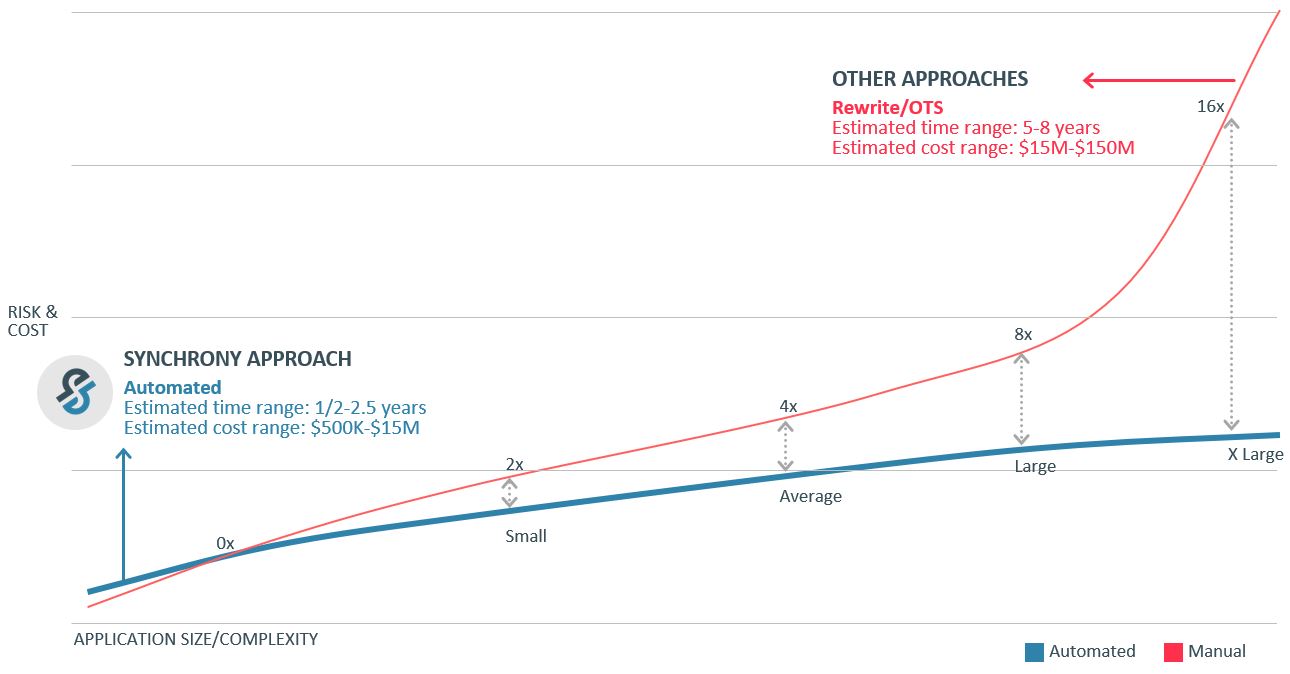
As the chart illustrates, ModOps accelerates modernization delivery and does so at a fraction of the cost and with faster time-to-value. It balances the overall speed, cost, quality, and risk while creating a unified experience that addresses a complex modernization process in a predictable way.
Continuous modernization
Continuous Development (CD), along with Continuous Integration (CI), have become the cornerstones of DevOps— the way applications are being developed and released into production. By replacing CD with Continuous Modernization (CM), ModOps will achieve the same—the way existing applications are to be modernized. Continuous Modernization will bring a high degree of automation and a systematic approach to managing the entire modernization lifecycle.
The three main pillars of ModOps are:
automation-driven modernization and transformation of legacy applications to modern programming languages and platforms;
coexistence of modernization activities with ongoing development activities, without any code freezes; and
functional and UX equivalency with no hidden costs or operational disruptions to the business.
ModOps is the answer for any company whose objective is to preserve its IP and its original investment in mission-critical legacy applications by adapting to and effectively competing in a rapidly moving digital economy.
As in DevOps, ModOps promotes agility, collaboration, and complete transparency. Project managers, migration engineers, testers, and other business stakeholders have full visibility into the overall status and progress of an ongoing modernization at every stage. With built-in planning, tracking, monitoring and dashboards, extensible workflows, automated testing and real-time feedback, a modernization is guaranteed to run smoothly and to be completed on time and on budget.
Tools for ModOps
The evolution of DevOps has spurred the development of tools to help teams more easily apply DevOps principles to the application development process. Modernization Lifecycle Platform (MLP) is doing the same for the application modernization process. It is a DevOps-driven, integrated, Modernization-as-a-Service platform that creates a unified approach to modernizing legacy applications. Whether it’s a modernization of COBOL to Java, PowerBuilder to C# or Smalltalk to Java, the underlying process, methodology, and user experience are uniform, no matter the chosen source and target platform combination. As a result, organizations are just months—not years—away from having their legacy applications transformed to the digital economy of web, mobile, and cloud.
No more legacy applications
We see a future where the application software is never “left behind” or lost to obsolescence. The major business challenges created by legacy applications—growing technical debt and shrinking technical talent—would themselves become obsolete.
Adding Continuous Modernization (CM) alongside CI/CD would give developers the ability to systematically and incrementally apply new software updates, adapt new APIs, or any other software components to in-house applications, thus doing away with any future wholesale modernization initiatives. By embracing ModOps and adopting a platform like MLP, businesses will become more agile, competitive, efficient, and responsive in addressing the demands of today’s digital economy.
Greenwich, CT (June 16, 2021) – Synchrony Systems, Inc., a leader in legacy application modernizations, today announced the selection to the inaugural class of the 2021 Digital Innovator Award from Intellyx, the first and only analyst firm dedicated to digital transformation.
“At Intellyx, we get dozens of PR pitches each day from a wide range of vendors,” said Jason Bloomberg, President of Intellyx. “We will only set up briefings with the most disruptive and innovative firms in their space. That’s why it made sense for us to call out the companies that made the cut.”
“It’s an honor to be recognized by Intellyx for our innovation in the IT modernization space,” said Slavik Zorin, CEO of Synchrony Systems. “We’ve spent 25+ years modernizing legacy applications, building and using our proprietary migration tools. When we integrated the source code migration tools into an entire modernization process, our clients saw considerable gains in code quality, efficiency, and affordability.”
Synchrony’s Modernization Lifecycle Platform (MLP) supports the entire modernization lifecycle: from analysis and planning to transformation and remediation, from build and deployment to testing and production release. It applies the same systematic, iterative, and automation-driven modernization processes to produce production-ready, modernized applications.
It is compatible with any translation libraries or rule-sets, no matter the source or target programming language, platform, or framework. By automating the complete modernization process migration tools can be integrated into as part of an entire modernization assembly line.
We help enterprises transform legacy in-house applications to modern technologies while preserving business-critical functionality. Synchrony’s Modernization Lifecycle Platform (MLP) is a scalable, cloud-based platform for managing and executing end-to-end migrations and modernizations of legacy IT applications to modern software architectures and platforms. It enables automated code conversion, transformation, remediation, and upgrades of millions of lines of code in minutes, ensuring consistent, reliable, and repeatable results. MLP was named a 2019 SIIA CODiE Award Finalist for Best Emerging Technology and 2018 SIIA CODiE Awards finalist for Best DevOps Tool.
In-house applications, once associated with good fortune, have now become an albatross. These systems may still run business-critical processes or orchestrate data between commercial systems, but their underlying, aging technology has become a real liability. You know it’s only a matter of time before something fails, and it won’t be pretty.
You may be hearing a lot of bluster about the best way to go about modernizing legacy applications. “Refactor,” “re-platform,” “encapsulate and expose for microservices,” “lift and shift,” and “low-code rebuilds” are just a few of the buzz-phrases floating out there. At Synchrony systems, we also have our own view of how best to modernize. But the how is not always as straightforward as some try to make it seem. How to modernize depends on many factors that span well beyond source code or target technology.
So where do you begin? The following steps should not only help you prepare for legacy application modernization; they also should help you clarify the right modernization methodology to pursue.
Know what you have: document your current state
While this may sound like a no-brainer, you’d be surprised at how many companies don’t have a complete, up-to-date overview of their technology stack. Perhaps that’s because they’re busy putting out daily fires or launching new initiatives. Or maybe staff turnover put the critical, technical documentation on the back burner. Regardless of the reason(s), before starting any potential modernization initiatives, you must possess a full technical understanding of your IT portfolio and which parts of it are mission-critical to your business operations.
Three dimensions of the current state must be well understood: architecture, timeline, and capital.
Architecture: While it’s ok to not have all the answers, accurately describing what you know—and highlighting what you don’t—is important.
Do you have access to the source code of your in-house applications?
Do you understand your applications’ source platform dependency?
Do you understand your applications’ component architecture?
Do you understand your applications’ runtime architecture?
Timeline: Many in-house applications are built using licensed, 3rd-party software. Understanding the timing of the maintenance and support contracts is an important input to the modernization effort.
Capital: Capital includes the dollars used to support the in-house applications, as well as the resources and time spent maintaining them. You also need to understand what other IT projects your company is currently funding, the budget for the modernization initiatives, and when those funds will be available.
With this information, you can start to map out the priorities for your modernization.
Know where you want to be: document the future state
Sometimes the future state has a strategic mandate from the top—become cloud-first or consolidate technologies onto a single platform. Other times, the future state evolves more organically. Regardless of the path, you need a documented roadmap of the new vision for IT. This plan is really a risk-mitigation strategy for your legacy applications. It’s only a matter of time before the old versions start to fail, their security gets breached, a 3rd-party vendor stops supporting the software, or some other business-impacting event occurs.
Like the current state, your future state plan has the same three dimensions: architecture, timeline, and capital.
Architecture: Future state technology architecture needs to be aligned with the business need, and not just be technology for technology’s sake. The tech vision must map to the business vision and support the business value of investing in modernization. Along with technology, the future state should include recommendations about the people and process changes required to operate in this new architecture.
Timeline: Modernizations can be lengthy projects with many concurrently moving parts. A strong roadmap includes critical dates such as contract renewals, end of support, and/or end of life. It includes budget cycles for funding, and it maps critical hires such as short-term contractors, modernization specialists, and/or full-time developers/IT professionals. The roadmap also should include important business dates like acquisitions, major product launches, peak selling seasons, etc. All these factors can help shape your modernization priorities and urgency.
Capital: In addition to the investment allocation for the initiative, you also need to understand the capital outlay needed for resources—internal and external—required for success.
Determine the path forward
Now you can perform a gap analysis of the current and future states. The timeline and available capital will be key factors—the “how”—that inform your approach to modernization.
Another factor to consider is the relative effort of modernization. For example, rewriting an application from scratch is not only time-intensive from a greenfield development standpoint, but the effort to make it operational would include retraining users, rewriting documentation, re-tooling support, etc. Many hidden costs of rip-and-replace strategies that may be overlooked during the initial scoping will later become quite burdensome.
For very small, in-house applications with minimal business impact, simple migration tools may be all you need for the modernization. For very large, in-house applications, the strategy may be more complex and consist of several approaches, including:
Rip and Replace: replace with an off-the-shelf alternative
Lift and Shift: re-platform or re-host the entire legacy workload onto a virtual cloud environment
Rewrite: retire and invest in ground-up greenfield development
Re-architect: attempt to improve in place the underlying legacy application architecture into a more modern, service-based, web architecture.
Migrate: using automation, migrate “as-is” to a new target platform, preserving functionality and user experience
At this stage, talking with companies that specialize in modernizations is a wise idea. With the groundwork you’ve done, modernization experts should be able to give you a proposal for moving forward, a timeline, and a cost estimate for the modernization.
Start now
As Benjamin Franklin once said, “By failing to prepare, you are preparing to fail.” It’s never too early to begin the work necessary for a clear strategy to move away from your legacy applications.
At Synchrony Systems, we have over two decades of experience helping companies modernize their legacy, mission-critical applications in the most cost-effective and transparent way possible. Whether you are just starting to think about modernization or have an urgent need, we are happy to talk with you about your specific situation.