
Your privacy matters. We’ve updated our policies effective March 24, 2026.

LEARN MORE

Can continuous modernization prevent tech debt?

When was the last time your development team proposed a major software modernization project?

If it feels like you’re always either planning one, executing one, or recovering from one, the true problem may lie in your approach to modernization.

Most organizations discover their technical debt only after it’s metastasized: when security vulnerabilities force urgent patches, when critical dependencies reach end-of-life, or when talented developers refuse to work on outdated tech stacks. By then, what started as deferred maintenance has ballooned into a protracted six-figure overhaul.

Is adopting a Continuous Modernization (CM) approach the only surefire way to prevent an avalanche of technical debt?

What is Continuous Modernization?

Continuous Modernization is a proactive software maintenance strategy that systematically updates your proprietary applications, APIs, and internal software components as part of your regular development workflow. Rather than allowing dependencies to age until they require massive overhaul projects, CM integrates incremental updates directly into your existing DevOps processes.

Continuous Modernization is a natural extension of CI/CD practices. Just as Continuous Integration and Continuous Deployment automate testing and releases, Continuous Modernization automates the process of keeping your technology stack current with the latest versions of databases, frameworks, SDKs, and third-party libraries.

The hidden cost of deferred updates

Here’s a scenario that plays out repeatedly across enterprise IT departments: an application launches successfully with modern dependencies. Development teams move on to new projects. Months pass, then years. Meanwhile, that once-current application quietly falls behind. What begins as a minor version lag – perhaps staying on an older database driver or postponing a framework update – compounds over time. Before long, your “stable” application is running on unsupported software versions with known security vulnerabilities and compatibility issues.

When the gap becomes too wide to ignore, you’re forced to launch a major modernization initiative. Development resources that should be building revenue-generating features instead get redirected to upgrade work that delivers no visible value to stakeholders. The maintenance burden that was once manageable has transformed into an expensive, high-risk project.

McKinsey finds that technical debt accounts for roughly 40% of IT balance sheets – and adds 10-20% to the costs of any given IT project.

How Continuous Modernization prevents tech debt accumulation

Continuous Modernization flips this reactive approach on its head. Instead of waiting until upgrades become emergencies, organizations establish automated pipelines that handle updates incrementally and continuously.

The process works by running parallel upgrade tracks alongside your standard development workflow. When new versions of dependencies become available, they’re automatically tested against your codebase in isolated environments. Issues are identified early when they’re still small and manageable, rather than discovering compatibility problems years later when dozens of dependencies demand simultaneous updates.

This approach delivers several key advantages:

Smaller, manageable changes: Updating one or two dependencies at a time is significantly less risky than upgrading an entire stack simultaneously. Each change can be thoroughly tested and validated before moving forward.

Reduced upgrade complexity: When applications stay relatively current, upgrade paths remain straightforward. The documentation and community support for recent version transitions is robust, and breaking changes are well documented.

Lower resource requirements: Small, regular updates require far less time and effort than infrequent, massive overhauls that grind productivity to a halt. Teams can handle modernization work within normal cycles rather than requiring dedicated projects.

Improved security posture: Security patches and vulnerability fixes get applied promptly rather than languishing in a backlog of deferred maintenance work.

Better developer experience: Engineers spend less time wrestling with legacy technology and more time working with modern tools and patterns.
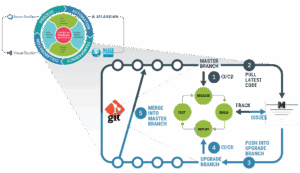
A flow chart showing the Continuous Modernization process


Implementing Continuous Modernization in your DevOps pipeline

Successful adoption of Continuous Modernization requires proactive, systematic processes and the right tooling. Here’s how mature CM practices typically integrate with existing workflows:

Automated upgrade branches

Continuous Modernization pipelines operate in dedicated upgrade branches, isolated from your main development codebase. This isolation is critical: it allows upgrade processes to run without any risk to production code or active development work.

When new software versions become available, automated systems pull your latest source code into upgrade branches and apply the necessary updates. This happens continuously in the background while your team continues normal development activities.

Integration with existing CI/CD testing

After upgrades are applied in the isolated branch, your standard regression test suites run automatically. This leverages all the testing infrastructure you’ve already built – unit tests, integration tests, end-to-end tests, and performance benchmarks.

If tests pass, the upgrade branch can be merged back into your main development line. If tests fail, the issues are logged, tracked, and remediated before any code reaches production.

Customizable upgrade rules

Every application and organization has unique requirements. An effective Continuous Modernization platform allows teams to customize the upgrade process. This usually means defining which dependencies to prioritize, establishing version constraints, specifying breaking change policies, and setting approval workflows.

These rules ensure the modernization process aligns with your organization’s risk tolerance and change management practices.

The business case for Continuous Modernization

While Continuous Modernization is fundamentally a technical practice, it delivers measurable business value:

Predictable maintenance costs: Regular, small updates cost less and are more predictable than emergency modernization projects. Finance teams appreciate the ability to budget for steady-state maintenance rather than lumpy capital investments.

Faster time-to-market: In one study, Stripe found that developers spend an average of 13.5 hours per week addressing technical debt, translating to 33% of their time spent on maintenance rather than shipping new features. When technical debt is kept under control, development teams spend more time shipping features and less time fighting antiquated tooling.

Reduced risk: Large-scale modernization projects are inherently risky: they touch many parts of the system simultaneously and often require extended testing periods. Continuous Modernization distributes that risk across many smaller, less risky changes.

Extended application lifespan: Custom applications represent significant investments. Continuous Modernization helps organizations maximize the return on those investments by keeping systems viable longer without requiring costly rewrites.

Getting started with Continuous Modernization

If your organization is dealing with aging custom applications, mounting technical debt, or expensive modernization cycles, it’s time to consider a Continuous Modernization approach.

Start by identifying applications that are critical to operations but beginning to show their age. Look for systems where dependencies are more than a few versions behind, security patches are piling up, or it’s becoming difficult to find engineers willing to work on outdated tech stacks.

These applications are ideal candidates for implementing Continuous Modernization pipelines. With the right platform and processes in place, you can transform them from growing liabilities into well-maintained, modern assets.

The shift to Continuous Modernization doesn’t happen overnight, but the investment pays dividends. Organizations that adopt CM spend less time in crisis mode and more time delivering value. They maintain more secure, stable, and sustainable application portfolios. And they position themselves to take advantage of new technologies and capabilities as they emerge, rather than being held back by ever-snowballing legacy technical debt.
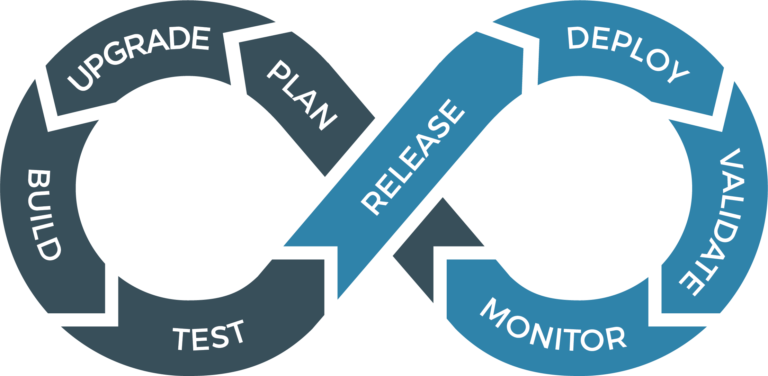

Continuous Modernization FAQ

What types of applications benefit most from Continuous Modernization?

Continuous Modernization is most valuable for business-critical custom applications that you plan to maintain long-term. This includes internal enterprise applications, customer-facing APIs, and proprietary platforms that are actively used but not under constant feature development. 

How is Continuous Modernization different from regular software maintenance?

Traditional software maintenance is reactive: teams address issues as they arise or tackle updates when they become urgent. Continuous Modernization is proactive and systematic, establishing automated processes that continuously evaluate and apply updates before they become problems. It’s the difference between regularly rotating your tires and changing your oil versus waiting until your car breaks down.

Does Continuous Modernization work with legacy applications?

Yes, although implementing Continuous Modernization for legacy applications may require some initial setup work. The first step typically involves getting the application into source control (if it isn’t already), establishing basic automated testing, and documenting dependencies. Once these foundations are in place, Continuous Modernization processes can be applied even to older systems. In fact, legacy applications stand to benefit the most from CM adoption since they typically carry the most technical debt.

How much does Continuous Modernization cost compared to periodic modernization projects?

While Continuous Modernization requires ongoing investment in tooling and processes, organizations typically find that regular, incremental updates cost significantly less than periodic, large-scale modernization initiatives – both in direct expenses and in the opportunity cost of stretched resources and delayed features. Additionally, costs become more predictable and can be budgeted as operational expenses rather than unpredictable capital projects.

Will Continuous Modernization break our applications?

When properly implemented, Continuous Modernization actually reduces the risk of breakage. In Synchrony Systems’ Modernization Lifecycle Platform (MLP), updates happen in isolated branches and go through full regression testing before merging. Issues are caught early when they’re easier to fix. Compare this to letting dependencies age for years and then attempting a massive update – the latter scenario is far more likely to cause unexpected problems.

How long does Continuous Modernization take?

By proactively performing regular, incremental updates, organizations avoid the need for painful, expensive “big bang” modernization projects. With Continuous Modernization, modernization cycles usually occur four times per year and take approximately 2-4 weeks. This includes automated dependency updates, code transformations, and full regression testing.

Can Continuous Modernization handle breaking changes in dependencies?

Yes. Sophisticated Continuous Modernization platforms can apply transformation rules to adapt code when dependencies introduce breaking changes. For complex breaking changes that require architectural decisions, the process pauses for human review and input. Teams can also establish policies around accepting major version updates versus sticking with minor and patch releases.

What happens when an update fails testing?

When an automated update fails regression testing, the issue is logged and tracked just like any other bug. The upgrade stays in the isolated branch and your main codebase is unaffected. Teams can investigate the failure, adjust upgrade rules if needed, or decide to skip that particular version and wait for the next release. This failure-and-remediation cycle happens safely, away from production code.

Do we need special tools to implement Continuous Modernization?

While you can cobble together Continuous Modernization processes using standard CI/CD tools and custom scripting, specialized platforms designed for Continuous Modernization –  like Synchrony’s Modernization Lifecycle Platform – make the process significantly more efficient and reliable. These platforms provide pre-built upgrade rules, customizable workflows, and integration with existing DevOps toolchains.

How does Continuous Modernization fit with our existing CI/CD pipeline?

Continuous Modernization runs parallel to your standard CI/CD pipeline rather than replacing it. Upgrade branches feed into your existing testing and deployment infrastructure. Most organizations find that Continuous Modernization enhances their DevOps practices rather than conflicting with them, adding another dimension of automation and reliability to their software delivery process.
 

Modernization 2.0: legacy to microservices transformation

Migrating to a cloud-native architecture is one of the most powerful ways to improve business agility. The modern cloud delivers virtually unlimited, on-demand compute power, enabling platforms to scale instantly to meet demand. It’s no surprise that 94% of companies worldwide already use cloud computing in some capacity, and 97% of IT leaders plan to expand their cloud systems in the next few years (source).

Yet many enterprises remain constrained by legacy, monolithic applications. These systems hold critical business logic but act as bottlenecks to digital transformation. Insurance applications, banking platforms, and other unique software systems have been built over the course of decades in languages like PowerBuilder, EGL, and Smalltalk, among others. These types of systems require a flexible, customizable, scalable, and agile modernization process that can be easily jump-started to deliver incremental results.

But how can you untangle a complex monolith without disrupting stable functionality and critical business operations? After all, carving out pieces of a monolithic system is a manual, labor-intensive, and time-consuming process. To move forward in today’s climate, organizations need a controlled, automated approach that ensures critical functions can be safely modernized, tested, and deployed in a timely manner.

Architectural breakthrough: microservices + micro-frontends

The optimal solution lies in a more modern architecture built on microservices and micro-frontends. Microservices are a web of independent, modular components that can be scaled, updated, and reused individually. Micro-frontends are user-facing components that can operate either independently or as a cohesive whole.

Modernizing the front end is just as important as modernizing straight business logic. Forrester Research finds that companies investing in UI/UX design see a $100 return for every $1 spent. Outdated interfaces remain one of the most immediate barriers for legacy applications, and micro-frontends directly address this need.

Synchrony Systems’ Modernization Lifecycle Platform (MLP) comes equipped with end-to-end automation for extracting “subsets” of business logic and user interface, and transforming them into reusable components for microservices and micro-frontends. This enables organizations to modernize their monolithic legacy applications into a hyperscale cloud architecture. By focusing on the high-value business functionality first, Synchrony helps accelerate modernization timelines so enterprises can deploy and test migrated functions and complete features continuously in months instead of years.

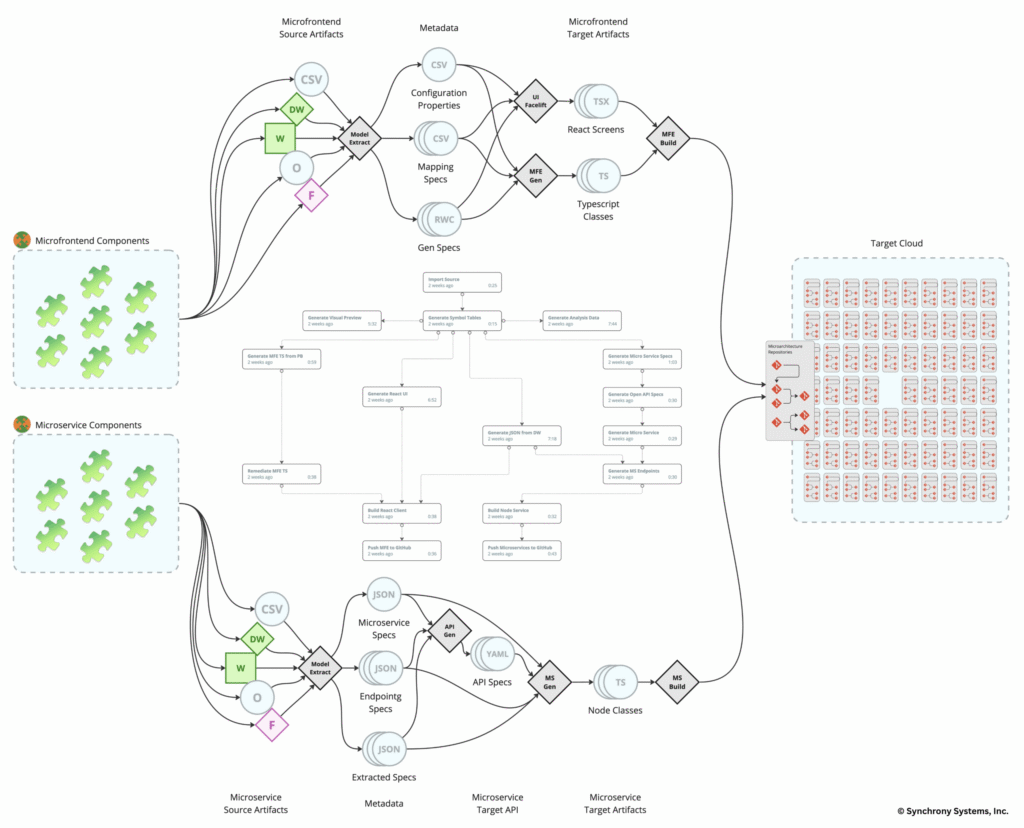
The illustration below shows how MLP orchestrates a modernization solution from a PowerBuilder monolithic architecture to a target microarchitecture with a TypedScript/React frontend and a TypedScript/Node.js backend as the target programming languages. (click image to enlarge)

Illustration of how MLP orchestrates a modernization solution from a PowerBuilder monolithic architecture to a target microarchitecture with a TypedScript/React frontend and a TypedScript/Node.js backend as the target programming languages

How monoliths become microservices and micro-frontends

Rather than migrating monolithic legacy codebases wholesale or “as-is,” Synchrony offers a technology-assisted reengineering process and workflow that is iterative, incremental, and analysis-driven.

Analytics and application rationalization

First, an exhaustive analytical inspection of your legacy application is performed using modernization technology purpose-built to identify and extract high-value business scenarios and their execution paths. This analysis produces targeted, self-contained components (a.k.a. “subsets”) for every identified business scenario embedded inside each monolithic codebase. This extraction acts as the foundation for exposing the hidden application “component vocabulary” in terms of application layers, subsystems, and business functions. Powered by the newly exposed knowledge of your system, the extracted component architecture becomes the stepping stone that drives continuous and incremental modernization toward the target cloud component architecture.

Target architecture metadata harness

The new application component architecture is the first representation and visualization of the formerly monolithic application’s structural decomposition into a granular micro-frontend/microservice layer. The component model is used for generating the required metadata that drives the execution of every modernization service agent, such as: a) data access generation; b) business objects generation; and c) UI facelift generation into a reactive frontend. This is where client-specific requirements are also incorporated to align with IT’s model target architecture.

Fine-tuning the transformation engine

The breakdown of subsets further undergoes an iterative process that identifies micro-frontends, microservices, and common layers used by both. An interactive process identifies UI/UX requirements and service layer requirements (typically slated for data access) to produce highly granular, reusable, and scalable components on the target. The process results in custom-tailored code refactoring, transformation, and generation, rules knowledgebases (KBs) for target business services, and facelift rules for a modern, reactive target web frontend.

Orchestrating modernization workflows

The analytics, metadata harness, and fine-tuned transformation knowledgebase are all assembled into custom-tailored workflows. When executed end-to-end, they produce the desired target architecture, consisting of hundreds and often thousands of structural (repositories) and microarchitectural (microservices and micro-frontends) components. Workflows can be invoked on demand by users or triggered by specific events, such as commits to newly generated code or updates to the metadata harness or KB. The holistic integration of code, tools, and processes ensures that the modernization project runs efficiently and at scale.

Continuous modernization

All units of execution inside a workflow, known as “autoflows,” can be thought of as pipelines of pipelines that enable continuous execution of the entire modernization lifecycle. The original monolithic application architecture is incrementally decomposed into independent, atomic, and stateless microservices and self-contained, reusable micro-frontends, ready for deployment into IT-specific cloud environments. The result is a transformed application with cloud-native architecture and modern UI/UX, preserving the original business logic and retaining 100% functional equivalence.

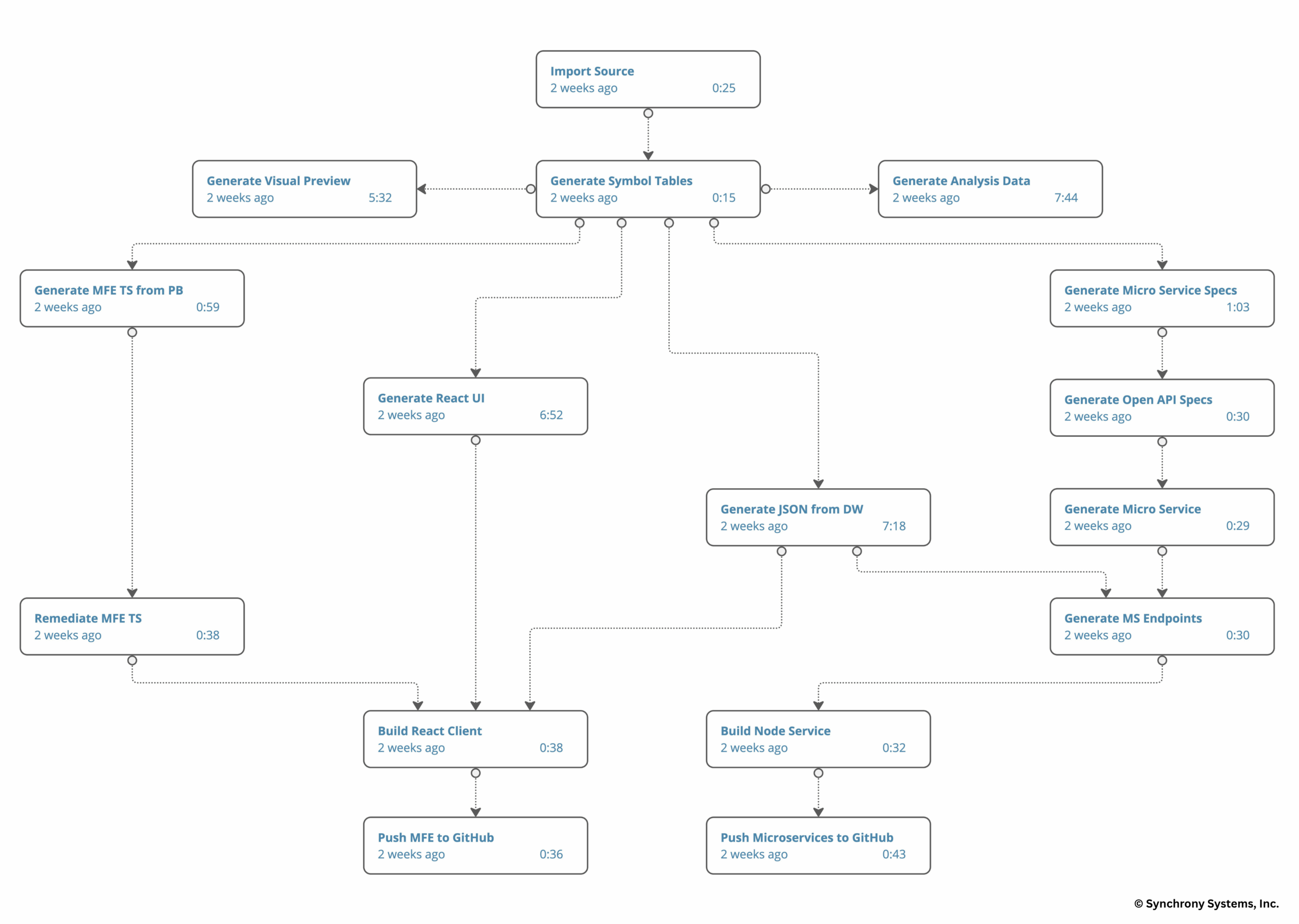
The illustration below shows an end-to-end customized MLP modernization workflow for monolithic client/server desktop applications. (click image to enlarge)

Illustration shows an end-to-end customized MLP modernization workflow for monolithic client/server desktop applications

Why modernizing to microservices and micro-frontends improves speed and agility

  • Customers can continuously extract high-value functionality and features from their legacy applications at their own pace and timeframe, until everything is modernized.
  • Eliminating dead code and breaking the monolithic functionality into a web of independent microarchitecture components eliminates technical debt and fosters technological agility.
  • Legacy applications get fully transformed into modern target architectures, unlike the like-for-like, “as-is” transformations that preserve the legacy architectural semantics, making it hard to be agile and scalable on modern target platforms.
  • Microservices and micro-frontends are delivered incrementally as early milestones for customers to test and deploy into production piecemeal, rather than waiting for the entire application to be modernized.
  • Built for flexibility and adaptation, Synchrony’s modernization platform conforms to the customer’s specific target architecture, tooling, and requirements (e.g., RESTful, Kubernetes, cloud infrastructure, API gateway, widget libraries, data access harnesses, etc.) rather than dictating a standardized solution.

Real-world transformation: from monoliths to microarchitectures

Modernizing monolithic application architectures into microarchitectures enables companies to untangle decades of core domain functionality and extract it into highly reusable components. Synchrony has helped dozens of teams extract and transform critical domain functionality and UI from their legacy client/server or host/mainframe monolithic architectures into reusable target microarchitectures.

PowerBuilder

A PowerBuilder client/server application subset (after removing dead code and selecting the initial set of high-value components) with a traditional monolithic architecture:

  • Windows → 323
  • Data Windows → 1,908
  • Lines of Code (LOC) → 416K

Yields the following cloud microarchitecture:

  • Micro-frontends → 47
  • Microservices → 488
  • Repositories → 1,650

Would you like to learn how this could be applied to your in-house legacy applications?

Contact us to meet with our senior modernization specialists for an in-depth conversation and consultation about the target architecture options your in-house portfolio of legacy applications can take.


Microarchitecture in legacy application modernization FAQ

This FAQ addresses common questions about our technology, drawing from our expertise in modernization. Whether you’re a developer, architect, or CTO, these insights can help you understand how to revitalize your tech stack without disrupting operations.

What is microservices extraction in legacy application modernization?

Synchrony Systems’ Microservices Extraction technology is an automated tool that untangles complex legacy monoliths and converts them into a network of reusable microservices and microfrontends. It focuses on extracting subsets of business logic and user interfaces from languages such as PowerBuilder, EGL, and Smalltalk. This process creates independent, modular components that can be scaled, updated, and deployed individually in a cloud-native environment, such as TypeScript/React for frontends and TypeScript/Node.js for backends.

Why should enterprises modernize legacy applications into microarchitectures?

Legacy applications are, by definition, outdated. They are built on aging infrastructure and rely on a talent pool nearing retirement to keep running. These systems inherently limit scalability, agility, and innovation. By modernizing to microservices and micro-frontends, organizations can leverage the cloud’s on-demand compute power, enabling instant scaling to meet demand. This shift eliminates technical debt, fosters technological agility, and allows for incremental improvements without a full overhaul.

How does Synchrony Systems’ platform differ from traditional modernization approaches?

Traditional methods often involve manual, labor-intensive processes or “as-is” migrations that preserve outdated semantics, making it hard to achieve true agility. Synchrony’s platform uses end-to-end automation for an iterative, incremental, analysis-driven reengineering process. It avoids wholesale migrations by focusing on high-value business scenarios first, delivering functional equivalents in months rather than years. The result is a hyperscale cloud architecture tailored to your specific requirements, including RESTful services, Kubernetes, and custom API gateways.

What are microservices and micro-frontends, and why are they important?

Microservices are independent, modular backend components that handle specific business functions, allowing them to be scaled, updated, or reused without affecting the entire system. Microfrontends are user-facing UI components that can operate standalone or integrate seamlessly. Together, they create a flexible “web” of components that improve speed, reusability, and overall application performance.

What is Synchrony’s step-by-step process for microservices extraction?

The process is built into the Modernization Lifecycle Platform (MLP) and includes several key phases:

  • Analytics and application rationalization: An exhaustive analysis identifies high-value business scenarios and extracts self-contained components, revealing the application’s hidden “component vocabulary” across layers, subsystems, and functions.
  • Target architecture metadata harness: This generates metadata to drive modernization agents, incorporating client-specific requirements for data access, business objects, and reactive UI generation.
  • Fine-tuning the transformation engine: Subsets are broken down into granular micro-frontends and microservices. An interactive process refines UI/UX and service layer needs, creating custom refactoring rules and knowledgebases.
  • Orchestrating modernization workflows: Analytics, metadata, and transformation rules are assembled into custom workflows that produce structural repositories and microarchitectural components. These can be triggered on demand or by events like code commits.
  • Continuous modernization: Workflows run as “autoflows” (pipelines of pipelines), incrementally decomposing the monolith into atomic, stateless components ready for cloud deployment. The final output is a fully transformed application that preserves business logic and is 100% functionally equivalent.

If the modernization process is automated, how does it ensure safety?

Synchrony’s MLP emphasizes controlled automation to avoid disrupting stable functionality. It uses purpose-built technology for inspection, extraction, and transformation, ensuring critical functions are modernized, tested, and deployed safely and accurately. Automation handles the heavy lifting, but the process includes iterative fine-tuning and interactive elements to incorporate your team’s input throughout the modernization process, minimizing risks and maintaining operational continuity.

Can modernization be done incrementally without a big-bang approach?

Absolutely. MLP enables continuous extraction of high-value functionality at your own pace. Microservices and microfrontends are delivered as early milestones, enabling testing and piecemeal production deployment. This eliminates the need to wait for the entire application to be modernized, reducing downtime and accelerating timelines from years to months.

What benefits does this technology provide in terms of speed and agility?

  • Reduced technical debt: Breaks down monoliths into independent components, eliminating dead code and enabling easier updates.
  • Improved scalability and flexibility: Components conform to your target architecture (e.g., cloud infrastructure, widget libraries), fostering reuse across teams.
  • Faster time-to-market: Incremental deployments mean quicker value realization from high-priority features.
  • Improved UI/UX: Transforms outdated interfaces into modern, reactive frontends, enhancing user experience and ROI.
  • Full transformation: Unlike “as-is” methods, it delivers a truly cloud-native architecture for long-term agility.

Which legacy languages and systems does Synchrony support?

MLP is designed for a variety of legacy systems, including client/server desktop applications written in languages such as PowerBuilder, EGL, Smalltalk, VisualGen, COBOL, and more. It’s flexible and customizable, able to handle unique monolithic architectures across insurance, banking, and other industries.

How can I get started with Synchrony Systems’ Microservices Extraction technology?

Contact us to connect with our senior modernization specialists.


How to pay off your technical debt (whitepaper)

Modernize your legacy code for a cloud-native world

Many organizations have already moved to the cloud. Yet the tech debt remains. Applications that were once considered “legacy” now run in modern infrastructure, but they’re still monolithic, tightly coupled, and difficult to change. Cloud hosting alone doesn’t make software cloud-native.

The business logic still matters. These systems still run underwriting, billing, claims, supply chains, and core operations. They cannot simply be replaced. But they can’t stay frozen either.

So what actually reduces tech debt? In this white paper, Jason Bloomberg, President of Intellyx, takes a practical look at legacy modernization — what works, what doesn’t, and where many organizations miscalculate.

Inside the paper:

  • Why lift and shift often fails to reduce tech debt
  • The architectural challenges behind monolith-to-cloud transitions
  • The limits of line-by-line code translation
  • Balancing automation with human engineering expertise
  • Why iterative approaches reduce modernization risk
  • The importance of scoping and lifecycle management in architecture transformation

If your cloud strategy hasn’t delivered the flexibility you expected, this paper offers a more grounded way to think about modernization.


Download your free copy of the tech debt white paper today.

Microservices extraction for monolithic app modernization

Many companies have accelerated their modernization plans in order to meet the new demands of conducting business in a digital-only or primarily digital environment. A recent survey released by Maria DB in partnership with Propeller Insights found that 40% of businesses are accelerating cloud adoption plans, and business leaders expect a long-term benefit from the technology agility and new ways of working.

“Since legacy applications are often the bottleneck for such transformations, legacy modernization is now more critical than ever,” writes Jason Bloomberg, president of Intellyx, in his recent article Digital Transformation and Application Modernization in Time of Crisis.

“Modernizing certain functionality is always more urgent than the rest. True, it will eventually be important to modernize most or all of the legacy application functionality, but today the focus is on what’s most important,” Bloomberg continues.

No longer a pipe dream: automated microservices extraction from the monolith

The historical criticism of a microservices approach to modernizing monolithic applications has been driven by the human ability to understand (or not) the architecture and programming of the monolith itself. If the intellectual capital that developed the application left the company and/or the documentation was weak, then trying to develop properly architected microservices to replace functionality was wrought with issues. When trying to wrap a monolith with microservices, the defects of the legacy architecture translated through to the microservices layer. A microservices approach to replacing the monolith was a mere pipe dream.

Thanks to Synchrony Systems’ innovative engineering and deep domain expertise in the migration automation field, new modernization technology is available that can identify and extract full execution paths of critical business functions and automatically migrate them to the desired target platform as microservices. These microservices have a modern architecture which makes them suitable to be deployed immediately to the cloud and to platforms such as Kubernetes. The microservices extraction technology preserves 100% of the functional equivalence of the legacy functionality, ensuring existing operational processes remain intact postmodernization.

Microservices Extraction Technology Diagram

Along with the narrow, vertical fully executable functionality, the microservices extraction technology can also accurately identify candidate “dead” code that can be removed altogether. This reduces technical debt and total cost of ownership by deprecating functionality that no longer matters, and therefore, should not be modernized.

No longer is it necessary to modernize the entire application. Automatic microservices extraction technology gives businesses the ability to rapidly modernize only the code that matters and addresses urgent business needs today.

The benefits of microservices can finally be achieved during application modernization

This microservices extraction technology makes it possible to modernize monolithic legacy applications and realize the long-sought benefits of microservices architecture. These benefits include:

  • Speed—migrate key business functions to the target platform in months, not years.
  • Agility—deliver incremental, modern microservices aligned with your DevOps practices.
  • Flexibility—transform business-critical functionality driven by business priorities.
  • Scalability—deploy truly scalable microservices and without the bottleneck of the legacy monolith.
  • Savings—reduce technical debt, the total cost of ownership and the upfront spend on the modernization.

Companies will also benefit from the new services model for modernizations, Modernization-as-a-Service (MaaS), that microservices extraction capabilities enable. Modernizations now can be planned, budgeted, and executed incrementally over time instead of an all-or-nothing approach.

Synchrony Systems announces microservices extraction capabilities for rapid migration of in-house legacy application functionality

Greenwich, CT (April 6, 2020) – Synchrony Systems, Inc., a leader in legacy application modernizations, today announced new microservices extraction capabilities of their Modernization Lifecycle Platform (MLP). The underlying source code migration and upgrade technology identifies and extracts full execution paths of critical business functions and automatically migrates them to the desired target platform as microservices suitable to be deployed to the cloud and to platforms such as Kubernetes.


The typical modernization process of monolithic in-house applications is to upgrade the entire application before the smallest bit of functionality can be run on the target platform. Traditionally, application modernizations have been an all-or-nothing proposition.


“Thanks to the ingenuity of our lab, we’ve added a powerful capability to our source code transformation engine that dramatically reduces the cost and time that it takes to produce a working system in order to deliver some of the application’s business-critical functionality,” said Slavik Zorin, CEO of Synchrony Systems. “No longer is it necessary to modernize the entire application. Instead, it is now possible to accurately extract narrow, vertical execution paths of critical business-functions and migrate them to a modern, cloud-ready, target platform. This gives businesses the ability to rapidly modernize only the code that matters and address urgent business needs today.”


Microservices extraction also has the ability to more accurately identify candidate “dead” code that can be removed altogether. This visibility helps IT and software engineering professionals reduce technical debt and total cost of ownership by deprecating functionality that no longer matters, and therefore, should not be modernized.


“CIOs who have managed migration projects know that short-term quick fixes create long-term technical debt,” stated Jason Bloomberg, president of Intellyx, an analyst and advisory firm helping business executives and IT leaders untangle the technologies and practices behind digital transformation. “The microservices extraction capabilities in Synchrony Systems’ Modernization Lifecycle Platform not only shortens the time to value, but they can actually decrease technical debt as well as the long-term total cost of ownership of modernized systems.”


“This is a game-changer for institutional companies like banking or insurance where in-house applications are preventing them from actualizing their digital transformation or engagement initiatives,” added Zorin. “Companies are now able to migrate key business functions to a target platform in only a few months, not years while preserving 100% functional equivalence and delivering in the process a modern target architecture.”


Contact us to learn more about the microservice extraction capabilities of MLP.


About Synchrony Systems, Inc.

We help enterprises transform legacy in-house applications to modern technologies while preserving business-critical functionality. Synchrony’s Modernization Lifecycle Platform (MLP) is a scalable, cloud-based platform for managing and executing end-to-end migrations and modernizations of legacy IT applications to modern software architectures and platforms. It enables automated code conversion, transformation, remediation, and upgrades of millions of lines of code in minutes, ensuring consistent, reliable, and repeatable results. MLP was named a 2019 SIIA CODiE Award Finalist for Best Emerging Technology and 2018 SIIA CODiE Awards finalist for Best DevOps Tool.

Modernize applications while preserving business-critical functionality

Modernize applications while preserving business-critical functionality

Success in today’s marketplace is largely determined by the speed and efficiency with which technology drives digital engagement.

The more current your business is with the latest technology, the more competitive it is.

But as your in-house applications age, the more out of date with technology they become.

This ever-growing technology gap prevents your business from staying competitive and responsive to its customers.

Fortunately, many top companies have discovered a new approach to modernizing their applications to the latest technologies while preserving business-critical functionality.

Synchrony Systems’ Modernization Lifecycle Platform (MLP) delivers this new solution in a fast, secure, and affordable way.

Only MLP integrates knowledge, process, and tools to rapidly modernize your in-house applications.

With MLP, your business is not only able to close the technology gap, it will never fall behind again.

Technology constantly reinvents itself. With modern applications, your company is ready to thrive in the competitive marketplace.

Is aging technology holding back your business? Contact us today for an initial assessment.

Synchrony Systems named SIIA Business technology Product CODiE Award finalist for best emerging technology

Modernization Lifecycle Platform (MLP) earns prestigious industry recognition

Greenwich, CT (May 6, 2019) Synchrony Systems, a leader in legacy application modernizations, today announced that MLP was named a 2019 SIIA CODiE Awards finalist in the Best Emerging Technology category. Finalists represent the best products, technologies, and services in software, information and business technology.


MLP is a scaleable, cloud-based platform for managing and executing end-to-end migrations and modernizations of legacy IT applications to modern software architectures and platforms. It enables automated code conversion, transformation, remediation and upgrades of millions of lines of code in minutes, ensuring consistent, reliable, and repeatable results. With MLP, upgrading and modernizing legacy applications is no longer disruptive to the business. There are no code freezes of ongoing development since MLP enables parallel upgrades and modernization to run concurrently and continuously with development.


The SIIA CODiE Awards are the premier awards for the software and information industries and have been recognizing product excellence for over 30 years. The awards offer 76 categories that are organized by industry focus of education technology and business technology. MLP was honored as one of 137 finalists across the 44 business technology categories.


“The 2019 CODiE Award finalists are some of the most innovative, high-impact products in the market. We are thrilled to place a spotlight on these innovations and the power they have to transform the future of how we do business.” said Jeff Joseph, President of SIIA.


“We are excited that MLP is a finalist in the Best Emerging Technology category,” said Slavik Zorin, Founder and CEO of Synchrony Systems. “Battling technical debt is a large challenge for IT departments across all industries and will only continue to grow as today’s leading-edge technology is tomorrow’s legacy. MLP provides a technology-agnostic, systematic approach and a uniform process for migrating and upgrading mission-critical proprietary business applications while maintaining 100% functional equivalence and without disrupting the day-to-day business operations. It’s an honor to be recognized by the CODiE judges for our vision and accomplishments thus far.”


The SIIA CODiE Awards are the industry’s only peer-recognized awards program. Business technology leaders including senior executives, analysts, media, consultants and investors evaluate assigned products during the first-round review which determines the finalists. SIIA members then vote on the finalist products and the scores from both rounds are tabulated to select the winners. Winners will be announced during the Business Technology & Company CODiE Award Winner Announcement Party immediately following TechConText, June 12 in San Francisco.


Details about each finalist are listed at http://www.siia.net/codie/2019-Finalists


About the SIIA CODiE™ Awards

The SIIA CODiE Awards is the only peer-reviewed program to showcase business and education technology’s finest products and services. Since 1986, thousands of products, services and solutions have been recognized for achieving excellence. For more information, visit siia.net/CODiE.

About Synchrony Systems, Inc.

Synchrony Systems has been helping companies modernize their legacy, mission-critical applications for over 20 years. Their extensive experience, deep belief in automation while maintaining agility, and desire to develop a more systematic way to modernize has resulted in the world’s only Modernization Lifecycle Platform (MLP). For more information, visit sync-sys.com/.

Slavik Zorin featured in SIIA’s Vision from the Top

Greenwich, CT (November 12 2018) — Synchrony Systems, Inc., a leader in legacy application modernizations, today announced that their CEO Slavik Zorin was the featured executive in the Software and Information Industry Association’s (SIIA) Vision from the Top. This program gives members a glimpse into what drove the success of these industry leaders. At the end of the year, all interviews will be released in the form of an eBook.


An excerpt from the interview can be found below. The full interview can be found here on the SIIA website.

Interview Excerpt:

Jennifer Carl: Over the past twenty years what advances have you seen in the modernization of software?


Slavik Zorin: If I look back over 20 years and think about the trends, it has really all started with the mainframe or the “big iron”, where all application software was developed, maintained and run, all in one single place. Over time, this monolithic computing power has been supplemented by more granular and distributed computing power, namely the personal computers and network operating systems. This marked the beginning of an architectural revolution, away from large and monolithic systems, and towards highly distributed and scalable systems that are more flexible, and easier to develop and deploy – what is today’s microservices architecture.

As the rate of change in technological advances continues to accelerate, especially as we look at technologies such as Big Data and AI, we are beginning to approach the age when software will be able upgrade and modernize itself. This will not only become transformational, but also disruptive to the service-driven businesses and migration companies alike. As this future begins to unfold, Synchrony’s MLP platform must play an important role in managing a large number of application modernizations across diverse programming languages and platforms, incorporating the required knowledge and systematic process in order to achieve a frictionless and continuous modernization of application software.


Jennifer Carl: You are a technologist at heart. What is sparking your interested at the moment, and how does it apply to Synchrony?


Slavik Zorin: Lots of things interest me in the industry. IoT, for example, is extremely interesting and incredibly empowering evolution of technology in terms of the benefits it’s going to deliver to the world. We are going to be able to monitor everything—agriculture, logistics, automobiles, medicine, our homes, our health, you name it… But It’s not just about the monitoring; it’s the massive amount of real-time data collected from these miniature IoT devices, and the harnessing of this data that will foster progress, global prosperity, and change the way we interact with each other and the world.

But it is the intersection of machine learning (ML) or AI, if you prefer that term, accompanied by the big data analytics, where we see the possibilities for Synchrony Systems. As the MLP platform and its ecosystem expands to manage hundreds and even thousands of modernizations, the knowledge of how systems are built will grow geometrically making the perfect place to apply ML. Imagine taking a monolithic system and having a really powerful learning and inference engine intelligently extract business rules, APIs, and turn a monolithic application architecture into a scalable microservices architecture.

Blockchain is another disrupting technology that might have interesting applications in our business. A well understood measurement of software applications is lines of code (aka LOC). LOC is also the way we compute the underlying intrinsic value when transforming LOC from one programming environment to another. We can imagine a digital currency based on LOC that can emerge and be used to transact within our ecosystem. This is something we are keeping tabs on and might play a role in creating.


The full interview can be found here on the SIIA website.

Modernization as a service (MaaS): CEO interview

Our founder and CEO, Slavik Zorin, has been a pioneer in legacy application modernization for 20 years. His approach to modernizations has been quite different from traditional modernizations. These excerpts expand on the concept of Modernization-as-a-Service (MaaS), introduced in part 1, and on the future of modernization.


The power of Modernization-as-a-Service (MaaS)

“The MaaS platform forms the ecosystem that enables all stakeholders to participate in the legacy modernization process in an open, transparent and collaborative manner. The ecosystem consists of three types of stakeholders. First are the suppliers of modernization tools and technologies who support and extend the technical platform in real-time and on-demand. Second are the providers of the modernization services, the system integrators, and professional services companies who use the MaaS platform to perform the necessary work of modernizing the legacy applications. Third are the consumers, who are the customers that own the legacy applications and who play an important role in areas such as quality assurance, review, and acceptance testing of the modernized applications.

MaaS is the game changer because it brings all stakeholders onto a single unified modernization platform that allows running not one, or two, but thousands of modernization projects at the same time. Today, companies who specialize in this field are capable of running only a handful of modernizations at a time within their specific niche. That makes them service companies, not software companies. Scaling a migration company from a one modernization at-a-time services company to thousand modernizations at-a-time software company is the vision behind MaaS.

Just think about it: MaaS revolutionizes today’s approach to legacy modernizations. It is the first collaborative modernization platform of its kind that creates a new industry and injects new life into the massive IT inventory of aging software systems. We have the necessary ingredients for it to work today: the bandwidth; the scalable cloud computing infrastructure that is 24 by 7; and the business imperatives of economizing and therefore, capitalizing on the massive investments already made in IT. MaaS brings it all together: the technology and the ecosystem which are the key ingredients for creating massive competitive advantage.”


The future of the legacy application modernization market is MaaS

“What I see is that there will be no such thing as application software that is left behind or lost to obsolescence. I see the future as a world without legacy applications.

The MaaS platform offers companies a continuous evolution for their application software. Once the platform and the ecosystem grow and become ubiquitous, companies will be empowered to modernize their applications frequently; similar to the frequency with which most homeowners renovate their homes compared to those who level and rebuild them ground-up.

My vision is that a world without legacy applications is one powered by a platform like MaaS that will become the springboard for industrialization of the current legacy modernization market. It is the vehicle that will transform the current market from small and fractured niches into a global industry.

Deliver a ubiquitous platform with a worldwide ecosystem supporting a) the entire lifecycle of legacy application modernization and b) the continuous evolution of legacy application software.”

This MaaS vision is the genesis of our Modernization Lifecycle Platform (MLP).  It’s a MaaS platform that supports the entire modernization lifecycle—from analysis and planning to continuous transformation, build and deployment, to testing and production release—for all stakeholders.

Synchrony Systems, Inc. named SIIA Business Technology CODiE Award finalist for Best DevOps Tool

Modernization Lifecycle Platform (MLP) earns prestigious industry recognition

Greenwich, CT (May 7, 2018) — Synchrony Systems, Inc., a leader in legacy application modernizations, today announced that their Modernization Lifecycle Platform (MLP) was named a 2018 SIIA CODiE Awards finalist in the Best DevOps Tool category. Finalists represent the best products, technologies, and services in software, information and business technology.


MLP is a scaleable, cloud-based platform for managing and executing end-to-end migrations and modernizations of legacy IT applications to modern software architectures and platforms. It enables automated code conversion, transformation, and remediation of millions of lines of code in minutes, ensuring consistent, reliable, and repeatable results. MLP has a complete DevOps modernization software stack with integrated quality management containing rule-based transformation tools and extensible workflows specifically tailored for conducting wholesale application modernization projects. Unique to MLP, it supports the coexistence of ongoing development of an application while it’s undergoing a modernization and eliminates the need for code freezes that disrupt the business.


The SIIA CODiE Awards are the premier awards for the software and information industries and have been recognizing product excellence for over 30 years. The awards offer 91 categories that are organized by industry focus of education technology and business technology. MLP was honored as one of 167 finalists across the 52 business technology categories.


“The 2018 CODiE Award finalists are some of the most innovative, high-impact products in the market. We are happy to recognize these products and the power they have to transform the future of how we do business.” said Ken Wasch, President of SIIA.


“We are thrilled that our platform, MLP, is a finalist for the Best DevOps Tool category,” said Slavik Zorin, Founder and CEO of Synchrony Systems. “MLP was developed based on our 20+ years in the modernization business and to correct all that is wrong with traditional rip-and-replace or manual rewrite modernization approaches. As we like to say, today’s leading-edge technology is tomorrow’s legacy, and MLP provides a technology-agnostic, systematic approach and a uniform process for migrating these mission-critical proprietary business applications while maintaining 100% functional equivalence while delivering an improved and a modern web-based user experience.


The SIIA CODiE Awards are the industry’s only peer-recognized awards program. Business technology leaders including senior executives, analysts, media, consultants and investors evaluate assigned products during the first-round review which determines the finalists. SIIA members then vote on the finalist products and the scores from both rounds are tabulated to select the winners. Winners will be announced during the  Business Technology CODiE Award Celebration at the SIIA Annual Conference & CODiE Awards, June 12 in San Francisco.


Details about each finalist are listed at http://www.siia.net/codie/Finalists


About the SIIA CODiE™ Awards
The SIIA CODiE Awards is the only peer-reviewed program to showcase business and education technology’s finest products and services. Since 1986, thousands of products, services and solutions have been recognized for achieving excellence.  For more information, visit siia.net/CODiE.

About Synchrony Systems, Inc.
Synchrony Systems has been helping companies modernize their legacy, mission-critical applications for over 20 years. Their extensive experience, deep belief in automation while maintaining agility, and desire to develop a more systematic way to modernize has resulted in the world’s only Modernization Lifecycle Platform (MLP). For more information, visit sync-sys.com/.

For Immediate Release:
Synchrony Systems Contact: Heather Nightingale, 207.619.3443, heather@sync-sys.com
SIIA Communications Contact: Benjamin Price, 703.909.4034, bprice@siia.net